
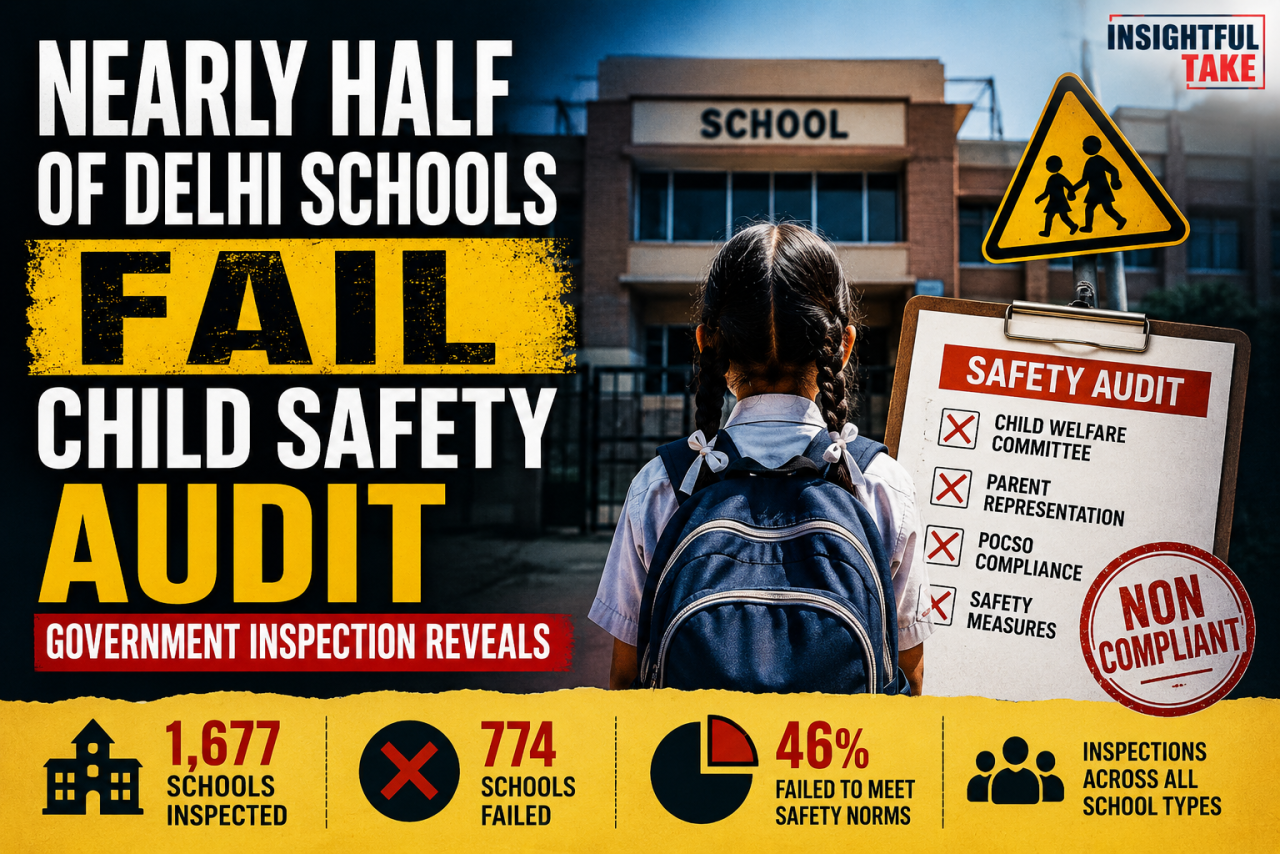
Nearly one in every two schools inspected in Delhi has failed child safety checks, exposing serious gaps in student protection despite strict legal safeguards.
An ongoing inspection drive across Delhi has uncovered a troubling pattern. Out of 1,677 schools inspected so far, 774, or 46 percent, have failed to meet mandatory student safety and child protection standards. The findings, released by the Lieutenant Governor's office, cover the first two weeks of inspections that began on July 13. The exercise will continue until all 5,633 schools across the national capital have been assessed.
The scale of non-compliance highlights a significant gap between policy and implementation in one of India's most closely watched education systems. Delhi has often been presented as a model for education reform, yet the latest audit suggests that basic child protection measures remain inconsistently enforced across different categories of schools.
Private Schools Record the Highest Failure Rate
The inspection data reveals wide disparities across school categories. Of the 812 private schools inspected, 463 were found deficient, resulting in a failure rate of nearly 57 percent, the highest among all categories.
Government schools performed comparatively better, with 270 out of 790 inspected schools failing to meet the prescribed norms. Government-aided schools recorded 41 deficiencies among the 75 institutions inspected.
According to the Lieutenant Governor's office, private schools accounted for a disproportionately large share of deficiencies despite generally being regarded as better funded and better equipped than government schools. The findings challenge the common perception that higher fees necessarily translate into stronger safety standards.
Key Child Protection Measures Missing
The inspection teams evaluated schools against child safety guidelines issued by the National Commission for Protection of Child Rights (NCPCR), the Delhi Commission for Protection of Child Rights (DCPCR), and the Protection of Children from Sexual Offences (POCSO) Act.
Two shortcomings emerged repeatedly. Many schools had failed to constitute Child Welfare Committees, while others had formed the committees only on paper without including mandatory parent representatives.
These are not merely administrative oversights. Child Welfare Committees serve as the first institutional mechanism for addressing student safety concerns, complaints, and potential abuse. Without meaningful parental representation, these committees lose an important layer of transparency and accountability.
Inspection Drive Focuses on Enforcement
Unlike routine compliance exercises, the current inspection drive includes mandatory follow-up verification to ensure that identified deficiencies are actually corrected rather than temporarily addressed for inspection purposes.
Officials said the campaign follows directions issued on July 6 by Lieutenant Governor Taranjit Singh Sandhu and Chief Minister Rekha Gupta, who called for strict and time-bound implementation of Child Protection Month initiatives. The objective is to make child protection measures a permanent feature of school administration instead of an annual compliance exercise.
Inspection teams include representatives from the Directorate of Education, the Department of Women and Child Development, Delhi Police, and parent representatives. The teams are currently inspecting between 150 and 200 schools every day.
The audit covers every category of educational institution in Delhi, including government schools, government-aided schools, Municipal Corporation of Delhi schools, New Delhi Municipal Council schools, Delhi Cantonment Board schools, and private schools.
Why the Findings Matter
The Delhi audit offers one of the most detailed assessments of school-level child safety compliance in India. A deficiency rate of 46 percent raises broader concerns about the effectiveness of child protection mechanisms in schools, particularly if similar conditions exist in states where such comprehensive inspections have not yet been undertaken.
The inspection drive is still underway, and the final results will provide a clearer picture of the city's overall compliance levels. More importantly, the success of the initiative will ultimately be measured not by the number of deficiencies identified, but by how effectively schools address them and establish lasting systems that genuinely protect children.
As inspections continue across the remaining schools, the exercise has the potential to become a national benchmark for accountability in school safety, provided the reforms extend beyond paperwork and result in meaningful institutional change.
An ongoing inspection drive across Delhi has uncovered a troubling pattern. Out of 1,677 schools inspected so far, 774, or 46 percent, have failed to meet mandatory student safety and child protection standards. The findings, released by the Lieutenant Governor's office, cover the first two weeks of inspections that began on July 13. The exercise will continue until all 5,633 schools across the national capital have been assessed.
The scale of non-compliance highlights a significant gap between policy and implementation in one of India's most closely watched education systems. Delhi has often been presented as a model for education reform, yet the latest audit suggests that basic child protection measures remain inconsistently enforced across different categories of schools.
Private Schools Record the Highest Failure Rate
The inspection data reveals wide disparities across school categories. Of the 812 private schools inspected, 463 were found deficient, resulting in a failure rate of nearly 57 percent, the highest among all categories.
Government schools performed comparatively better, with 270 out of 790 inspected schools failing to meet the prescribed norms. Government-aided schools recorded 41 deficiencies among the 75 institutions inspected.
According to the Lieutenant Governor's office, private schools accounted for a disproportionately large share of deficiencies despite generally being regarded as better funded and better equipped than government schools. The findings challenge the common perception that higher fees necessarily translate into stronger safety standards.
Key Child Protection Measures Missing
The inspection teams evaluated schools against child safety guidelines issued by the National Commission for Protection of Child Rights (NCPCR), the Delhi Commission for Protection of Child Rights (DCPCR), and the Protection of Children from Sexual Offences (POCSO) Act.
Two shortcomings emerged repeatedly. Many schools had failed to constitute Child Welfare Committees, while others had formed the committees only on paper without including mandatory parent representatives.
These are not merely administrative oversights. Child Welfare Committees serve as the first institutional mechanism for addressing student safety concerns, complaints, and potential abuse. Without meaningful parental representation, these committees lose an important layer of transparency and accountability.
Inspection Drive Focuses on Enforcement
Unlike routine compliance exercises, the current inspection drive includes mandatory follow-up verification to ensure that identified deficiencies are actually corrected rather than temporarily addressed for inspection purposes.
Officials said the campaign follows directions issued on July 6 by Lieutenant Governor Taranjit Singh Sandhu and Chief Minister Rekha Gupta, who called for strict and time-bound implementation of Child Protection Month initiatives. The objective is to make child protection measures a permanent feature of school administration instead of an annual compliance exercise.
Inspection teams include representatives from the Directorate of Education, the Department of Women and Child Development, Delhi Police, and parent representatives. The teams are currently inspecting between 150 and 200 schools every day.
The audit covers every category of educational institution in Delhi, including government schools, government-aided schools, Municipal Corporation of Delhi schools, New Delhi Municipal Council schools, Delhi Cantonment Board schools, and private schools.
Why the Findings Matter
The Delhi audit offers one of the most detailed assessments of school-level child safety compliance in India. A deficiency rate of 46 percent raises broader concerns about the effectiveness of child protection mechanisms in schools, particularly if similar conditions exist in states where such comprehensive inspections have not yet been undertaken.
The inspection drive is still underway, and the final results will provide a clearer picture of the city's overall compliance levels. More importantly, the success of the initiative will ultimately be measured not by the number of deficiencies identified, but by how effectively schools address them and establish lasting systems that genuinely protect children.
As inspections continue across the remaining schools, the exercise has the potential to become a national benchmark for accountability in school safety, provided the reforms extend beyond paperwork and result in meaningful institutional change.















Leave a Comment