
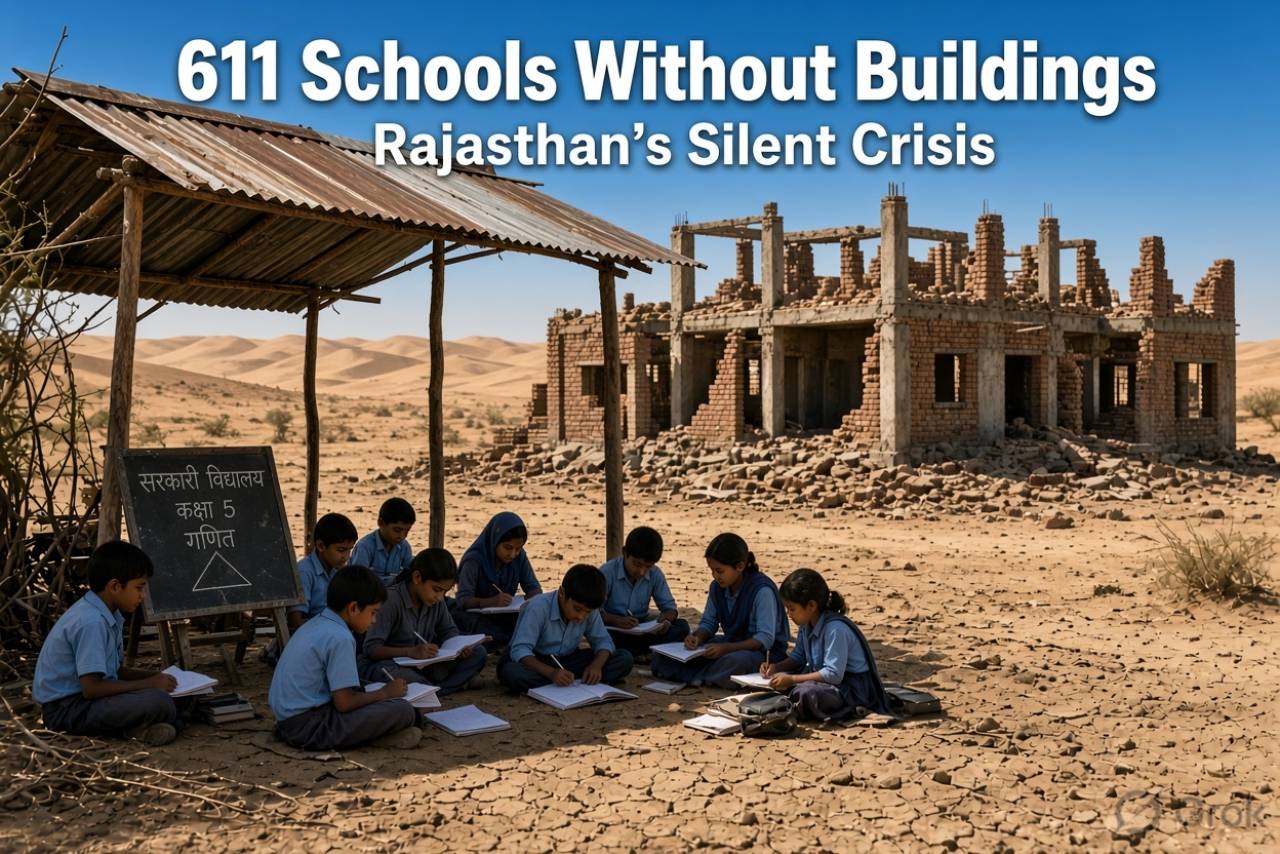
611 government schools in Rajasthan have no buildings of their own. Thousands more lack basic facilities. Can the School Thik Karo campaign help push the demand for better schools?
A school is more than a building. It is a place where children learn, ask questions, make friends and dream about their future. But what happens when a school does not even have a proper building?
Recent data presented in the Rajasthan Assembly has raised serious questions about the condition of government schools in the state. According to UDISE data for 2025-26 under Samagra Shiksha, 611 government schools in Rajasthan do not have buildings of their own. Ten of these are girls’ schools.
The situation becomes more worrying when we look at other basic facilities. Out of 64,484 government schools that have buildings, 2,047 do not have toilets and 1,049 do not have drinking water. These figures were presented in the Assembly in response to a question from Leader of the Opposition Tikaram Jully.
These are not just numbers on a government document. Behind every number are children and teachers who have to study and work in difficult conditions.
Where Are These Schools?
The problem is spread across different parts of Rajasthan.
In Jhalawar district, Aklera block has 23 schools without their own buildings. Khanpur has 16 and Jhalrapatan has 11. Even Jaipur, the state capital, has 38 such schools.
The problem of basic facilities is also serious in several districts. Banswara, Dungarpur and Udaipur have a large number of schools without proper sanitation facilities, while Dausa has the highest number of schools without drinking water.
Many of these areas include communities that have historically faced difficulties in accessing public services. For children living in remote areas, a poorly equipped school can make education much harder.
Why the ‘School Thik Karo’ Campaign Matters
The CJP’s “School Thik Karo” campaign has tried to bring attention to these problems by visiting schools and looking at their actual conditions.
Campaign volunteers have visited places where children study in tin sheds, rented rooms and open spaces. Near Bagru, outside Jaipur, a team led by Ashutosh Ranka reportedly faced resistance while trying to inspect a school.
There can be valid rules about entering school campuses and protecting children’s privacy. Such rules should always be respected. At the same time, citizens also have a right to ask an important question: Are public schools providing children with the basic conditions they need to learn?
The purpose of such campaigns should not simply be to blame one political party or another. The larger goal should be to make governments answerable and to ensure that every child gets a safe and decent place to study.
The Government’s Response
The Rajasthan government has announced ₹550 crore for repairs and ₹450 crore for new construction.
The government has also blamed the previous Congress government for some of the problems that have continued for years.
Political parties will naturally disagree about who is responsible for the situation. But for a child sitting in a classroom without proper facilities, political arguments do not solve the immediate problem.
A student needs a safe classroom.
A student needs clean drinking water.
A student needs a usable toilet.
A student needs a school building where learning can take place without fear, discomfort or constant distraction.
The important question is therefore not only who caused the problem, but also who will solve it and how quickly.
A Tragedy We Should Not Forget
Rajasthan has already seen the terrible consequences of poor school infrastructure.
In 2025, a school building in Jhalawar collapsed, killing seven young people. Subsequent surveys reportedly highlighted problems in thousands of classrooms and toilets.
Such incidents remind us that school infrastructure is not simply about comfort or appearance. It can be a matter of life and safety.
A cracked wall, a damaged roof or a broken building cannot be treated as a small administrative problem when children spend several hours inside it every day.
Why Toilets and Water Matter
When we talk about education, we often talk about teachers, textbooks, examinations and marks. But basic facilities are also an important part of education.
A school without toilets can make it difficult for students, especially adolescent girls, to attend school comfortably and regularly.
A school without drinking water creates another daily problem. Children cannot concentrate properly when they are thirsty, and teachers cannot teach effectively when basic facilities are missing.
A school without a proper building creates an even bigger challenge. A dedicated classroom provides a safe and organised environment where students can learn.
Education cannot be separated from these basic needs.
What Students and Citizens Can Do
The demand for better schools should not belong to one political party alone. It should belong to everyone.
Students can talk about the condition of their schools. Parents can ask local authorities about missing facilities. Teachers can report problems. Local communities can monitor whether promised work is actually completed.
Citizens can also support peaceful and responsible campaigns that bring genuine problems to public attention.
The goal should be simple: every child should have access to a safe, functional and properly equipped school.
If the government announces money for school construction and repairs, citizens should also ask where that money goes, when the work will begin and when it will be completed.
Announcements are important, but completed classrooms matter more.
A School Is a Promise
The 611 schools without their own buildings should not be treated as just another statistic.
Each school represents children who deserve the same opportunity as students in better-equipped schools. Their parents also pay taxes and contribute to society. Their children deserve a safe place to learn.
Rajasthan has the resources and institutions needed to improve its schools. What is required now is consistent action, proper monitoring and public pressure.
The “School Thik Karo” campaign can help start an important conversation, but lasting improvement will require more than a campaign. It will require governments, teachers, parents, students and communities to keep asking for results.
A school building is made of bricks, cement and steel. But a good school is built on something more important: the belief that every child deserves a chance to learn.
The data has been presented. The campaign has begun. The children are still waiting.
Now the question is simple: when will the schools be made better?
A school is more than a building. It is a place where children learn, ask questions, make friends and dream about their future. But what happens when a school does not even have a proper building?
Recent data presented in the Rajasthan Assembly has raised serious questions about the condition of government schools in the state. According to UDISE data for 2025-26 under Samagra Shiksha, 611 government schools in Rajasthan do not have buildings of their own. Ten of these are girls’ schools.
The situation becomes more worrying when we look at other basic facilities. Out of 64,484 government schools that have buildings, 2,047 do not have toilets and 1,049 do not have drinking water. These figures were presented in the Assembly in response to a question from Leader of the Opposition Tikaram Jully.
These are not just numbers on a government document. Behind every number are children and teachers who have to study and work in difficult conditions.
Where Are These Schools?
The problem is spread across different parts of Rajasthan.
In Jhalawar district, Aklera block has 23 schools without their own buildings. Khanpur has 16 and Jhalrapatan has 11. Even Jaipur, the state capital, has 38 such schools.
The problem of basic facilities is also serious in several districts. Banswara, Dungarpur and Udaipur have a large number of schools without proper sanitation facilities, while Dausa has the highest number of schools without drinking water.
Many of these areas include communities that have historically faced difficulties in accessing public services. For children living in remote areas, a poorly equipped school can make education much harder.
Why the ‘School Thik Karo’ Campaign Matters
The CJP’s “School Thik Karo” campaign has tried to bring attention to these problems by visiting schools and looking at their actual conditions.
Campaign volunteers have visited places where children study in tin sheds, rented rooms and open spaces. Near Bagru, outside Jaipur, a team led by Ashutosh Ranka reportedly faced resistance while trying to inspect a school.
There can be valid rules about entering school campuses and protecting children’s privacy. Such rules should always be respected. At the same time, citizens also have a right to ask an important question: Are public schools providing children with the basic conditions they need to learn?
The purpose of such campaigns should not simply be to blame one political party or another. The larger goal should be to make governments answerable and to ensure that every child gets a safe and decent place to study.
The Government’s Response
The Rajasthan government has announced ₹550 crore for repairs and ₹450 crore for new construction.
The government has also blamed the previous Congress government for some of the problems that have continued for years.
Political parties will naturally disagree about who is responsible for the situation. But for a child sitting in a classroom without proper facilities, political arguments do not solve the immediate problem.
A student needs a safe classroom.
A student needs clean drinking water.
A student needs a usable toilet.
A student needs a school building where learning can take place without fear, discomfort or constant distraction.
The important question is therefore not only who caused the problem, but also who will solve it and how quickly.
A Tragedy We Should Not Forget
Rajasthan has already seen the terrible consequences of poor school infrastructure.
In 2025, a school building in Jhalawar collapsed, killing seven young people. Subsequent surveys reportedly highlighted problems in thousands of classrooms and toilets.
Such incidents remind us that school infrastructure is not simply about comfort or appearance. It can be a matter of life and safety.
A cracked wall, a damaged roof or a broken building cannot be treated as a small administrative problem when children spend several hours inside it every day.
Why Toilets and Water Matter
When we talk about education, we often talk about teachers, textbooks, examinations and marks. But basic facilities are also an important part of education.
A school without toilets can make it difficult for students, especially adolescent girls, to attend school comfortably and regularly.
A school without drinking water creates another daily problem. Children cannot concentrate properly when they are thirsty, and teachers cannot teach effectively when basic facilities are missing.
A school without a proper building creates an even bigger challenge. A dedicated classroom provides a safe and organised environment where students can learn.
Education cannot be separated from these basic needs.
What Students and Citizens Can Do
The demand for better schools should not belong to one political party alone. It should belong to everyone.
Students can talk about the condition of their schools. Parents can ask local authorities about missing facilities. Teachers can report problems. Local communities can monitor whether promised work is actually completed.
Citizens can also support peaceful and responsible campaigns that bring genuine problems to public attention.
The goal should be simple: every child should have access to a safe, functional and properly equipped school.
If the government announces money for school construction and repairs, citizens should also ask where that money goes, when the work will begin and when it will be completed.
Announcements are important, but completed classrooms matter more.
A School Is a Promise
The 611 schools without their own buildings should not be treated as just another statistic.
Each school represents children who deserve the same opportunity as students in better-equipped schools. Their parents also pay taxes and contribute to society. Their children deserve a safe place to learn.
Rajasthan has the resources and institutions needed to improve its schools. What is required now is consistent action, proper monitoring and public pressure.
The “School Thik Karo” campaign can help start an important conversation, but lasting improvement will require more than a campaign. It will require governments, teachers, parents, students and communities to keep asking for results.
A school building is made of bricks, cement and steel. But a good school is built on something more important: the belief that every child deserves a chance to learn.
The data has been presented. The campaign has begun. The children are still waiting.
Now the question is simple: when will the schools be made better?























Leave a Comment