
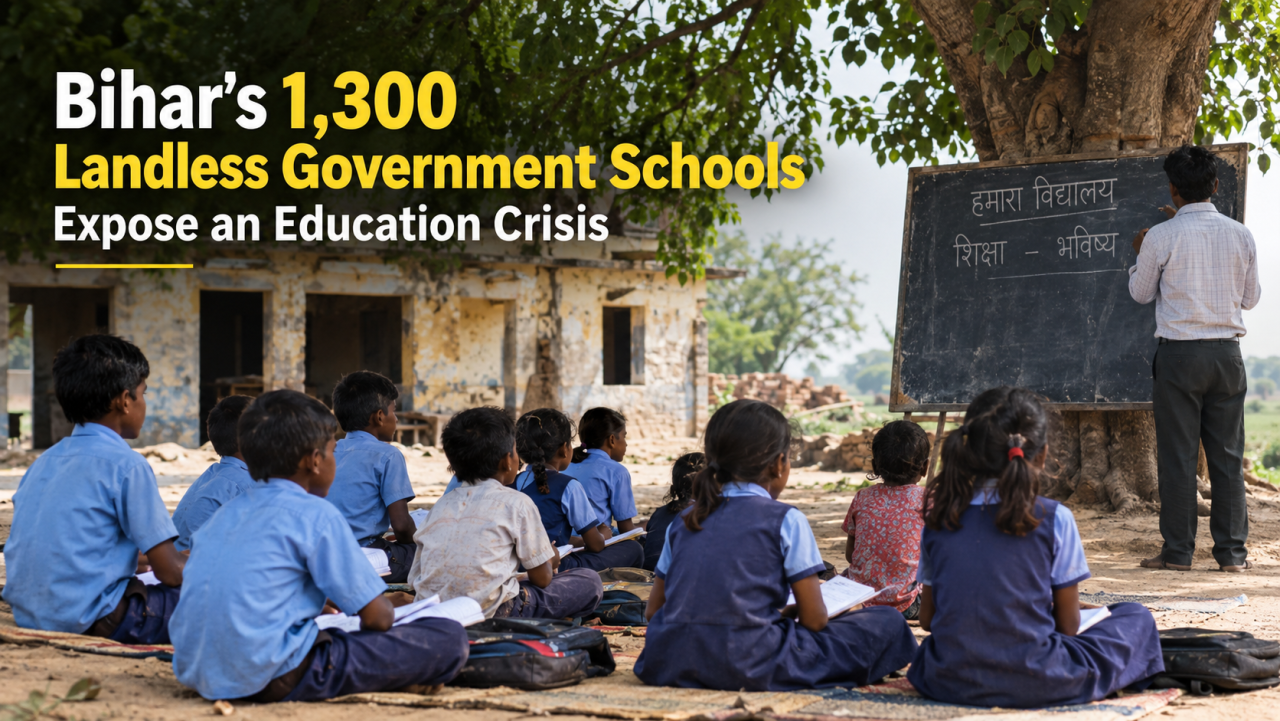
Thousands of Bihar’s children are still learning without a school building of their own. The numbers reveal a deeper failure in education infrastructure.
More than five decades after India committed itself to universal education, Bihar is still running over 1,300 government schools without a single brick of their own.
Official records show that of the state's 76,236 government schools, 9,360 are high schools, 38,164 are primary schools and 28,712 are middle schools. Among them are institutions functioning without dedicated land or buildings. These schools survive on borrowed premises, shared campuses, community halls and rented rooms, and in some cases, under nothing more than the shade of a tree.
This is not a fringe problem confined to a handful of remote villages. It is concentrated and severe in four northern districts.
Muzaffarpur alone accounts for 416 landless schools out of its 3,368 government institutions. Gopalganj has 191 such schools among its 1,915. West Champaran reports 105 landless schools out of 2,616, while East Champaran has 102 out of 3,413.
Together, these four districts account for nearly 800 schools that exist on paper but still lack a permanent physical foundation.
When a Tree Becomes a Classroom
The human cost of this administrative failure plays out every day.
At Rajkiya Uchch Madhya Vidyalaya in Jamuniya Nawka Tola, West Champaran, a school serving 339 students from Classes 1 to 8 operates out of just three rooms.
One classroom accommodates 72 students of Class 8. Class 7's 71 students and Class 6 share space under a tree, while Classes 4 and 5 occupy verandahs. Classes 1 to 3 are taught under a tree tied to the boundary walls.
The headmaster described the situation as a "Hobson's choice", meaning there is effectively no choice at all.
A Class 8 student put the reality more simply. Her classroom is a tree, she said, and when it rains, the tree leaks along with the sky.
That sentence captures the crisis better than any government file could.
The Infrastructure Deficit Behind the Numbers
This is what "infrastructure deficit" looks like when stripped of bureaucratic language.
It means children from minority communities, who account for more than 80 percent of students at some of these institutions, sitting in the open and facing the sun and rain while learning mathematics and languages on floors rather than at desks.
It means one teacher managing five grade levels in a single room, as reported at Maccharagawa Urdu Vidyalaya.
It means a school in Bhojpur functioning without its own land or building for more than two decades, using a single community hall instead.
These are not merely shortcomings in infrastructure. They affect the quality of learning, teacher availability, access to laboratories and digital facilities, and the basic dignity associated with attending a school.
The Bureaucracy Knows the Problem
What makes the crisis particularly damning is not simply its scale, but its administrative persistence.
District Education Officers across Bihar have acknowledged the numbers and the problems arising from the lack of land and buildings.
Gopalganj's DEO has acknowledged that landless schools have to share basic facilities with other institutions and lack laboratories and ICT infrastructure.
Muzaffarpur's DEO has confirmed that many schools operate from community halls or rented premises. Repair work, the officer said, has taken place "from time to time", but there has been no clear indication of a concrete building programme for all such schools.
East Champaran's DEO has also confirmed that lists of landless schools have been shared with higher authorities.
Yet the schools remain landless.
That is where the problem moves beyond infrastructure and becomes an issue of governance.
Promises, Lists and Another Six Months
State Education Minister Mithilesh Tiwari has said the issue was discussed at length during a recent government Chintan Shivir. The education department reportedly handed over a list of landless schools to the Revenue and Land Reforms Department, along with assurances that land would be allocated within six months.
But the government's own messaging reveals the uncertainty surrounding the issue.
Education Secretary Rajiv Raushan declined to give an exact figure, saying only that some schools among the state's more than 76,000 institutions continue to operate without land of their own. He also indicated that the number keeps changing as the government pursues land allocation with district magistrates.
There is an important distinction here.
A changing administrative count may be understandable as land is allocated and schools are shifted into permanent premises. But without a publicly available, regularly updated list showing which schools have received land, which have received buildings and which are still waiting, it becomes difficult to measure progress.
Acknowledgment is not construction.
A list is not a classroom.
And a six-month assurance is not a school building.
A Problem Decades in the Making
Bihar's school landlessness problem did not emerge overnight.
It reflects decades of expanding access to schooling without matching investment in permanent physical infrastructure.
The New Primary School in Kutubpur Dera, Bhojpur, is one example. It has reportedly functioned from a single community hall for more than two decades.
In Kaimur, the Urdu Primary School has never had its own land or building since its establishment in 2011 and currently operates from court premises.
Such examples raise a larger question about the state's approach to school expansion.
Enrolment numbers and access to government schooling matter. Mid-day meals matter. But a child being officially enrolled in a school is only one part of the education story.
The other part is whether that child has a classroom.
Whether there is enough space to teach.
Whether teachers have the facilities they need.
Whether children can learn without sitting under a tree or in a borrowed community building.
Bihar Needs More Than Another Assurance
The state government's claim that it is "serious" about the issue, echoed in statements from officials such as Purnia's DEO, will mean little without verifiable timelines and completed construction.
Six-month promises on land allocation can only be meaningful if citizens can later see what happened after those six months.
Which schools received land?
Which received buildings?
Which are still waiting?
How much money was sanctioned?
How much was spent?
And when did construction actually begin and finish?
These are basic questions of public accountability.
Until Bihar's administration demonstrates that acknowledgment can translate into actual construction, audited, dated and independently verifiable, thousands of students will continue learning in conditions that should have disappeared from India's education system long ago.
For children studying under trees, in verandahs, community halls or borrowed rooms, the problem is not abstract.
They do not need another list of landless schools.
They need a school building.
More than five decades after India committed itself to universal education, Bihar is still running over 1,300 government schools without a single brick of their own.
Official records show that of the state's 76,236 government schools, 9,360 are high schools, 38,164 are primary schools and 28,712 are middle schools. Among them are institutions functioning without dedicated land or buildings. These schools survive on borrowed premises, shared campuses, community halls and rented rooms, and in some cases, under nothing more than the shade of a tree.
This is not a fringe problem confined to a handful of remote villages. It is concentrated and severe in four northern districts.
Muzaffarpur alone accounts for 416 landless schools out of its 3,368 government institutions. Gopalganj has 191 such schools among its 1,915. West Champaran reports 105 landless schools out of 2,616, while East Champaran has 102 out of 3,413.
Together, these four districts account for nearly 800 schools that exist on paper but still lack a permanent physical foundation.
When a Tree Becomes a Classroom
The human cost of this administrative failure plays out every day.
At Rajkiya Uchch Madhya Vidyalaya in Jamuniya Nawka Tola, West Champaran, a school serving 339 students from Classes 1 to 8 operates out of just three rooms.
One classroom accommodates 72 students of Class 8. Class 7's 71 students and Class 6 share space under a tree, while Classes 4 and 5 occupy verandahs. Classes 1 to 3 are taught under a tree tied to the boundary walls.
The headmaster described the situation as a "Hobson's choice", meaning there is effectively no choice at all.
A Class 8 student put the reality more simply. Her classroom is a tree, she said, and when it rains, the tree leaks along with the sky.
That sentence captures the crisis better than any government file could.
The Infrastructure Deficit Behind the Numbers
This is what "infrastructure deficit" looks like when stripped of bureaucratic language.
It means children from minority communities, who account for more than 80 percent of students at some of these institutions, sitting in the open and facing the sun and rain while learning mathematics and languages on floors rather than at desks.
It means one teacher managing five grade levels in a single room, as reported at Maccharagawa Urdu Vidyalaya.
It means a school in Bhojpur functioning without its own land or building for more than two decades, using a single community hall instead.
These are not merely shortcomings in infrastructure. They affect the quality of learning, teacher availability, access to laboratories and digital facilities, and the basic dignity associated with attending a school.
The Bureaucracy Knows the Problem
What makes the crisis particularly damning is not simply its scale, but its administrative persistence.
District Education Officers across Bihar have acknowledged the numbers and the problems arising from the lack of land and buildings.
Gopalganj's DEO has acknowledged that landless schools have to share basic facilities with other institutions and lack laboratories and ICT infrastructure.
Muzaffarpur's DEO has confirmed that many schools operate from community halls or rented premises. Repair work, the officer said, has taken place "from time to time", but there has been no clear indication of a concrete building programme for all such schools.
East Champaran's DEO has also confirmed that lists of landless schools have been shared with higher authorities.
Yet the schools remain landless.
That is where the problem moves beyond infrastructure and becomes an issue of governance.
Promises, Lists and Another Six Months
State Education Minister Mithilesh Tiwari has said the issue was discussed at length during a recent government Chintan Shivir. The education department reportedly handed over a list of landless schools to the Revenue and Land Reforms Department, along with assurances that land would be allocated within six months.
But the government's own messaging reveals the uncertainty surrounding the issue.
Education Secretary Rajiv Raushan declined to give an exact figure, saying only that some schools among the state's more than 76,000 institutions continue to operate without land of their own. He also indicated that the number keeps changing as the government pursues land allocation with district magistrates.
There is an important distinction here.
A changing administrative count may be understandable as land is allocated and schools are shifted into permanent premises. But without a publicly available, regularly updated list showing which schools have received land, which have received buildings and which are still waiting, it becomes difficult to measure progress.
Acknowledgment is not construction.
A list is not a classroom.
And a six-month assurance is not a school building.
A Problem Decades in the Making
Bihar's school landlessness problem did not emerge overnight.
It reflects decades of expanding access to schooling without matching investment in permanent physical infrastructure.
The New Primary School in Kutubpur Dera, Bhojpur, is one example. It has reportedly functioned from a single community hall for more than two decades.
In Kaimur, the Urdu Primary School has never had its own land or building since its establishment in 2011 and currently operates from court premises.
Such examples raise a larger question about the state's approach to school expansion.
Enrolment numbers and access to government schooling matter. Mid-day meals matter. But a child being officially enrolled in a school is only one part of the education story.
The other part is whether that child has a classroom.
Whether there is enough space to teach.
Whether teachers have the facilities they need.
Whether children can learn without sitting under a tree or in a borrowed community building.
Bihar Needs More Than Another Assurance
The state government's claim that it is "serious" about the issue, echoed in statements from officials such as Purnia's DEO, will mean little without verifiable timelines and completed construction.
Six-month promises on land allocation can only be meaningful if citizens can later see what happened after those six months.
Which schools received land?
Which received buildings?
Which are still waiting?
How much money was sanctioned?
How much was spent?
And when did construction actually begin and finish?
These are basic questions of public accountability.
Until Bihar's administration demonstrates that acknowledgment can translate into actual construction, audited, dated and independently verifiable, thousands of students will continue learning in conditions that should have disappeared from India's education system long ago.
For children studying under trees, in verandahs, community halls or borrowed rooms, the problem is not abstract.
They do not need another list of landless schools.
They need a school building.
























Leave a Comment