
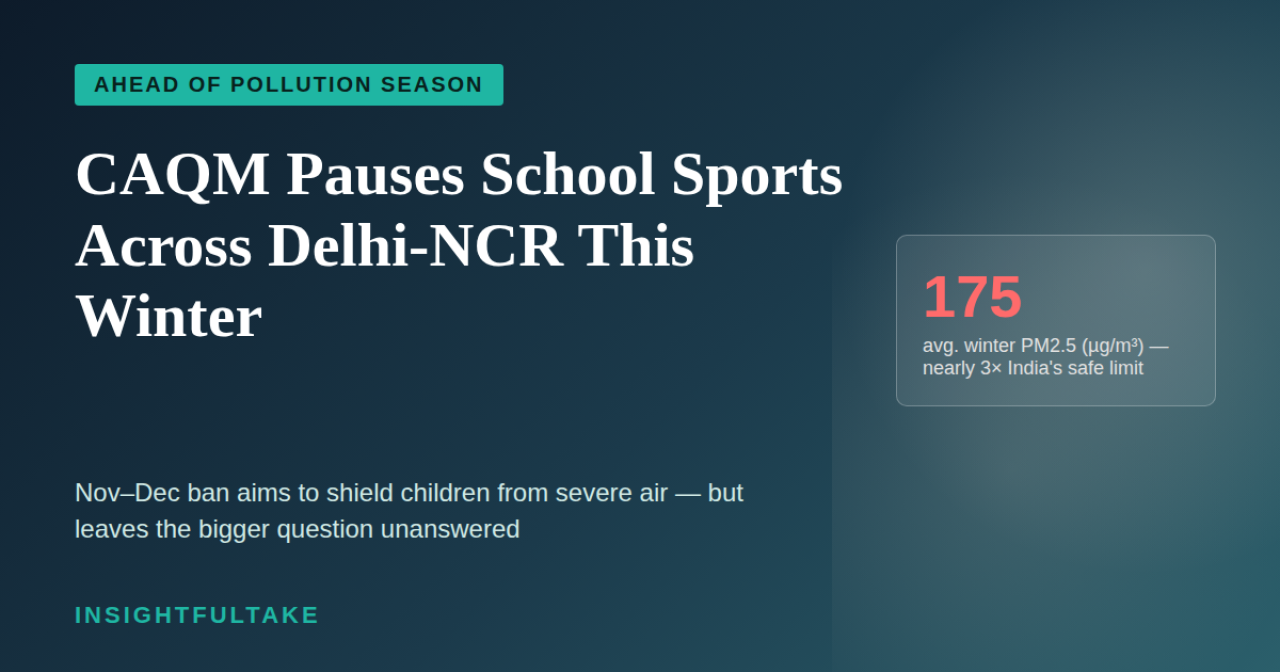
CAQM has asked Delhi-NCR schools to pause physical sports in November and December. It may protect children from pollution, but why has the air become too toxic for them to play outside?
The Commission for Air Quality Management (CAQM) has directed the governments of Delhi, Haryana, Rajasthan and Uttar Pradesh to ensure that schools in the Delhi-NCR region hold no physical sports activities or competitions during November and December 2026.
Competitions already scheduled during these two months will have to be rescheduled. The September 10 advisory also asks the states to explore alternative ways for students to remain active without compromising their health or academic routine.
The decision is not entirely new. CAQM issued a similar direction last November after the Supreme Court raised concerns about children participating in outdoor sports during periods of severe air pollution. The latest advisory effectively extends that precaution into another winter.
If children have to stop playing outdoors every winter because of pollution, how long can this fix the regular pollution problem?
Winter Brings the Pollution Back
Delhi's winter pollution follows a familiar pattern.
As temperatures fall, wind speeds often weaken and atmospheric conditions become less favourable for dispersing pollutants. Emissions from vehicles, industries, construction and waste burning combine with pollution from surrounding areas. Crop-residue burning in Punjab and Haryana can further add to the problem during the same period.
The result is often a toxic mix that remains trapped close to the ground.
Recent data shows how serious the problem can become. A Centre for Science and Environment analysis found that Delhi's average PM2.5 concentration during the 2024-25 winter was around 175 micrograms per cubic metre. The city's pollution peaked at 602 micrograms per cubic metre on November 18, 2024.
CSE also found that Delhi did not record a single "good" air-quality day during that winter. Its analysis showed that the city's annual PM2.5 average increased from around 101 micrograms per cubic metre in 2023 to nearly 105 micrograms per cubic metre in 2024.
These numbers explain why authorities are reluctant to let children spend long periods exercising outdoors during the worst weeks of winter.
Children Are Not Just Smaller Adults
The concern is not simply that polluted air makes outdoor activity unpleasant.
Children's lungs are still developing, and prolonged exposure to air pollution can have consequences for respiratory health and development. Physical exercise also increases breathing rates, which can increase the amount of polluted air inhaled during outdoor activity.
A 2022 study examining air pollution and child development across Indian cities found a strong association between higher PM2.5 exposure and childhood stunting. Researchers estimated that meeting WHO air-quality guidelines could significantly reduce the number of stunted children in India.
The Supreme Court also recognised the specific concern around school sports last year. Its intervention led CAQM to consider restrictions on outdoor sports and competitions during the peak pollution months.
From a public-health perspective, therefore, asking schools to shift outdoor competitions away from the most polluted period is understandable.
But protecting children from polluted sports grounds should not mean accepting polluted neighbourhoods as normal.
What Happens to Young Athletes?
This is where the advisory faces a practical challenge.
CAQM has asked state governments to explore alternative opportunities for sports and ensure that students are not unduly disadvantaged because competitions are postponed.
That is an important condition. But implementation will determine whether it actually protects students' interests.
Many government schools across Delhi-NCR do not have large covered halls, indoor courts or other facilities capable of replacing outdoor grounds. A football match cannot simply be moved indoors. Athletics, cricket and several other sports require space that many schools do not have.
For ordinary students, missing a few weeks of outdoor sport may be manageable.
For students preparing for district, state or national-level competitions, it can be different. Their training schedules often coincide with selection trials and fixed competition calendars. A two-month disruption can affect preparation, performance and selection opportunities.
So the question is not simply whether sports should be paused.
It is whether authorities have a workable plan for what comes next.
The Air Outside School Still Matters
There is an even bigger gap.
A school can stop a child from playing football on a polluted afternoon. It cannot stop that child from breathing polluted air while travelling to school, walking home, sitting at home or playing in a neighbourhood park.
That makes the sports restriction a protective measure, not a solution to Delhi-NCR's pollution crisis.
The sources of pollution are well established, although their relative contribution changes with location, weather and season. Vehicles, construction and road dust, industrial emissions, waste burning and agricultural fires all contribute to the regional pollution burden.
A policy that repeatedly tells children to stay indoors without delivering comparable progress on these sources risks turning an emergency precaution into a permanent winter routine.
A Two-Month Pause Cannot Become the New Normal
There is nothing unreasonable about protecting children during periods when air pollution reaches dangerous levels.
But an annual sports restriction should also serve as a reminder of the larger failure.
Schools need access to safe indoor sports infrastructure. Students competing at higher levels need protection from losing critical opportunities. And governments across the region need measurable, sustained action to reduce pollution at its sources.
Otherwise, the pattern becomes predictable: winter arrives, pollution rises, outdoor sports are restricted, and the cycle begins again.
Children should not have to choose between breathing safely and playing freely.
The real measure of success will not be how efficiently schools cancel or reschedule sports competitions.
The Commission for Air Quality Management (CAQM) has directed the governments of Delhi, Haryana, Rajasthan and Uttar Pradesh to ensure that schools in the Delhi-NCR region hold no physical sports activities or competitions during November and December 2026.
Competitions already scheduled during these two months will have to be rescheduled. The September 10 advisory also asks the states to explore alternative ways for students to remain active without compromising their health or academic routine.
The decision is not entirely new. CAQM issued a similar direction last November after the Supreme Court raised concerns about children participating in outdoor sports during periods of severe air pollution. The latest advisory effectively extends that precaution into another winter.
If children have to stop playing outdoors every winter because of pollution, how long can this fix the regular pollution problem?
Winter Brings the Pollution Back
Delhi's winter pollution follows a familiar pattern.
As temperatures fall, wind speeds often weaken and atmospheric conditions become less favourable for dispersing pollutants. Emissions from vehicles, industries, construction and waste burning combine with pollution from surrounding areas. Crop-residue burning in Punjab and Haryana can further add to the problem during the same period.
The result is often a toxic mix that remains trapped close to the ground.
Recent data shows how serious the problem can become. A Centre for Science and Environment analysis found that Delhi's average PM2.5 concentration during the 2024-25 winter was around 175 micrograms per cubic metre. The city's pollution peaked at 602 micrograms per cubic metre on November 18, 2024.
CSE also found that Delhi did not record a single "good" air-quality day during that winter. Its analysis showed that the city's annual PM2.5 average increased from around 101 micrograms per cubic metre in 2023 to nearly 105 micrograms per cubic metre in 2024.
These numbers explain why authorities are reluctant to let children spend long periods exercising outdoors during the worst weeks of winter.
Children Are Not Just Smaller Adults
The concern is not simply that polluted air makes outdoor activity unpleasant.
Children's lungs are still developing, and prolonged exposure to air pollution can have consequences for respiratory health and development. Physical exercise also increases breathing rates, which can increase the amount of polluted air inhaled during outdoor activity.
A 2022 study examining air pollution and child development across Indian cities found a strong association between higher PM2.5 exposure and childhood stunting. Researchers estimated that meeting WHO air-quality guidelines could significantly reduce the number of stunted children in India.
The Supreme Court also recognised the specific concern around school sports last year. Its intervention led CAQM to consider restrictions on outdoor sports and competitions during the peak pollution months.
From a public-health perspective, therefore, asking schools to shift outdoor competitions away from the most polluted period is understandable.
But protecting children from polluted sports grounds should not mean accepting polluted neighbourhoods as normal.
What Happens to Young Athletes?
This is where the advisory faces a practical challenge.
CAQM has asked state governments to explore alternative opportunities for sports and ensure that students are not unduly disadvantaged because competitions are postponed.
That is an important condition. But implementation will determine whether it actually protects students' interests.
Many government schools across Delhi-NCR do not have large covered halls, indoor courts or other facilities capable of replacing outdoor grounds. A football match cannot simply be moved indoors. Athletics, cricket and several other sports require space that many schools do not have.
For ordinary students, missing a few weeks of outdoor sport may be manageable.
For students preparing for district, state or national-level competitions, it can be different. Their training schedules often coincide with selection trials and fixed competition calendars. A two-month disruption can affect preparation, performance and selection opportunities.
So the question is not simply whether sports should be paused.
It is whether authorities have a workable plan for what comes next.
The Air Outside School Still Matters
There is an even bigger gap.
A school can stop a child from playing football on a polluted afternoon. It cannot stop that child from breathing polluted air while travelling to school, walking home, sitting at home or playing in a neighbourhood park.
That makes the sports restriction a protective measure, not a solution to Delhi-NCR's pollution crisis.
The sources of pollution are well established, although their relative contribution changes with location, weather and season. Vehicles, construction and road dust, industrial emissions, waste burning and agricultural fires all contribute to the regional pollution burden.
A policy that repeatedly tells children to stay indoors without delivering comparable progress on these sources risks turning an emergency precaution into a permanent winter routine.
A Two-Month Pause Cannot Become the New Normal
There is nothing unreasonable about protecting children during periods when air pollution reaches dangerous levels.
But an annual sports restriction should also serve as a reminder of the larger failure.
Schools need access to safe indoor sports infrastructure. Students competing at higher levels need protection from losing critical opportunities. And governments across the region need measurable, sustained action to reduce pollution at its sources.
Otherwise, the pattern becomes predictable: winter arrives, pollution rises, outdoor sports are restricted, and the cycle begins again.
Children should not have to choose between breathing safely and playing freely.
The real measure of success will not be how efficiently schools cancel or reschedule sports competitions.













Leave a Comment