
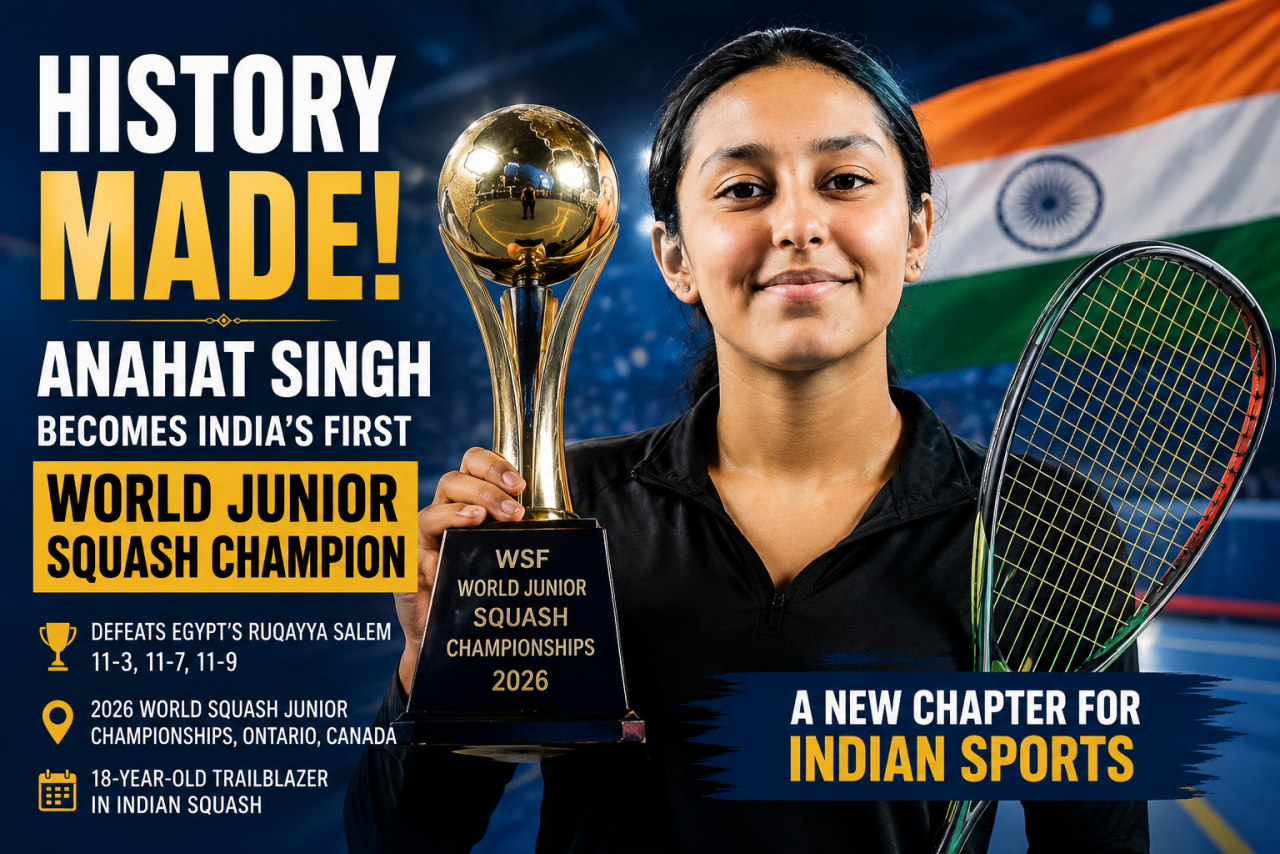
History made! Eighteen-year-old Anahat Singh becomes the first Indian to win the World Junior Squash Championship, marking a defining moment for Indian sports.
India has a new sporting landmark. Eighteen-year-old Anahat Singh defeated Egypt's Ruqayya Salem 11-3, 11-7, 11-9 in the girls' final of the 2026 World Squash Junior Championships, held near the Niagara Falls in Ontario, Canada, on Saturday. With this win, she became the first Indian to be crowned world junior squash champion, a title that had eluded the country despite decades of growing presence on the international squash circuit.
Anahat, currently ranked 20th in the world and seeded No. 1 at the junior event, dominated the summit clash from the outset. She raced through the first two sets, conceding just 10 points in the process. Ruqayya mounted a fightback in the third, briefly leading 8-6, but Anahat regrouped to close out the match and the title.
The victory carries weight beyond the scoreline. This was Anahat's final year of eligibility for the junior worlds, and her past attempts had ended short of gold. She had returned with a bronze in the previous edition after a semi-final defeat, and in the years before that, her campaigns had stalled at the same stage. The pattern of near-misses had built a quiet desperation to finally convert potential into a title, and on Saturday, that wait ended.
Speaking moments after the win, Anahat said the tournament had tested her more than any other in recent years, with losses at the semi-final and quarter-final stages in previous editions. Knowing this was her last opportunity to compete as a junior added urgency to her run, and she described the win as one that means a great deal to her personally.
The achievement also places her in select company. Less than 24 hours before the final, Anahat became the first Indian since Joshna Chinappa in 2005 to reach the summit clash of the junior world championships, a gap of over two decades. That she went on to convert the opportunity into a title underscores the scale of the accomplishment, and signals a generational shift in Indian squash.
For a sport that has long operated on the margins of India's mainstream sporting consciousness, dominated as it is by cricket, this result deserves wider attention. Squash in India has historically struggled with limited public courts, sparse corporate sponsorship, and minimal television coverage compared to sports like badminton or hockey. Yet a steady stream of Indian players, including Anahat, has continued to compete at the highest levels internationally, often with limited institutional support.
Anahat's rise is particularly significant because she has been building a professional career simultaneously with her junior campaigns, a rare feat that speaks to both her talent and discipline. Her ability to juggle senior-tour commitments while still chasing an age-group title, and to finally deliver on both fronts, offers a template for how young Indian athletes can pursue excellence across levels of competition without compromising on either.
This kind of victory matters for reasons that go beyond medals. India's sporting culture has, in recent years, shown signs of diversifying beyond its traditional strongholds. Wins in shooting, badminton, wrestling, and now squash, particularly by athletes still in their teens, help build public familiarity with a wider range of disciplines. Each such success creates a reference point for young players and their families when deciding whether a sport outside cricket is worth pursuing seriously.
There is also an infrastructure argument embedded in performances like this one. When athletes succeed despite limited domestic support systems, it strengthens the case for greater investment in grassroots coaching, court facilities, and sports science backing for non-mainstream disciplines. A world title at the junior level often translates into greater visibility for a sport back home, encouraging state associations and private academies to expand access.
Anahat Singh's next challenge will be establishing herself further on the senior professional tour, where she already competes regularly. But Saturday's win in Ontario stands on its own as a marker of what sustained effort across multiple attempts, and years of quiet persistence, can achieve. For a country still building out its sporting ecosystem beyond a handful of dominant games, her triumph is a reminder that talent exists across disciplines, and that recognition often follows only when someone breaks through first.
India has a new sporting landmark. Eighteen-year-old Anahat Singh defeated Egypt's Ruqayya Salem 11-3, 11-7, 11-9 in the girls' final of the 2026 World Squash Junior Championships, held near the Niagara Falls in Ontario, Canada, on Saturday. With this win, she became the first Indian to be crowned world junior squash champion, a title that had eluded the country despite decades of growing presence on the international squash circuit.
Anahat, currently ranked 20th in the world and seeded No. 1 at the junior event, dominated the summit clash from the outset. She raced through the first two sets, conceding just 10 points in the process. Ruqayya mounted a fightback in the third, briefly leading 8-6, but Anahat regrouped to close out the match and the title.
The victory carries weight beyond the scoreline. This was Anahat's final year of eligibility for the junior worlds, and her past attempts had ended short of gold. She had returned with a bronze in the previous edition after a semi-final defeat, and in the years before that, her campaigns had stalled at the same stage. The pattern of near-misses had built a quiet desperation to finally convert potential into a title, and on Saturday, that wait ended.
Speaking moments after the win, Anahat said the tournament had tested her more than any other in recent years, with losses at the semi-final and quarter-final stages in previous editions. Knowing this was her last opportunity to compete as a junior added urgency to her run, and she described the win as one that means a great deal to her personally.
The achievement also places her in select company. Less than 24 hours before the final, Anahat became the first Indian since Joshna Chinappa in 2005 to reach the summit clash of the junior world championships, a gap of over two decades. That she went on to convert the opportunity into a title underscores the scale of the accomplishment, and signals a generational shift in Indian squash.
For a sport that has long operated on the margins of India's mainstream sporting consciousness, dominated as it is by cricket, this result deserves wider attention. Squash in India has historically struggled with limited public courts, sparse corporate sponsorship, and minimal television coverage compared to sports like badminton or hockey. Yet a steady stream of Indian players, including Anahat, has continued to compete at the highest levels internationally, often with limited institutional support.
Anahat's rise is particularly significant because she has been building a professional career simultaneously with her junior campaigns, a rare feat that speaks to both her talent and discipline. Her ability to juggle senior-tour commitments while still chasing an age-group title, and to finally deliver on both fronts, offers a template for how young Indian athletes can pursue excellence across levels of competition without compromising on either.
This kind of victory matters for reasons that go beyond medals. India's sporting culture has, in recent years, shown signs of diversifying beyond its traditional strongholds. Wins in shooting, badminton, wrestling, and now squash, particularly by athletes still in their teens, help build public familiarity with a wider range of disciplines. Each such success creates a reference point for young players and their families when deciding whether a sport outside cricket is worth pursuing seriously.
There is also an infrastructure argument embedded in performances like this one. When athletes succeed despite limited domestic support systems, it strengthens the case for greater investment in grassroots coaching, court facilities, and sports science backing for non-mainstream disciplines. A world title at the junior level often translates into greater visibility for a sport back home, encouraging state associations and private academies to expand access.
Anahat Singh's next challenge will be establishing herself further on the senior professional tour, where she already competes regularly. But Saturday's win in Ontario stands on its own as a marker of what sustained effort across multiple attempts, and years of quiet persistence, can achieve. For a country still building out its sporting ecosystem beyond a handful of dominant games, her triumph is a reminder that talent exists across disciplines, and that recognition often follows only when someone breaks through first.























Leave a Comment