
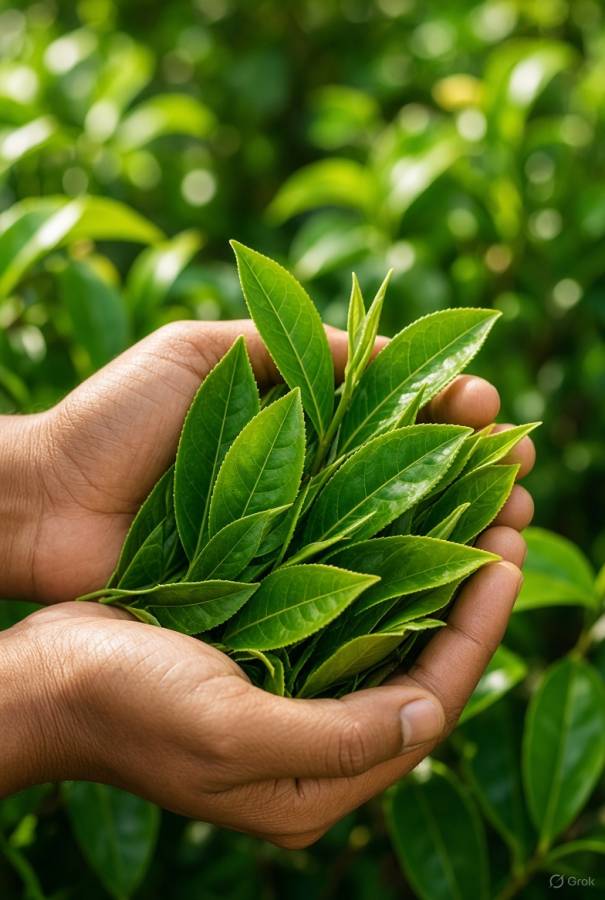
Assam has entered the matcha market, turning its distinctive tea leaves into a premium green powder long associated with Japan.
India has entered the matcha business, and the first commercial batch has come not from a Japanese import house but from a tea estate in Upper Assam.
In July, five kilograms of matcha grown and processed at Chota Tingrai Tea Estate in Tinsukia district were sold at the Guwahati Tea Auction Centre for ₹15,000. Two bidders bought the batch after five buyers competed for it. The sale marked the first time homegrown matcha had been offered commercially at an Indian tea auction.
Matcha Is More Than Ground Green Tea
Matcha is not simply green tea ground into powder.
Under standards set by the International Organization for Standardization, the leaves used for matcha must come from shade-grown tea bushes. They are steamed rather than pan-fired to stop oxidation, dried while retaining their bright green colour and then stone-ground into a fine powder.
Every stage requires precision.
At the Chota Tingrai factory, producing 15 kg of finished matcha currently takes about 16 hours of processing, including roughly 12 hours of grinding. By comparison, the estate can produce around 800 kg of conventional green tea within a few hours.
The difference is not limited to processing time. Shade cultivation and the specialised equipment needed for matcha also require considerably higher investment than conventional tea production.
A Japanese Connection Took Assam Into Matcha
Chota Tingrai's move into matcha did not begin with a conventional business plan. It grew from a personal connection.
Mrigendra Jalan, whose family has run the estate since the 1980s, became acquainted with Japanese tea grower Ichiro Hara through informal exchanges between the two families.
In 2016, Hara's son Shoji began working with the Jalans. He believed demand for ceremonial matcha in Japan was changing and wanted to explore whether Assam's Camellia assamica tea bushes could be adapted to a process traditionally associated with Camellia sinensis varieties grown in Japan.
The first attempts were far from successful.
According to Pyush Jalan, who now heads the estate, the early batches attracted little interest from Japanese buyers. Assam's native tea leaf produced a flavour profile that was different from what Japanese consumers traditionally expected from matcha.
Instead of abandoning the experiment, the family changed its approach.
Cultivation conditions and processing methods were gradually adjusted until the Assam-grown leaf developed a distinct character of its own. The process took years of experimentation and eventually resulted in two branded lines, Mridul Jalan and Avantika Jalan, named after members of the family.
The products are now being positioned as an Indian offering in a category long associated with Japanese tea-producing regions such as Uji and Nishio.
Why Japan's Matcha Shortage Matters
The timing could prove important.
Japan's matcha industry has been facing supply pressures as labour-intensive shade cultivation and specialised processing struggle to keep pace with rising global demand.
International interest has also expanded rapidly, helped by the popularity of matcha lattes, desserts and other matcha-based products on social media.
China and Vietnam have already moved into matcha production, seeking to supply a growing international market. India could now become another producer if the Assam experiment can be replicated across other tea gardens.
For Assam, the opportunity comes at a difficult time for the traditional tea industry.
Tea producers have been dealing with climate pressures, changing consumption patterns and weak international prices. A specialty product capable of commanding a significantly higher price than ordinary green tea offers an alternative route for estates looking beyond the conventional tea market.
Can Assam Build a Matcha Industry?
Joydeep Phukan, principal officer and secretary at the Tea Research Association in Kolkata, has confirmed that the Chota Tingrai batch represents India's first branded matcha production. The association is also examining the infrastructure and cultivar adjustments that may be required if other tea gardens want to enter the sector.
For Chota Tingrai, the experiment is far from over.
Pyush Jalan has said the estate plans to hold further auctions later this year while continuing to work on yield and consistency. Those two factors will be crucial if Assam's matcha is to move beyond a specialised product and become a commercially scalable category.
Japan has spent generations building the reputation of its matcha. Assam will have to develop its own identity rather than simply reproduce the Japanese model.
The Guwahati auction, however, has already demonstrated something significant. Assam's tea gardens may be able to move beyond supplying leaves for conventional blends and enter a premium global market of their own.
India has entered the matcha business, and the first commercial batch has come not from a Japanese import house but from a tea estate in Upper Assam.
In July, five kilograms of matcha grown and processed at Chota Tingrai Tea Estate in Tinsukia district were sold at the Guwahati Tea Auction Centre for ₹15,000. Two bidders bought the batch after five buyers competed for it. The sale marked the first time homegrown matcha had been offered commercially at an Indian tea auction.
Matcha Is More Than Ground Green Tea
Matcha is not simply green tea ground into powder.
Under standards set by the International Organization for Standardization, the leaves used for matcha must come from shade-grown tea bushes. They are steamed rather than pan-fired to stop oxidation, dried while retaining their bright green colour and then stone-ground into a fine powder.
Every stage requires precision.
At the Chota Tingrai factory, producing 15 kg of finished matcha currently takes about 16 hours of processing, including roughly 12 hours of grinding. By comparison, the estate can produce around 800 kg of conventional green tea within a few hours.
The difference is not limited to processing time. Shade cultivation and the specialised equipment needed for matcha also require considerably higher investment than conventional tea production.
A Japanese Connection Took Assam Into Matcha
Chota Tingrai's move into matcha did not begin with a conventional business plan. It grew from a personal connection.
Mrigendra Jalan, whose family has run the estate since the 1980s, became acquainted with Japanese tea grower Ichiro Hara through informal exchanges between the two families.
In 2016, Hara's son Shoji began working with the Jalans. He believed demand for ceremonial matcha in Japan was changing and wanted to explore whether Assam's Camellia assamica tea bushes could be adapted to a process traditionally associated with Camellia sinensis varieties grown in Japan.
The first attempts were far from successful.
According to Pyush Jalan, who now heads the estate, the early batches attracted little interest from Japanese buyers. Assam's native tea leaf produced a flavour profile that was different from what Japanese consumers traditionally expected from matcha.
Instead of abandoning the experiment, the family changed its approach.
Cultivation conditions and processing methods were gradually adjusted until the Assam-grown leaf developed a distinct character of its own. The process took years of experimentation and eventually resulted in two branded lines, Mridul Jalan and Avantika Jalan, named after members of the family.
The products are now being positioned as an Indian offering in a category long associated with Japanese tea-producing regions such as Uji and Nishio.
Why Japan's Matcha Shortage Matters
The timing could prove important.
Japan's matcha industry has been facing supply pressures as labour-intensive shade cultivation and specialised processing struggle to keep pace with rising global demand.
International interest has also expanded rapidly, helped by the popularity of matcha lattes, desserts and other matcha-based products on social media.
China and Vietnam have already moved into matcha production, seeking to supply a growing international market. India could now become another producer if the Assam experiment can be replicated across other tea gardens.
For Assam, the opportunity comes at a difficult time for the traditional tea industry.
Tea producers have been dealing with climate pressures, changing consumption patterns and weak international prices. A specialty product capable of commanding a significantly higher price than ordinary green tea offers an alternative route for estates looking beyond the conventional tea market.
Can Assam Build a Matcha Industry?
Joydeep Phukan, principal officer and secretary at the Tea Research Association in Kolkata, has confirmed that the Chota Tingrai batch represents India's first branded matcha production. The association is also examining the infrastructure and cultivar adjustments that may be required if other tea gardens want to enter the sector.
For Chota Tingrai, the experiment is far from over.
Pyush Jalan has said the estate plans to hold further auctions later this year while continuing to work on yield and consistency. Those two factors will be crucial if Assam's matcha is to move beyond a specialised product and become a commercially scalable category.
Japan has spent generations building the reputation of its matcha. Assam will have to develop its own identity rather than simply reproduce the Japanese model.
The Guwahati auction, however, has already demonstrated something significant. Assam's tea gardens may be able to move beyond supplying leaves for conventional blends and enter a premium global market of their own.






















Leave a Comment