
Darjeeling tea is more than a taste. It is a symbol of India’s heritage, but its future is now at risk.
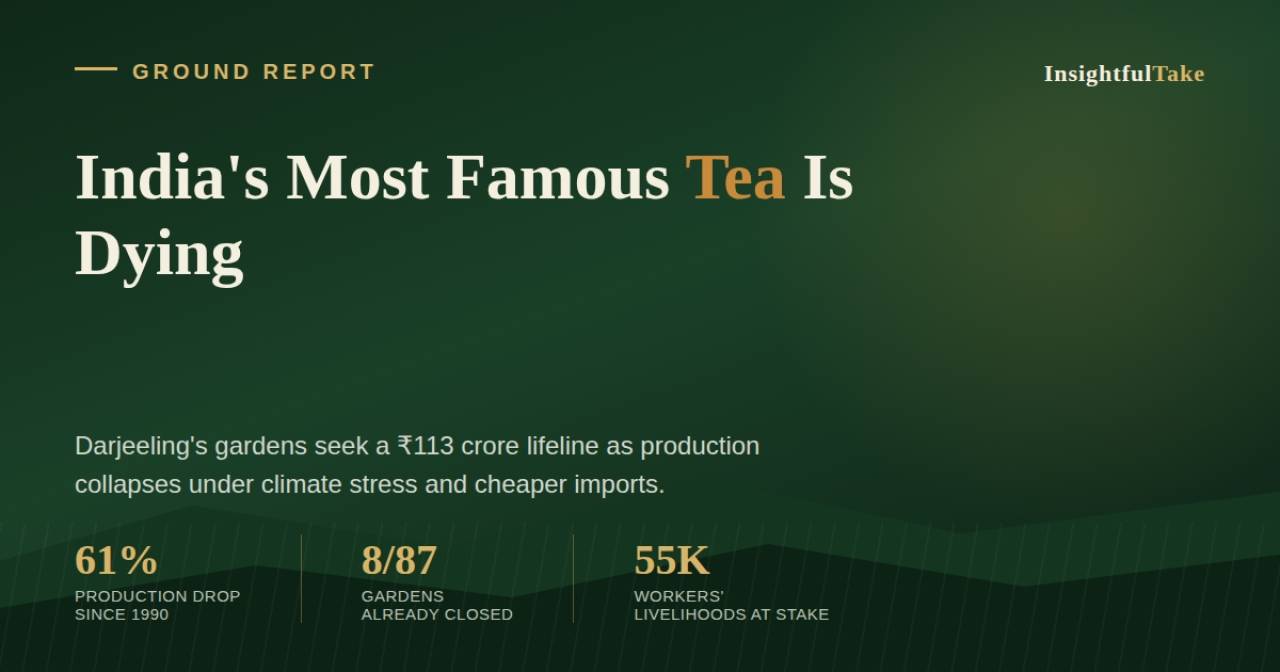
Darjeeling tea production has plunged by more than 61 percent in three decades. With ageing plantations, climate stress, rising costs and cheaper imports threatening the industry, the tea estates of the hills are asking West Bengal for an annual revival package of ₹113 crore.
The Indian Tea Association (ITA) has asked the West Bengal government for an annual package of ₹113 crore to prevent the Darjeeling tea industry from collapsing further.
The demand, submitted through two separate white papers to the state government, is more than a routine request for financial assistance. It is a warning that one of the world's most recognised agricultural brands is approaching a point where remaining commercially viable could become increasingly difficult.
The numbers underline the scale of the crisis.
Darjeeling tea production has fallen by more than 61 percent in three decades. In 1990, the hills produced around 14.5 million kilograms of tea. By 2025, production had dropped to approximately 5.6 million kilograms.
The decline is visible in the land under cultivation as well. The area has fallen from around 20,065 hectares to 17,500 hectares over the same period.
Of the 87 tea gardens that once formed the backbone of the region's economy, eight are now closed. Around 55,000 workers continue to depend on the remaining gardens for their livelihoods.
This is not simply the story of a struggling industry in one corner of India. It is a warning about what happens when a heritage product is forced to compete with cheaper alternatives without a policy framework designed around its unique economic and environmental challenges.
A Crisis Built Over Decades
According to Arijit Raha, secretary general of the Indian Tea Association, the Darjeeling tea industry is facing severe economic stress because of stagnant prices, climate adversities, low productivity, manpower shortages and rising input costs.
None of these challenges emerged overnight. But their combined impact has pushed the industry towards what stakeholders fear could become an irreversible decline.
One of the most immediate competitive pressures comes from Nepal.
Tea produced across the border can enter Indian markets at a landed cost lower than what many Darjeeling estates spend simply producing their leaves. That creates a fundamental disadvantage for local growers.
Darjeeling tea may command a premium reputation in international markets, but reputation alone cannot compensate for a widening cost gap.
The problem becomes particularly complicated because Darjeeling tea has a Geographical Indication (GI) status. Its identity and production are intrinsically linked to the region. Yet the estates carrying that heritage continue to face competition from cheaper tea entering the Indian market.
Climate Change Is Making an Old Problem Worse
Economic pressures are being compounded by a changing climate.
Many tea bushes in the Darjeeling hills are ageing. At the same time, erratic rainfall and changing temperature patterns are affecting both productivity and quality.
The industry's concern is not only that climate change is affecting tea production, but that government planning has not adequately reflected the sector's vulnerability.
The West Bengal State Action Plan on Climate Change for 2022 to 2027, according to the industry's representation, does not specifically mention the tea industry despite the sector's exposure to changing weather conditions.
For an industry dependent almost entirely on a delicate relationship between soil, rainfall, temperature and altitude, that omission is significant.
What the Tea Industry Wants
The ITA's white papers have outlined a broad revival strategy rather than a single subsidy.
Among its demands are:
- A financial support and revival package
- Seasonal industry status for tea
- Employment support during lean periods
- Rejuvenation of ageing tea bushes
- Modernisation of ageing factories
- A minimum support price for tea leaves
- Freehold status for tea tourism projects
Industry representatives have also pointed towards the Assam Tea Industries Special Incentive Scheme of 2020 as a possible model.
The Assam scheme provided support for orthodox and speciality tea production, interest subvention and factory modernisation. Darjeeling's tea industry believes a similar policy framework could help estates facing a combination of structural and financial pressures.
ITA representatives have already held meetings with the state's industry and finance ministers, as well as Suvendu Adhikari, the chief advisor to the West Bengal chief minister.
The discussions suggest that the state government is engaging with the industry's concerns. However, no financial commitment has been announced so far.
Why Darjeeling Tea Matters Beyond the Hills
Darjeeling tea is not simply another agricultural commodity.
It is a globally recognised Indian brand whose identity is legally connected to its geographical origin through its GI status. Its decline would therefore represent more than a fall in production or export earnings.
It would mean the weakening of an agricultural heritage that India has spent generations building.
There is also a substantial human cost.
Around 55,000 workers remain dependent on the tea gardens. For many communities in the hills, alternative employment opportunities are limited.
When a tea garden closes, the impact extends far beyond the company that owns it. Wages disappear, seasonal employment contracts shrink, local businesses lose customers and entire communities can become economically vulnerable.
The ITA's white paper makes another crucial point. Every lost cropping season further weakens the financial viability of tea estates and reduces the possibility of recovery.
That warning deserves attention because tea is not an industry that can simply restart after a period of neglect.
Tea bushes take years to mature. Ageing plantations require substantial investment and careful rejuvenation. Once productive capacity is lost, rebuilding it cannot happen overnight, even if financial assistance arrives later.
A Test of Policy Priorities
The Darjeeling tea crisis is ultimately a test of how India chooses to protect industries that are simultaneously culturally important and economically vulnerable.
The state government now faces a difficult choice.
A structured revival package could help modernise plantations, protect employment, improve productivity and give Darjeeling tea a fighting chance against cheaper competition and climate-related disruption.
It could also provide a policy model for other heritage industries confronting similar pressures.
But delay carries its own cost.
Every closed garden, abandoned hectare and lost production season makes recovery more difficult and more expensive.
Darjeeling tea has spent generations becoming synonymous with quality, altitude and Indian tea heritage.
The danger today is not that the name will disappear overnight.
It is that the name will survive while the industry behind it gradually shrinks.
And one day, the world's most famous Darjeeling tea may be remembered less for how much India produces and more for how much it once did.
Darjeeling tea production has plunged by more than 61 percent in three decades. With ageing plantations, climate stress, rising costs and cheaper imports threatening the industry, the tea estates of the hills are asking West Bengal for an annual revival package of ₹113 crore.
The Indian Tea Association (ITA) has asked the West Bengal government for an annual package of ₹113 crore to prevent the Darjeeling tea industry from collapsing further.
The demand, submitted through two separate white papers to the state government, is more than a routine request for financial assistance. It is a warning that one of the world's most recognised agricultural brands is approaching a point where remaining commercially viable could become increasingly difficult.
The numbers underline the scale of the crisis.
Darjeeling tea production has fallen by more than 61 percent in three decades. In 1990, the hills produced around 14.5 million kilograms of tea. By 2025, production had dropped to approximately 5.6 million kilograms.
The decline is visible in the land under cultivation as well. The area has fallen from around 20,065 hectares to 17,500 hectares over the same period.
Of the 87 tea gardens that once formed the backbone of the region's economy, eight are now closed. Around 55,000 workers continue to depend on the remaining gardens for their livelihoods.
This is not simply the story of a struggling industry in one corner of India. It is a warning about what happens when a heritage product is forced to compete with cheaper alternatives without a policy framework designed around its unique economic and environmental challenges.
A Crisis Built Over Decades
According to Arijit Raha, secretary general of the Indian Tea Association, the Darjeeling tea industry is facing severe economic stress because of stagnant prices, climate adversities, low productivity, manpower shortages and rising input costs.
None of these challenges emerged overnight. But their combined impact has pushed the industry towards what stakeholders fear could become an irreversible decline.
One of the most immediate competitive pressures comes from Nepal.
Tea produced across the border can enter Indian markets at a landed cost lower than what many Darjeeling estates spend simply producing their leaves. That creates a fundamental disadvantage for local growers.
Darjeeling tea may command a premium reputation in international markets, but reputation alone cannot compensate for a widening cost gap.
The problem becomes particularly complicated because Darjeeling tea has a Geographical Indication (GI) status. Its identity and production are intrinsically linked to the region. Yet the estates carrying that heritage continue to face competition from cheaper tea entering the Indian market.
Climate Change Is Making an Old Problem Worse
Economic pressures are being compounded by a changing climate.
Many tea bushes in the Darjeeling hills are ageing. At the same time, erratic rainfall and changing temperature patterns are affecting both productivity and quality.
The industry's concern is not only that climate change is affecting tea production, but that government planning has not adequately reflected the sector's vulnerability.
The West Bengal State Action Plan on Climate Change for 2022 to 2027, according to the industry's representation, does not specifically mention the tea industry despite the sector's exposure to changing weather conditions.
For an industry dependent almost entirely on a delicate relationship between soil, rainfall, temperature and altitude, that omission is significant.
What the Tea Industry Wants
The ITA's white papers have outlined a broad revival strategy rather than a single subsidy.
Among its demands are:
- A financial support and revival package
- Seasonal industry status for tea
- Employment support during lean periods
- Rejuvenation of ageing tea bushes
- Modernisation of ageing factories
- A minimum support price for tea leaves
- Freehold status for tea tourism projects
Industry representatives have also pointed towards the Assam Tea Industries Special Incentive Scheme of 2020 as a possible model.
The Assam scheme provided support for orthodox and speciality tea production, interest subvention and factory modernisation. Darjeeling's tea industry believes a similar policy framework could help estates facing a combination of structural and financial pressures.
ITA representatives have already held meetings with the state's industry and finance ministers, as well as Suvendu Adhikari, the chief advisor to the West Bengal chief minister.
The discussions suggest that the state government is engaging with the industry's concerns. However, no financial commitment has been announced so far.
Why Darjeeling Tea Matters Beyond the Hills
Darjeeling tea is not simply another agricultural commodity.
It is a globally recognised Indian brand whose identity is legally connected to its geographical origin through its GI status. Its decline would therefore represent more than a fall in production or export earnings.
It would mean the weakening of an agricultural heritage that India has spent generations building.
There is also a substantial human cost.
Around 55,000 workers remain dependent on the tea gardens. For many communities in the hills, alternative employment opportunities are limited.
When a tea garden closes, the impact extends far beyond the company that owns it. Wages disappear, seasonal employment contracts shrink, local businesses lose customers and entire communities can become economically vulnerable.
The ITA's white paper makes another crucial point. Every lost cropping season further weakens the financial viability of tea estates and reduces the possibility of recovery.
That warning deserves attention because tea is not an industry that can simply restart after a period of neglect.
Tea bushes take years to mature. Ageing plantations require substantial investment and careful rejuvenation. Once productive capacity is lost, rebuilding it cannot happen overnight, even if financial assistance arrives later.
A Test of Policy Priorities
The Darjeeling tea crisis is ultimately a test of how India chooses to protect industries that are simultaneously culturally important and economically vulnerable.
The state government now faces a difficult choice.
A structured revival package could help modernise plantations, protect employment, improve productivity and give Darjeeling tea a fighting chance against cheaper competition and climate-related disruption.
It could also provide a policy model for other heritage industries confronting similar pressures.
But delay carries its own cost.
Every closed garden, abandoned hectare and lost production season makes recovery more difficult and more expensive.
Darjeeling tea has spent generations becoming synonymous with quality, altitude and Indian tea heritage.
The danger today is not that the name will disappear overnight.
It is that the name will survive while the industry behind it gradually shrinks.
And one day, the world's most famous Darjeeling tea may be remembered less for how much India produces and more for how much it once did.

.jpeg)






















Leave a Comment