
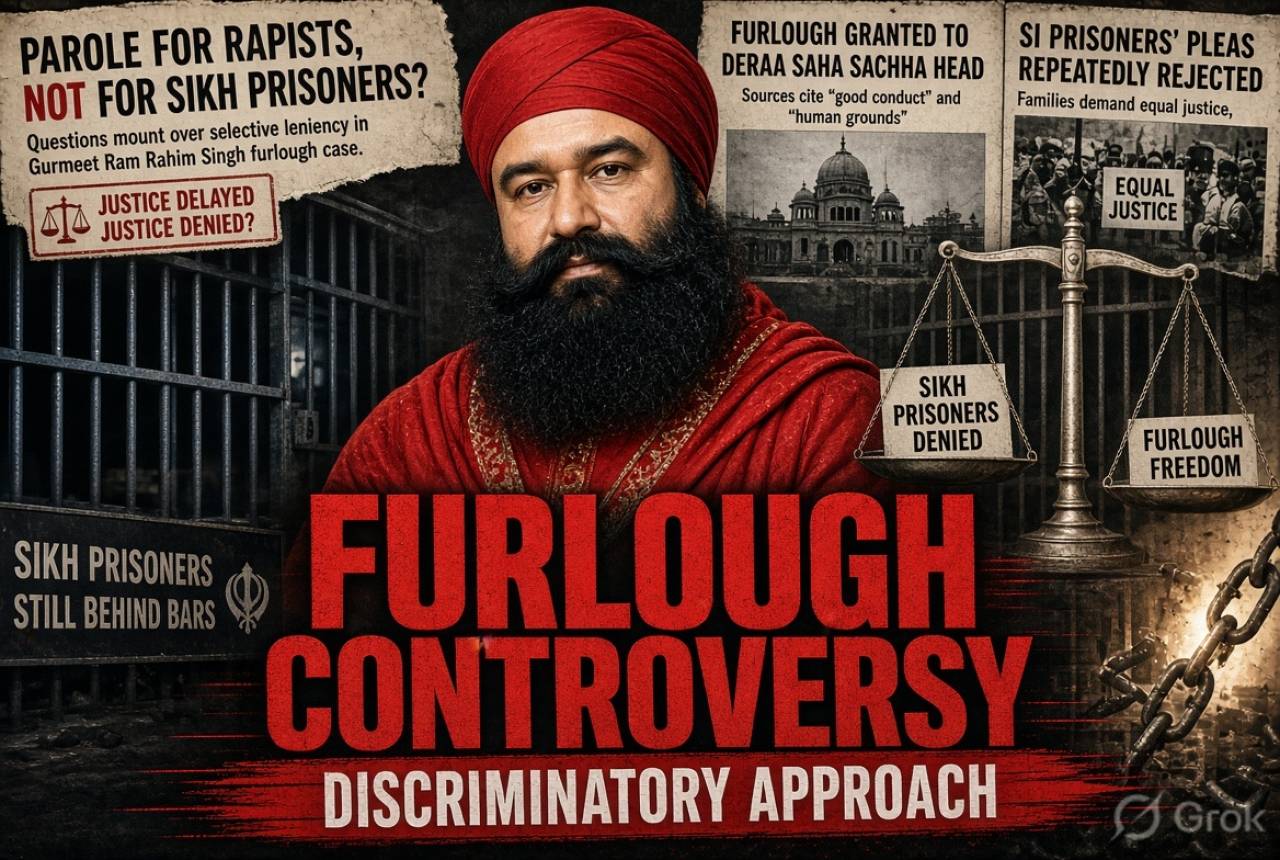
Ram Rahim’s repeated furloughs have reopened a difficult question about India’s parole system: where does legal entitlement end and public accountability begin?
Gurmeet Ram Rahim Singh walked out of Rohtak’s Sunaria jail on August 26, 2026, on a 21-day furlough. It was his 17th temporary release since his conviction in 2017.
Within hours, the Akal Takht Jathedar, the Shiromani Gurdwara Parbandhak Committee (SGPC), and several Sikh political groups condemned the decision. Their objections have revived a question that has followed the Dera Sacha Sauda chief for nearly a decade.
Why does a man convicted in rape and murder cases continue to receive temporary releases while other prisoners, including those who have completed their sentences, remain behind bars?
The Man and His Convictions
Ram Rahim, 59, is serving a 20-year sentence imposed by a special CBI court in Rohtak in 2017 after he was convicted of raping two of his disciples in 2002.
The case took 15 years to reach a verdict. His conviction triggered violent clashes between his followers and security forces in August 2017, resulting in several deaths.
Ram Rahim was subsequently convicted in two murder cases. In 2019, he was convicted for the murder of journalist Ram Chander Chhatrapati, who had reported allegations of sexual abuse involving the Dera. In 2021, he was convicted for conspiring to murder former Dera manager Ranjit Singh.
His convictions have placed him among India's most controversial prisoners, with his temporary releases repeatedly attracting political, religious and public scrutiny.
A Pattern of Temporary Releases
The controversy is not centred on one furlough. It is the frequency of Ram Rahim’s releases.
Since his conviction, he has received temporary releases at regular intervals. These have included a three-week furlough in February 2022, a month-long parole in June that year, a 40-day parole in October 2022, another 40-day parole in January 2023, and a 30-day parole in July 2023.
He was granted another 50-day parole in November 2023. Further releases followed in 2024 and 2025, including a 50-day furlough in January 2024 and a 30-day parole in January 2025.
His latest furlough in August 2026 came less than two months after he returned from a 30-day parole in June.
The repeated releases have created the impression among critics that temporary relief has become unusually frequent in his case.
Haryana prison authorities, however, have maintained that the releases are lawful. They have pointed out that Ram Rahim has not violated the conditions imposed during his temporary releases.
Parole and furlough are intended to serve a reformative purpose. They allow eligible prisoners to maintain family and social ties and, subject to the applicable rules, return temporarily to society.
Ram Rahim’s lawyers have also argued in earlier court proceedings that other prisoners convicted in multiple serious cases have received similar relief. They cited the cases of 89 convicts serving multiple life sentences and argued that Ram Rahim's releases were consistent with the treatment of similarly placed prisoners.
The Punjab and Haryana High Court had earlier examined his eligibility. In 2022, the court held that Ram Rahim did not fall within the category of “hardcore prisoners” for the purpose of furlough eligibility, a classification that could otherwise restrict access to such temporary release.
Why the Sikh Community Is Angry
The strongest criticism has come from Sikh religious and political organisations.
The anger is rooted partly in a comparison that Sikh leaders have raised repeatedly over the years.
Jagtar Singh Hawara, convicted in the 1995 assassination of former Punjab chief minister Beant Singh, remains in prison. Sikh organisations have also continued to demand the release of several Sikh prisoners, commonly referred to as “Bandi Singhs”, who they say have completed their sentences or become eligible for release.
Akal Takht Jathedar Giani Kuldeep Singh Gargajj criticised the repeated release of Ram Rahim, arguing that convicts involved in serious crimes such as rape were being allowed out so frequently that the process appeared more like a “picnic” than a temporary reformative measure.
SGPC president Harjinder Singh Dhami also criticised the latest furlough, describing it as discriminatory and arguing that similar consideration should be given to Sikh prisoners.
The comparison has become a politically sensitive issue because it goes beyond Ram Rahim himself. For Sikh organisations, the controversy reflects what they see as unequal treatment within the prison and remission system.
Dera Sacha Sauda representatives and state authorities, however, have maintained that each application is considered separately under the applicable Haryana prison laws and procedures, including security assessments.
The Political Backdrop
The timing of Ram Rahim’s temporary releases has added another layer to the controversy.
Several of his previous releases have come close to elections. His January 2025 parole was granted shortly before the Delhi Assembly elections. His temporary releases in 2024 also came ahead of the Haryana Assembly election.
The August 2026 furlough has drawn attention because it comes months before the Punjab Assembly election.
Dera Sacha Sauda has a significant following in parts of Haryana and Punjab. Its influence is particularly associated with areas such as Sirsa, Fatehabad, Hisar, Kaithal and Kurukshetra.
Opposition leaders in Punjab have repeatedly questioned whether the timing of Ram Rahim’s releases has political implications. Critics argue that political parties may be reluctant to antagonise a religious organisation with an established support base during an election season.
The political parties, however, have generally maintained that electoral considerations do not determine decisions on parole or furlough.
That distinction has done little to end the controversy because the timing itself continues to invite suspicion.
Parole and Furlough Are Not the Same
Part of the public confusion comes from the terms themselves.
Parole and furlough are both forms of temporary release, but they serve different purposes under prison law. Parole is generally associated with specific grounds or circumstances, while furlough is linked more closely to maintaining social and family ties and encouraging rehabilitation.
Neither amounts to a cancellation of a sentence.
A prisoner released on parole or furlough remains a convict serving a sentence and is required to return to prison after the permitted period. The conditions attached to the release can also be stricter depending on the circumstances.
The legal question in Ram Rahim’s case, therefore, is not simply whether a convicted prisoner can ever be released temporarily. The more contentious issue is whether the frequency and timing of repeated releases are consistent with the purpose and spirit of the system.
Final Take
So far, the controversy has not resulted in a judicial finding that Ram Rahim’s individual furloughs were illegal on their merits.
The continuing dispute is therefore less about whether he is legally capable of receiving temporary release and more about whether the system should impose clearer limits on how frequently such relief can be granted.
That distinction matters.
A parole or furlough can be legally valid under existing rules and still raise legitimate questions about consistency, transparency and equal treatment.
Ram Rahim’s case has exposed precisely that tension.
For his critics, repeated releases of a high-profile convict create a perception that influence and political considerations may be operating alongside the formal rules. For prison authorities, the argument is simpler: if a prisoner meets the legal requirements and complies with the conditions, temporary release cannot be denied merely because the prisoner is controversial.
Until the rules governing frequency, timing and eligibility are clarified, or a court directly examines whether repeated temporary releases can become excessive, the controversy is unlikely to disappear.
And every time Ram Rahim walks out of Sunaria jail, the same question is likely to return.
If the rules allow it, are the rules themselves the problem?
Gurmeet Ram Rahim Singh walked out of Rohtak’s Sunaria jail on August 26, 2026, on a 21-day furlough. It was his 17th temporary release since his conviction in 2017.
Within hours, the Akal Takht Jathedar, the Shiromani Gurdwara Parbandhak Committee (SGPC), and several Sikh political groups condemned the decision. Their objections have revived a question that has followed the Dera Sacha Sauda chief for nearly a decade.
Why does a man convicted in rape and murder cases continue to receive temporary releases while other prisoners, including those who have completed their sentences, remain behind bars?
The Man and His Convictions
Ram Rahim, 59, is serving a 20-year sentence imposed by a special CBI court in Rohtak in 2017 after he was convicted of raping two of his disciples in 2002.
The case took 15 years to reach a verdict. His conviction triggered violent clashes between his followers and security forces in August 2017, resulting in several deaths.
Ram Rahim was subsequently convicted in two murder cases. In 2019, he was convicted for the murder of journalist Ram Chander Chhatrapati, who had reported allegations of sexual abuse involving the Dera. In 2021, he was convicted for conspiring to murder former Dera manager Ranjit Singh.
His convictions have placed him among India's most controversial prisoners, with his temporary releases repeatedly attracting political, religious and public scrutiny.
A Pattern of Temporary Releases
The controversy is not centred on one furlough. It is the frequency of Ram Rahim’s releases.
Since his conviction, he has received temporary releases at regular intervals. These have included a three-week furlough in February 2022, a month-long parole in June that year, a 40-day parole in October 2022, another 40-day parole in January 2023, and a 30-day parole in July 2023.
He was granted another 50-day parole in November 2023. Further releases followed in 2024 and 2025, including a 50-day furlough in January 2024 and a 30-day parole in January 2025.
His latest furlough in August 2026 came less than two months after he returned from a 30-day parole in June.
The repeated releases have created the impression among critics that temporary relief has become unusually frequent in his case.
Haryana prison authorities, however, have maintained that the releases are lawful. They have pointed out that Ram Rahim has not violated the conditions imposed during his temporary releases.
Parole and furlough are intended to serve a reformative purpose. They allow eligible prisoners to maintain family and social ties and, subject to the applicable rules, return temporarily to society.
Ram Rahim’s lawyers have also argued in earlier court proceedings that other prisoners convicted in multiple serious cases have received similar relief. They cited the cases of 89 convicts serving multiple life sentences and argued that Ram Rahim's releases were consistent with the treatment of similarly placed prisoners.
The Punjab and Haryana High Court had earlier examined his eligibility. In 2022, the court held that Ram Rahim did not fall within the category of “hardcore prisoners” for the purpose of furlough eligibility, a classification that could otherwise restrict access to such temporary release.
Why the Sikh Community Is Angry
The strongest criticism has come from Sikh religious and political organisations.
The anger is rooted partly in a comparison that Sikh leaders have raised repeatedly over the years.
Jagtar Singh Hawara, convicted in the 1995 assassination of former Punjab chief minister Beant Singh, remains in prison. Sikh organisations have also continued to demand the release of several Sikh prisoners, commonly referred to as “Bandi Singhs”, who they say have completed their sentences or become eligible for release.
Akal Takht Jathedar Giani Kuldeep Singh Gargajj criticised the repeated release of Ram Rahim, arguing that convicts involved in serious crimes such as rape were being allowed out so frequently that the process appeared more like a “picnic” than a temporary reformative measure.
SGPC president Harjinder Singh Dhami also criticised the latest furlough, describing it as discriminatory and arguing that similar consideration should be given to Sikh prisoners.
The comparison has become a politically sensitive issue because it goes beyond Ram Rahim himself. For Sikh organisations, the controversy reflects what they see as unequal treatment within the prison and remission system.
Dera Sacha Sauda representatives and state authorities, however, have maintained that each application is considered separately under the applicable Haryana prison laws and procedures, including security assessments.
The Political Backdrop
The timing of Ram Rahim’s temporary releases has added another layer to the controversy.
Several of his previous releases have come close to elections. His January 2025 parole was granted shortly before the Delhi Assembly elections. His temporary releases in 2024 also came ahead of the Haryana Assembly election.
The August 2026 furlough has drawn attention because it comes months before the Punjab Assembly election.
Dera Sacha Sauda has a significant following in parts of Haryana and Punjab. Its influence is particularly associated with areas such as Sirsa, Fatehabad, Hisar, Kaithal and Kurukshetra.
Opposition leaders in Punjab have repeatedly questioned whether the timing of Ram Rahim’s releases has political implications. Critics argue that political parties may be reluctant to antagonise a religious organisation with an established support base during an election season.
The political parties, however, have generally maintained that electoral considerations do not determine decisions on parole or furlough.
That distinction has done little to end the controversy because the timing itself continues to invite suspicion.
Parole and Furlough Are Not the Same
Part of the public confusion comes from the terms themselves.
Parole and furlough are both forms of temporary release, but they serve different purposes under prison law. Parole is generally associated with specific grounds or circumstances, while furlough is linked more closely to maintaining social and family ties and encouraging rehabilitation.
Neither amounts to a cancellation of a sentence.
A prisoner released on parole or furlough remains a convict serving a sentence and is required to return to prison after the permitted period. The conditions attached to the release can also be stricter depending on the circumstances.
The legal question in Ram Rahim’s case, therefore, is not simply whether a convicted prisoner can ever be released temporarily. The more contentious issue is whether the frequency and timing of repeated releases are consistent with the purpose and spirit of the system.
Final Take
So far, the controversy has not resulted in a judicial finding that Ram Rahim’s individual furloughs were illegal on their merits.
The continuing dispute is therefore less about whether he is legally capable of receiving temporary release and more about whether the system should impose clearer limits on how frequently such relief can be granted.
That distinction matters.
A parole or furlough can be legally valid under existing rules and still raise legitimate questions about consistency, transparency and equal treatment.
Ram Rahim’s case has exposed precisely that tension.
For his critics, repeated releases of a high-profile convict create a perception that influence and political considerations may be operating alongside the formal rules. For prison authorities, the argument is simpler: if a prisoner meets the legal requirements and complies with the conditions, temporary release cannot be denied merely because the prisoner is controversial.
Until the rules governing frequency, timing and eligibility are clarified, or a court directly examines whether repeated temporary releases can become excessive, the controversy is unlikely to disappear.
And every time Ram Rahim walks out of Sunaria jail, the same question is likely to return.
If the rules allow it, are the rules themselves the problem?

















Leave a Comment