
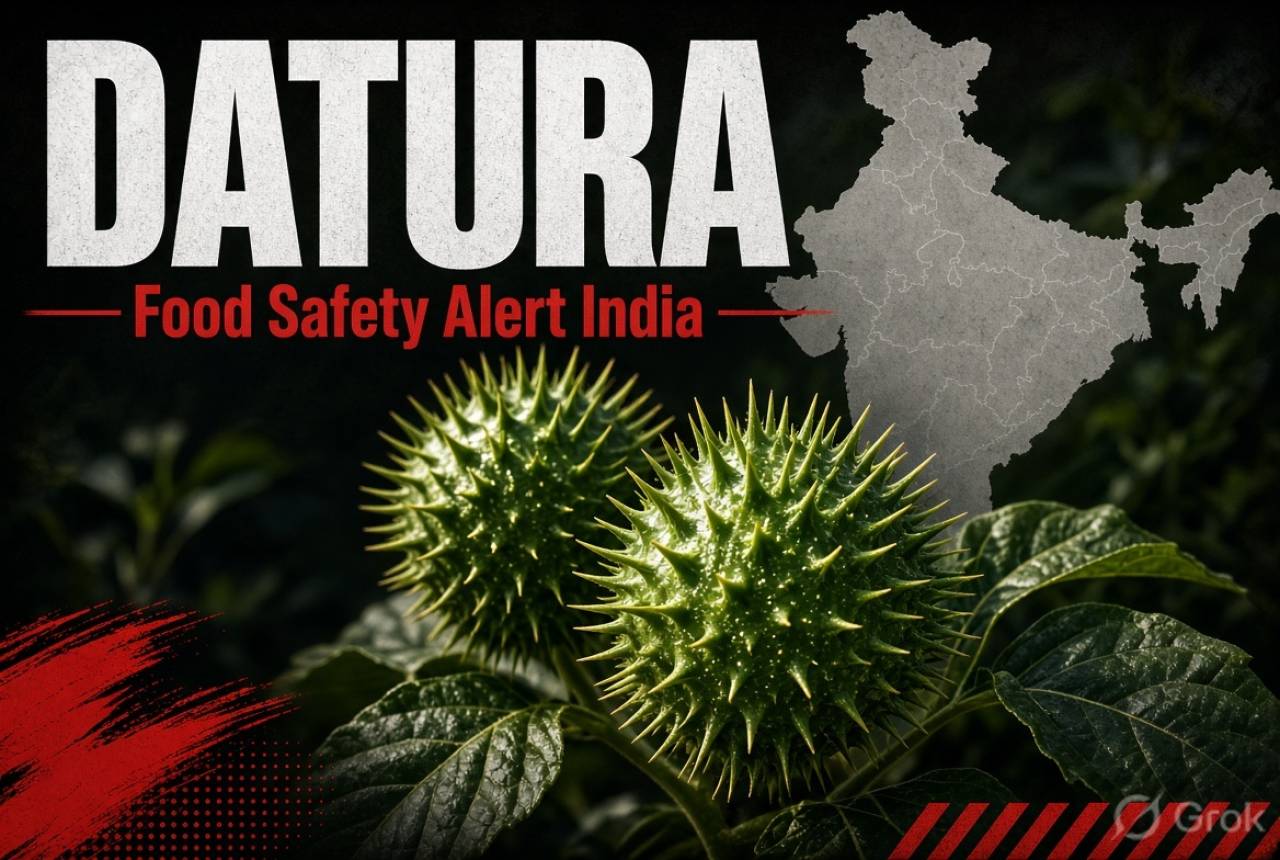
A plant revered in Shravan rituals is raising a serious food safety alarm after datura appeared online under the food category.
Karnataka food safety officials have acted against online sellers offering datura as a food item, raising fresh questions about how e-commerce platforms classify products that are culturally significant but potentially deadly when consumed.
Karnataka’s Food Safety and Drug Administration has suspended the licences of several online sellers found offering datura fruits and seeds under the food category, bringing the toxic plant under renewed scrutiny during the holy month of Shravan.
The action followed reports that platforms including Amazon, Instamart, BigBasket and Swiggy had listed datura products for sale without adequate warnings about their poisonous nature. The department has prohibited the sale of such products through the platforms and initiated proceedings under the Food Safety and Standards Act, 2006, against sellers found violating food safety rules.
A Plant Meant for Worship, Not Consumption
Datura occupies an important place in Hindu religious traditions, particularly during Shravan. Its flowers are traditionally offered to Lord Shiva and are commonly associated with rituals performed during the month.
But religious significance does not make the plant safe to eat.
Every part of the datura plant is toxic when ingested, with its seeds and fruits particularly associated with poisoning. The controversy appears to have arisen partly from the way these products were categorised and presented online.
Officials noted that placing datura under a general food category, rather than clearly identifying it as a ritual or non-edible item, could lead consumers to mistake it for an ordinary natural product.
That distinction matters because the word "natural" often creates an assumption of safety. Shalini Bliss, head of dietetics at PSRI Hospital, has warned that consumers can wrongly equate natural products with harmless ones, even though some naturally occurring substances can be highly toxic.
The Medical Risk
Doctors have also highlighted the potentially serious consequences of datura poisoning.
According to Dr Prateek Kadian, consultant medicine at Maccure Hospital, early symptoms can include dry mouth, blurred vision, dilated pupils, dizziness and a rapid heartbeat.
Severe poisoning can progress to confusion, agitation, hallucinations, seizures, loss of consciousness and dangerously high body temperature.
The rapid progression of symptoms makes accidental consumption particularly concerning. Medical experts stress that ingesting even a small quantity of a poisonous plant such as datura can pose a serious health risk.
Why the Online Listings Sparked Outrage
The episode quickly triggered criticism on social media, with users questioning how a plant widely recognised as poisonous could appear as a food product on major e-commerce and quick-commerce platforms.
Some argued that consumers should not bear the entire burden of identifying potentially dangerous products, particularly when the items are being presented through established digital marketplaces.
Others mocked the apparent labelling failure. One sarcastic comment questioned whether the supposedly edible product would also arrive with instructions to consume it the following day.
Behind the humour, however, lies a more serious concern.
Online marketplaces increasingly sell products that can have multiple identities. Datura is a clear example. It can be a legitimate religious offering while simultaneously being dangerous for human consumption.
That creates a responsibility for platforms to distinguish clearly between ritual-use products and food items, particularly when incorrect categorisation could have direct health consequences.
What Happens Next
The Karnataka action could lead to closer scrutiny of how e-commerce and quick-commerce platforms classify products that sit at the intersection of religion, culture and food safety.
The issue may also attract attention in other states, particularly during periods when demand for religious offerings increases.
The larger question is not whether datura has a place in Indian religious traditions. It does. The question is whether that cultural role should ever allow a poisonous plant to be presented to consumers as food.
As online platforms become increasingly central to the purchase of religious and festive products, accurate categorisation, prominent warnings and stronger product-level screening will become increasingly important.
For a plant revered in rituals but dangerous when swallowed, the distinction is simple. Datura belongs on the altar, not on the plate.
Karnataka food safety officials have acted against online sellers offering datura as a food item, raising fresh questions about how e-commerce platforms classify products that are culturally significant but potentially deadly when consumed.
Karnataka’s Food Safety and Drug Administration has suspended the licences of several online sellers found offering datura fruits and seeds under the food category, bringing the toxic plant under renewed scrutiny during the holy month of Shravan.
The action followed reports that platforms including Amazon, Instamart, BigBasket and Swiggy had listed datura products for sale without adequate warnings about their poisonous nature. The department has prohibited the sale of such products through the platforms and initiated proceedings under the Food Safety and Standards Act, 2006, against sellers found violating food safety rules.
A Plant Meant for Worship, Not Consumption
Datura occupies an important place in Hindu religious traditions, particularly during Shravan. Its flowers are traditionally offered to Lord Shiva and are commonly associated with rituals performed during the month.
But religious significance does not make the plant safe to eat.
Every part of the datura plant is toxic when ingested, with its seeds and fruits particularly associated with poisoning. The controversy appears to have arisen partly from the way these products were categorised and presented online.
Officials noted that placing datura under a general food category, rather than clearly identifying it as a ritual or non-edible item, could lead consumers to mistake it for an ordinary natural product.
That distinction matters because the word "natural" often creates an assumption of safety. Shalini Bliss, head of dietetics at PSRI Hospital, has warned that consumers can wrongly equate natural products with harmless ones, even though some naturally occurring substances can be highly toxic.
The Medical Risk
Doctors have also highlighted the potentially serious consequences of datura poisoning.
According to Dr Prateek Kadian, consultant medicine at Maccure Hospital, early symptoms can include dry mouth, blurred vision, dilated pupils, dizziness and a rapid heartbeat.
Severe poisoning can progress to confusion, agitation, hallucinations, seizures, loss of consciousness and dangerously high body temperature.
The rapid progression of symptoms makes accidental consumption particularly concerning. Medical experts stress that ingesting even a small quantity of a poisonous plant such as datura can pose a serious health risk.
Why the Online Listings Sparked Outrage
The episode quickly triggered criticism on social media, with users questioning how a plant widely recognised as poisonous could appear as a food product on major e-commerce and quick-commerce platforms.
Some argued that consumers should not bear the entire burden of identifying potentially dangerous products, particularly when the items are being presented through established digital marketplaces.
Others mocked the apparent labelling failure. One sarcastic comment questioned whether the supposedly edible product would also arrive with instructions to consume it the following day.
Behind the humour, however, lies a more serious concern.
Online marketplaces increasingly sell products that can have multiple identities. Datura is a clear example. It can be a legitimate religious offering while simultaneously being dangerous for human consumption.
That creates a responsibility for platforms to distinguish clearly between ritual-use products and food items, particularly when incorrect categorisation could have direct health consequences.
What Happens Next
The Karnataka action could lead to closer scrutiny of how e-commerce and quick-commerce platforms classify products that sit at the intersection of religion, culture and food safety.
The issue may also attract attention in other states, particularly during periods when demand for religious offerings increases.
The larger question is not whether datura has a place in Indian religious traditions. It does. The question is whether that cultural role should ever allow a poisonous plant to be presented to consumers as food.
As online platforms become increasingly central to the purchase of religious and festive products, accurate categorisation, prominent warnings and stronger product-level screening will become increasingly important.
For a plant revered in rituals but dangerous when swallowed, the distinction is simple. Datura belongs on the altar, not on the plate.


















Leave a Comment