
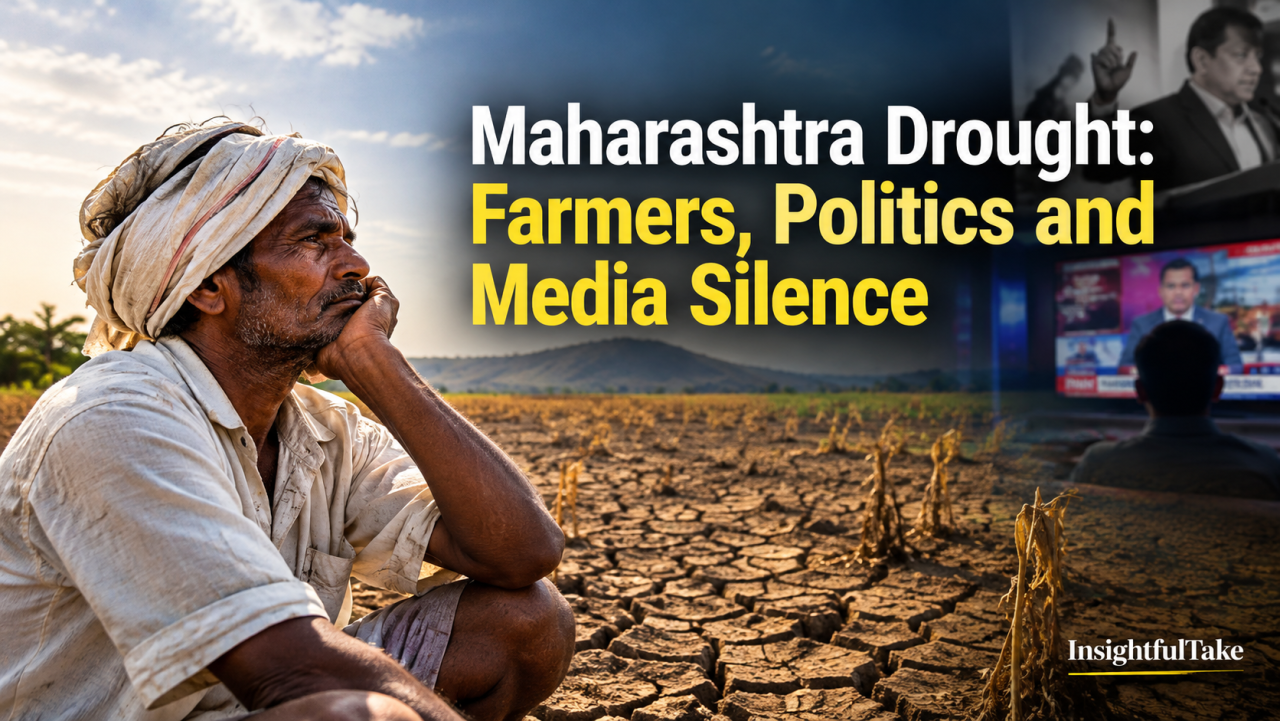
Rural distress rarely commands the same sustained attention as political battles in television studios. Maharashtra’s drought shows why agricultural crises deserve a much larger place in India’s public conversation.
A failed monsoon can destroy a farmer’s harvest in a few weeks. Recovering from that loss may take years. Yet the suffering of rural India often struggles to remain in the national headlines, competing with political confrontations, election calculations and the daily spectacle of television debates.
Maharashtra’s worsening drought is a reminder of what gets lost when the country pays attention to politics but overlooks the people whose livelihoods depend on the land.
The state government declared drought in 265 of Maharashtra’s 358 talukas in September 2026, after a significant rainfall deficit affected large parts of the state. The declaration brought relief measures into focus, including concessions on land revenue, agricultural loans and employment provisions. However, farmers also need timely assistance for crop losses, access to water and protection against mounting debt.
This is not simply a story about a bad monsoon. It is about the relationship between agriculture, public policy, political accountability and the media.
Agriculture Is Not a Marginal Story
There is a reason drought deserves national attention even when it affects only particular regions at a time. Agriculture remains central to the livelihoods of millions of Indian families.
According to the Economic Survey 2025-26, agriculture and allied activities account for 46.1 per cent of India’s workforce, although their contribution to national income is much smaller. The gap reflects a persistent problem: a very large share of workers depends on a sector that generates a relatively limited proportion of the country’s economic output.
When rainfall fails, the consequences travel far beyond the farm. Agricultural labourers lose work. Small businesses in villages see fewer customers. Families postpone purchases, borrow money and struggle to pay school fees. Livestock becomes harder to maintain as fodder and water become scarce.
A drought can therefore become a crisis of employment, education, nutrition and household debt.
For a farmer, a failed crop is not an abstract economic indicator. It can mean that money borrowed for seeds, fertilisers and irrigation has produced no income with which to repay the loan.
Maharashtra’s Warning From the Past
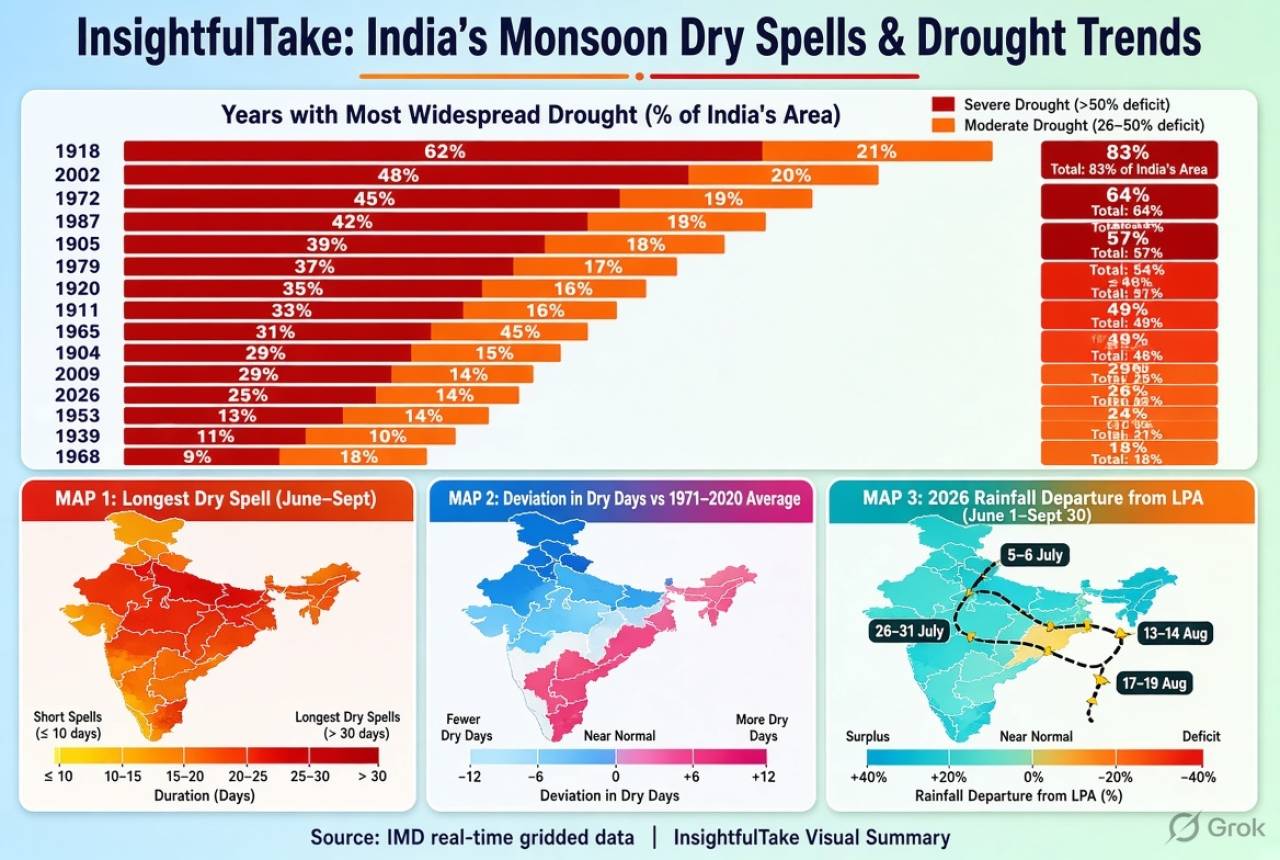
Maharashtra has faced severe droughts before. The crisis of 1972 remains an important reference point in the state’s agricultural history. The comparison with the present situation raises difficult questions about how much protection India has built against recurring water shortages.
The state has invested heavily in dams and irrigation infrastructure. Yet the share of its cropped area under irrigation remains limited. The drought analysis published by The Indian Express in October 2026 puts the figure at roughly 17 to 18 per cent. That leaves much of the cultivated area vulnerable to the timing and distribution of rainfall.
Building dams is important, but water security requires more than large infrastructure projects. It also depends on local water conservation, groundwater recharge, the condition of village ponds, efficient irrigation and decisions about which crops are suitable for a particular region.
Water-intensive cultivation in drought-prone areas deserves closer scrutiny. So does the unequal distribution of available water between different users and regions.
These are policy questions, not merely natural misfortunes. Rainfall cannot be controlled, but the damage caused by its absence can be reduced through better planning.
Relief Must Reach Farmers in Time
Declaring an area drought-affected is an important administrative step. It does not, by itself, restore a damaged crop or repay a farmer’s debt.
The effectiveness of relief depends on what happens next. Are crop-loss assessments completed quickly? Does compensation reach eligible farmers without unnecessary delays? Can families obtain drinking water and fodder? Are agricultural loans restructured before repayment pressure becomes unbearable? Is employment available to people who have lost work on farms?
These questions require public scrutiny.
Governments must explain not only what assistance has been announced but also how much has reached affected households, how long distribution has taken and which communities remain uncovered.
Political leaders should also be judged by their preparedness before a crisis. Water conservation, drought-resistant farming, crop diversification and reliable rural employment cannot be improvised after the monsoon has failed.
The Media Cannot Afford to Look Away
In a noisy democracy, the amount of attention a problem receives can influence how urgently it is addressed. Political controversies often generate immediate reactions, dramatic studio exchanges and repeated coverage. Rural distress is different. It demands field reporting, conversations with farmers, examination of government records and follow-up long after the first headline disappears.
This imbalance does not mean every newsroom ignores agriculture. Regional newspapers and independent reporters frequently document the hardships of rural communities. The problem is that such reporting does not always receive the same sustained national attention as political spectacle.
The consequences matter. When farmers’ experiences remain outside the main public conversation, questions about compensation, irrigation, crop insurance and rural employment receive less scrutiny. Citizens elsewhere in the country may not understand how closely food prices, agricultural incomes and rural demand are connected to their own lives.
A democracy needs more than coverage of who won a political contest. It also needs journalism that asks whether public money is solving public problems.
Rural India Deserves More Than Seasonal Sympathy
The test of governance is not how quickly leaders respond to a crisis on camera. It is whether institutions can reduce the damage, deliver assistance fairly and prepare communities for the next difficult season.
Maharashtra’s drought should therefore concern everyone, not only farmers in the affected districts. It exposes the limits of agricultural security and the cost of treating rural distress as a temporary news event.
India cannot claim inclusive progress while millions of livelihoods remain exposed to preventable water insecurity and inadequate support.
The next time a political controversy dominates the headlines, there is another story worth asking about: the farmer waiting for rain, the labourer searching for work and the family deciding which essential expense it can no longer afford.
Their struggles may not produce the loudest television debate. They deserve a place in the national conversation all the same.
A failed monsoon can destroy a farmer’s harvest in a few weeks. Recovering from that loss may take years. Yet the suffering of rural India often struggles to remain in the national headlines, competing with political confrontations, election calculations and the daily spectacle of television debates.
Maharashtra’s worsening drought is a reminder of what gets lost when the country pays attention to politics but overlooks the people whose livelihoods depend on the land.
The state government declared drought in 265 of Maharashtra’s 358 talukas in September 2026, after a significant rainfall deficit affected large parts of the state. The declaration brought relief measures into focus, including concessions on land revenue, agricultural loans and employment provisions. However, farmers also need timely assistance for crop losses, access to water and protection against mounting debt.
This is not simply a story about a bad monsoon. It is about the relationship between agriculture, public policy, political accountability and the media.
Agriculture Is Not a Marginal Story
There is a reason drought deserves national attention even when it affects only particular regions at a time. Agriculture remains central to the livelihoods of millions of Indian families.
According to the Economic Survey 2025-26, agriculture and allied activities account for 46.1 per cent of India’s workforce, although their contribution to national income is much smaller. The gap reflects a persistent problem: a very large share of workers depends on a sector that generates a relatively limited proportion of the country’s economic output.
When rainfall fails, the consequences travel far beyond the farm. Agricultural labourers lose work. Small businesses in villages see fewer customers. Families postpone purchases, borrow money and struggle to pay school fees. Livestock becomes harder to maintain as fodder and water become scarce.
A drought can therefore become a crisis of employment, education, nutrition and household debt.
For a farmer, a failed crop is not an abstract economic indicator. It can mean that money borrowed for seeds, fertilisers and irrigation has produced no income with which to repay the loan.
Maharashtra’s Warning From the Past
Maharashtra has faced severe droughts before. The crisis of 1972 remains an important reference point in the state’s agricultural history. The comparison with the present situation raises difficult questions about how much protection India has built against recurring water shortages.
The state has invested heavily in dams and irrigation infrastructure. Yet the share of its cropped area under irrigation remains limited. The drought analysis published by The Indian Express in October 2026 puts the figure at roughly 17 to 18 per cent. That leaves much of the cultivated area vulnerable to the timing and distribution of rainfall.
Building dams is important, but water security requires more than large infrastructure projects. It also depends on local water conservation, groundwater recharge, the condition of village ponds, efficient irrigation and decisions about which crops are suitable for a particular region.
Water-intensive cultivation in drought-prone areas deserves closer scrutiny. So does the unequal distribution of available water between different users and regions.
These are policy questions, not merely natural misfortunes. Rainfall cannot be controlled, but the damage caused by its absence can be reduced through better planning.
Relief Must Reach Farmers in Time
Declaring an area drought-affected is an important administrative step. It does not, by itself, restore a damaged crop or repay a farmer’s debt.
The effectiveness of relief depends on what happens next. Are crop-loss assessments completed quickly? Does compensation reach eligible farmers without unnecessary delays? Can families obtain drinking water and fodder? Are agricultural loans restructured before repayment pressure becomes unbearable? Is employment available to people who have lost work on farms?
These questions require public scrutiny.
Governments must explain not only what assistance has been announced but also how much has reached affected households, how long distribution has taken and which communities remain uncovered.
Political leaders should also be judged by their preparedness before a crisis. Water conservation, drought-resistant farming, crop diversification and reliable rural employment cannot be improvised after the monsoon has failed.
The Media Cannot Afford to Look Away
In a noisy democracy, the amount of attention a problem receives can influence how urgently it is addressed. Political controversies often generate immediate reactions, dramatic studio exchanges and repeated coverage. Rural distress is different. It demands field reporting, conversations with farmers, examination of government records and follow-up long after the first headline disappears.
This imbalance does not mean every newsroom ignores agriculture. Regional newspapers and independent reporters frequently document the hardships of rural communities. The problem is that such reporting does not always receive the same sustained national attention as political spectacle.
The consequences matter. When farmers’ experiences remain outside the main public conversation, questions about compensation, irrigation, crop insurance and rural employment receive less scrutiny. Citizens elsewhere in the country may not understand how closely food prices, agricultural incomes and rural demand are connected to their own lives.
A democracy needs more than coverage of who won a political contest. It also needs journalism that asks whether public money is solving public problems.
Rural India Deserves More Than Seasonal Sympathy
The test of governance is not how quickly leaders respond to a crisis on camera. It is whether institutions can reduce the damage, deliver assistance fairly and prepare communities for the next difficult season.
Maharashtra’s drought should therefore concern everyone, not only farmers in the affected districts. It exposes the limits of agricultural security and the cost of treating rural distress as a temporary news event.
India cannot claim inclusive progress while millions of livelihoods remain exposed to preventable water insecurity and inadequate support.
The next time a political controversy dominates the headlines, there is another story worth asking about: the farmer waiting for rain, the labourer searching for work and the family deciding which essential expense it can no longer afford.
Their struggles may not produce the loudest television debate. They deserve a place in the national conversation all the same.
















Leave a Comment