
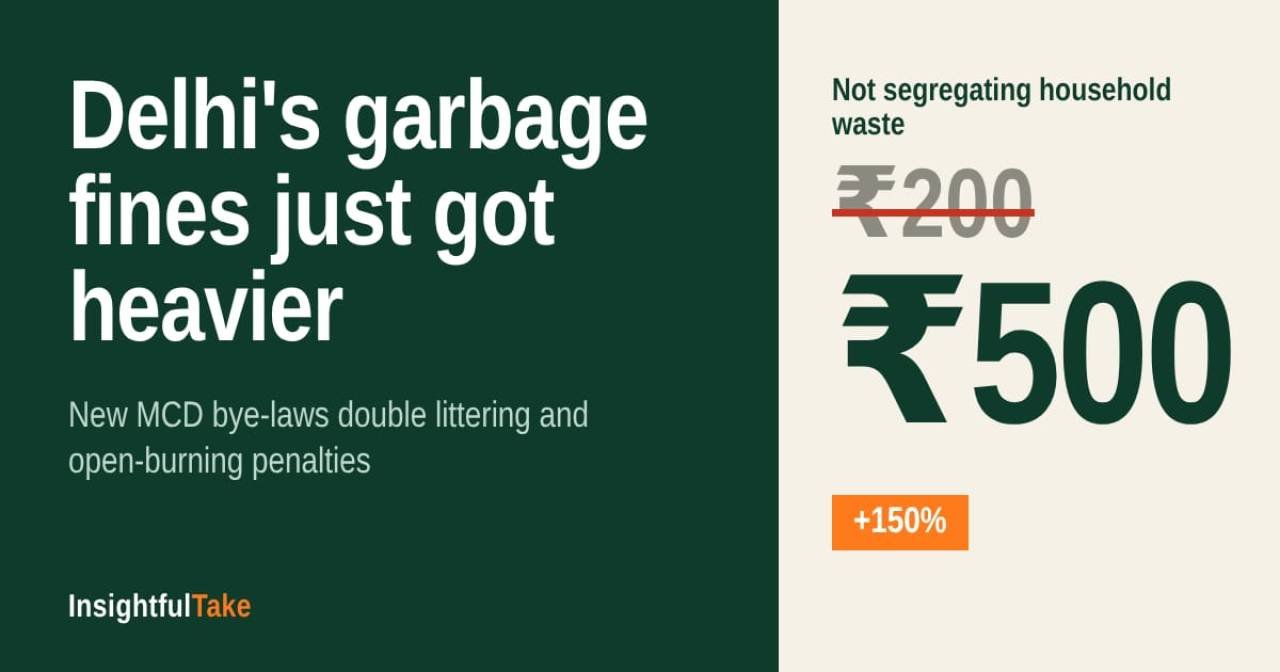
Delhi households could pay more than double the existing penalty for mixing wet and dry waste under the proposed Solid Waste Management Bye-Laws, 2026.
The new rules also raise fines for littering, open burning and improper disposal, while placing higher financial obligations on hotels, restaurants and bulk waste generators.
Mixing wet and dry garbage at home in Delhi could soon cost ₹500 instead of ₹200. The Municipal Corporation of Delhi's (MCD) standing committee has cleared the Solid Waste Management Bye-Laws, 2026, proposing a 150 per cent increase in the penalty for households that fail to segregate waste.
The revised penalties are scheduled to take effect from January 1, 2027, but the proposal must first receive approval from the MCD House.
The segregation penalty is likely to affect the largest number of residents, but the proposed changes extend well beyond household kitchens. Fines for littering and open burning will double, while hotels, restaurants, resident welfare associations (RWAs), commercial establishments and manufacturers will face higher penalties for violating waste management rules.
The standing committee approved the proposal on Thursday, marking another attempt by the civic body to improve waste collection, segregation and disposal across the capital.
Higher penalties for everyday violations
For ordinary households, four major changes stand out under the proposed bye-laws.
Violation
Existing fine
Proposed fine
Failure to segregate wet and dry waste
₹200
₹500
Littering
₹500
₹1,000
Open burning of waste
₹5,000
₹10,000
Dumping household construction and demolition waste
₹1,000
₹2,000
The penalty for improper disposal of sanitary and garden waste will also increase from ₹200 to ₹500.
The proposed rules introduce a ₹2,000 fine for property owners or occupants who fail to maintain cleanliness on their premises. Non-residential properties dumping construction debris will face a penalty of ₹10,000.
Goods vehicle drivers or owners caught littering will have to pay ₹5,000.
These provisions expand the financial responsibility of residents and property owners beyond simply separating household garbage.
Hotels, restaurants and RWAs face steeper fines
Commercial establishments and bulk waste generators will face substantially higher penalties, with several existing fines increasing by around 50 per cent.
Under the proposal, hotels violating waste management rules will pay ₹75,000 instead of ₹50,000. The penalty for restaurants will rise from ₹20,000 to ₹30,000.
RWAs and gated residential communities that fail to fulfil their waste management responsibilities will face a fine of ₹15,000, compared with the existing ₹10,000.
Organising an event involving more than 100 people at an unlicensed venue without informing the civic body or making arrangements for waste disposal will attract a ₹20,000 penalty, twice the earlier amount.
Bulk waste generators that fail to register with the authorities and meet their waste management obligations will face a new penalty of ₹50,000.
The proposed rules also target manufacturers and brand owners. Companies selling disposable products without a mechanism to collect back packaging waste will face a penalty of ₹1.5 lakh, up from ₹1 lakh.
The higher penalties indicate that the MCD intends to extend accountability across the waste management chain, including commercial establishments and businesses that generate large volumes of garbage.
Annual 5% increase will make penalties costlier
One of the most consequential provisions is the automatic annual revision of penalties.
Under the proposed bye-laws, every penalty will increase by 5 per cent on January 1 each year, without requiring fresh approval.
Repeat offenders could also face penalties calculated on a daily or monthly basis. The Delhi Pollution Control Committee may additionally impose environmental compensation in accordance with the applicable guidelines of the national pollution control authorities.
For households, this means the proposed ₹500 segregation fine will rise to ₹525 in the first annual revision and continue increasing in subsequent years.
The provision addresses a longstanding problem with municipal penalties. Fixed fines often lose their deterrent value over time as inflation reduces their financial impact. An automatic revision mechanism is intended to prevent that erosion.
Delhi's waste crisis behind the stricter rules
The proposed penalties come against the backdrop of Delhi's growing solid waste management challenge.
The capital generates approximately 11,800 tonnes of municipal solid waste every day, while its processing capacity stands at around 7,600 tonnes. The resulting gap of nearly 4,200 tonnes adds pressure on landfill sites, particularly Bhalswa and Ghazipur.
Poor segregation at the source makes the problem more difficult to manage. When wet waste gets mixed with plastic, paper and other dry materials, composting and recycling become more complicated. Such mixed garbage is more difficult to process and often ends up in landfills or waste-to-energy facilities.
Delhi has made progress in clearing accumulated waste from its legacy landfill sites. According to the state government, more than 217 lakh tonnes of old waste have been cleared from Okhla, Bhalswa and Ghazipur over approximately 18 months, freeing nearly 100 acres of land.
However, the continuing generation of fresh waste remains a major challenge. Clearing accumulated garbage from landfill sites will have limited long-term impact if thousands of tonnes of mixed waste continue to arrive every day.
Segregation at source remains one of the most practical ways to improve the system. Separating biodegradable waste from recyclable and non-recyclable material makes collection, transportation and processing more efficient.
The proposed fines are intended to make household segregation a civic obligation rather than a voluntary practice.
Enforcement remains the biggest concern
Higher penalties alone may not transform Delhi's waste management system. Their effectiveness will depend on whether the MCD can enforce the rules consistently across neighbourhoods and residential communities.
Atul Goyal, who heads URJA, an umbrella organisation representing resident welfare associations, has questioned the effectiveness of earlier enforcement efforts. According to him, penalties were often used to create fear, but actual implementation remained weak.
He has argued that notices for non-segregation are issued, but residents who resist compliance often escape meaningful action. He believes the civic body should concentrate on changing public behaviour and monitoring the private concessionaires responsible for garbage collection.
Goyal has also highlighted the lack of clarity over the accountability of RWAs. Delhi has approximately 6,000 registered RWAs, but there is no clear mechanism to determine which associations should be held responsible for specific waste management failures.
Cooperative group housing societies have established management structures, but RWAs in plotted residential colonies may not possess the legal authority to enforce segregation among individual households.
There is also a problem within the collection system itself. A household may separate wet and dry waste properly, only for a garbage collection vehicle to mix the two during transportation. In such cases, the responsibility cannot rest entirely with residents if the collection agency itself fails to maintain segregation.
This exposes a critical gap in the proposed enforcement approach. Citizens can be penalised for failing to segregate waste, but collection agencies must also be held accountable for preserving that segregation throughout the disposal process.
Without monitoring the entire chain, stricter household fines risk becoming a one-sided enforcement exercise.
Garbage user charges could trigger another dispute
The proposed bye-laws also revive the contentious issue of monthly garbage user charges, which has faced resistance in Delhi in the past.
Under the proposal, monthly charges for residential properties will vary according to property size and category.
For properties measuring up to 50 square yards, the proposed monthly charge will be ₹75 for categories A to D, compared with the existing ₹50. For categories E to H, the charge will be ₹40.
For properties measuring between 50 and 200 square metres, the proposed charges will be ₹150 and ₹75, respectively, across the two category groups.
Properties larger than 200 square metres will pay ₹300 in categories A to D and ₹150 in categories E to H. Street vendors will face a monthly charge of ₹150.
A senior municipal official has acknowledged that earlier attempts to collect these charges, including through their addition to property tax bills, faced opposition from the elected wing of the civic body.
The proposal still requires approval from the MCD House. The official expects the user fee provision to face resistance again.
The outcome will determine whether Delhi moves towards a more structured system of charging households and businesses for municipal waste services.
What Delhi residents should do before January 1
The proposed rules have not yet received final approval, but households can begin following the expected requirements without waiting for the new penalties.
Residents should maintain separate bins for wet and dry waste in their kitchens. Sanitary and garden waste should be handed over separately, while leaves and other rubbish should never be burned in the open.
Housing societies should also review their waste collection arrangements and ensure that segregation is maintained when garbage is handed over to collection agencies.
The MCD's proposed bye-laws seek to make residents, businesses, manufacturers and waste collection agencies more accountable for the garbage they generate and handle.
Delhi's waste crisis cannot be resolved through penalties alone. The civic body will also have to ensure reliable door-to-door collection, proper segregation during transportation, adequate processing capacity and transparent enforcement.
The real test of the 2026 bye-laws will be whether the stricter rules change how Delhi manages its daily waste, rather than simply increasing the cost of violating municipal regulations.
The new rules also raise fines for littering, open burning and improper disposal, while placing higher financial obligations on hotels, restaurants and bulk waste generators.
Mixing wet and dry garbage at home in Delhi could soon cost ₹500 instead of ₹200. The Municipal Corporation of Delhi's (MCD) standing committee has cleared the Solid Waste Management Bye-Laws, 2026, proposing a 150 per cent increase in the penalty for households that fail to segregate waste.
The revised penalties are scheduled to take effect from January 1, 2027, but the proposal must first receive approval from the MCD House.
The segregation penalty is likely to affect the largest number of residents, but the proposed changes extend well beyond household kitchens. Fines for littering and open burning will double, while hotels, restaurants, resident welfare associations (RWAs), commercial establishments and manufacturers will face higher penalties for violating waste management rules.
The standing committee approved the proposal on Thursday, marking another attempt by the civic body to improve waste collection, segregation and disposal across the capital.
Higher penalties for everyday violations
For ordinary households, four major changes stand out under the proposed bye-laws.
|
Violation |
Existing fine |
Proposed fine |
|
Failure to segregate wet and dry waste |
₹200 |
₹500 |
|
Littering |
₹500 |
₹1,000 |
|
Open burning of waste |
₹5,000 |
₹10,000 |
|
Dumping household construction and demolition waste |
₹1,000 |
₹2,000 |
The penalty for improper disposal of sanitary and garden waste will also increase from ₹200 to ₹500.
The proposed rules introduce a ₹2,000 fine for property owners or occupants who fail to maintain cleanliness on their premises. Non-residential properties dumping construction debris will face a penalty of ₹10,000.
Goods vehicle drivers or owners caught littering will have to pay ₹5,000.
These provisions expand the financial responsibility of residents and property owners beyond simply separating household garbage.
Hotels, restaurants and RWAs face steeper fines
Commercial establishments and bulk waste generators will face substantially higher penalties, with several existing fines increasing by around 50 per cent.
Under the proposal, hotels violating waste management rules will pay ₹75,000 instead of ₹50,000. The penalty for restaurants will rise from ₹20,000 to ₹30,000.
RWAs and gated residential communities that fail to fulfil their waste management responsibilities will face a fine of ₹15,000, compared with the existing ₹10,000.
Organising an event involving more than 100 people at an unlicensed venue without informing the civic body or making arrangements for waste disposal will attract a ₹20,000 penalty, twice the earlier amount.
Bulk waste generators that fail to register with the authorities and meet their waste management obligations will face a new penalty of ₹50,000.
The proposed rules also target manufacturers and brand owners. Companies selling disposable products without a mechanism to collect back packaging waste will face a penalty of ₹1.5 lakh, up from ₹1 lakh.
The higher penalties indicate that the MCD intends to extend accountability across the waste management chain, including commercial establishments and businesses that generate large volumes of garbage.
Annual 5% increase will make penalties costlier
One of the most consequential provisions is the automatic annual revision of penalties.
Under the proposed bye-laws, every penalty will increase by 5 per cent on January 1 each year, without requiring fresh approval.
Repeat offenders could also face penalties calculated on a daily or monthly basis. The Delhi Pollution Control Committee may additionally impose environmental compensation in accordance with the applicable guidelines of the national pollution control authorities.
For households, this means the proposed ₹500 segregation fine will rise to ₹525 in the first annual revision and continue increasing in subsequent years.
The provision addresses a longstanding problem with municipal penalties. Fixed fines often lose their deterrent value over time as inflation reduces their financial impact. An automatic revision mechanism is intended to prevent that erosion.
Delhi's waste crisis behind the stricter rules
The proposed penalties come against the backdrop of Delhi's growing solid waste management challenge.
The capital generates approximately 11,800 tonnes of municipal solid waste every day, while its processing capacity stands at around 7,600 tonnes. The resulting gap of nearly 4,200 tonnes adds pressure on landfill sites, particularly Bhalswa and Ghazipur.
Poor segregation at the source makes the problem more difficult to manage. When wet waste gets mixed with plastic, paper and other dry materials, composting and recycling become more complicated. Such mixed garbage is more difficult to process and often ends up in landfills or waste-to-energy facilities.
Delhi has made progress in clearing accumulated waste from its legacy landfill sites. According to the state government, more than 217 lakh tonnes of old waste have been cleared from Okhla, Bhalswa and Ghazipur over approximately 18 months, freeing nearly 100 acres of land.
However, the continuing generation of fresh waste remains a major challenge. Clearing accumulated garbage from landfill sites will have limited long-term impact if thousands of tonnes of mixed waste continue to arrive every day.
Segregation at source remains one of the most practical ways to improve the system. Separating biodegradable waste from recyclable and non-recyclable material makes collection, transportation and processing more efficient.
The proposed fines are intended to make household segregation a civic obligation rather than a voluntary practice.
Enforcement remains the biggest concern
Higher penalties alone may not transform Delhi's waste management system. Their effectiveness will depend on whether the MCD can enforce the rules consistently across neighbourhoods and residential communities.
Atul Goyal, who heads URJA, an umbrella organisation representing resident welfare associations, has questioned the effectiveness of earlier enforcement efforts. According to him, penalties were often used to create fear, but actual implementation remained weak.
He has argued that notices for non-segregation are issued, but residents who resist compliance often escape meaningful action. He believes the civic body should concentrate on changing public behaviour and monitoring the private concessionaires responsible for garbage collection.
Goyal has also highlighted the lack of clarity over the accountability of RWAs. Delhi has approximately 6,000 registered RWAs, but there is no clear mechanism to determine which associations should be held responsible for specific waste management failures.
Cooperative group housing societies have established management structures, but RWAs in plotted residential colonies may not possess the legal authority to enforce segregation among individual households.
There is also a problem within the collection system itself. A household may separate wet and dry waste properly, only for a garbage collection vehicle to mix the two during transportation. In such cases, the responsibility cannot rest entirely with residents if the collection agency itself fails to maintain segregation.
This exposes a critical gap in the proposed enforcement approach. Citizens can be penalised for failing to segregate waste, but collection agencies must also be held accountable for preserving that segregation throughout the disposal process.
Without monitoring the entire chain, stricter household fines risk becoming a one-sided enforcement exercise.
Garbage user charges could trigger another dispute
The proposed bye-laws also revive the contentious issue of monthly garbage user charges, which has faced resistance in Delhi in the past.
Under the proposal, monthly charges for residential properties will vary according to property size and category.
For properties measuring up to 50 square yards, the proposed monthly charge will be ₹75 for categories A to D, compared with the existing ₹50. For categories E to H, the charge will be ₹40.
For properties measuring between 50 and 200 square metres, the proposed charges will be ₹150 and ₹75, respectively, across the two category groups.
Properties larger than 200 square metres will pay ₹300 in categories A to D and ₹150 in categories E to H. Street vendors will face a monthly charge of ₹150.
A senior municipal official has acknowledged that earlier attempts to collect these charges, including through their addition to property tax bills, faced opposition from the elected wing of the civic body.
The proposal still requires approval from the MCD House. The official expects the user fee provision to face resistance again.
The outcome will determine whether Delhi moves towards a more structured system of charging households and businesses for municipal waste services.
What Delhi residents should do before January 1
The proposed rules have not yet received final approval, but households can begin following the expected requirements without waiting for the new penalties.
Residents should maintain separate bins for wet and dry waste in their kitchens. Sanitary and garden waste should be handed over separately, while leaves and other rubbish should never be burned in the open.
Housing societies should also review their waste collection arrangements and ensure that segregation is maintained when garbage is handed over to collection agencies.
The MCD's proposed bye-laws seek to make residents, businesses, manufacturers and waste collection agencies more accountable for the garbage they generate and handle.
Delhi's waste crisis cannot be resolved through penalties alone. The civic body will also have to ensure reliable door-to-door collection, proper segregation during transportation, adequate processing capacity and transparent enforcement.
The real test of the 2026 bye-laws will be whether the stricter rules change how Delhi manages its daily waste, rather than simply increasing the cost of violating municipal regulations.




















Leave a Comment