
She had no running shoes, no professional training and no athletic gear. Ramabai Ranveer had something stronger, a mother’s determination to secure a better future for her daughters.
In the dusty lanes of Ambajogai in Maharashtra’s Beed district, a quiet act of maternal determination has captured national attention.
Ramabai Ranveer, a 47-year-old cook and sole breadwinner from the Marathwada region, entered a local running event with a simple goal. She wanted to win the prize money to help pay for her daughters’ education.
She did. Ramabai won ₹3,000 after completing a roughly three-kilometre race barefoot, still wearing her everyday saree.
The event, known as the Amrut Daud or Amrit Daud, was organised in late August 2026 by the Bharatiya Shikshan Prasarak Sanstha to mark the 75th anniversary of its Kholeshwar educational complex. The race was held in Ambajogai, with the route running from Chhatrapati Shivaji Maharaj Chowk towards Bhagyanagar Chowk.
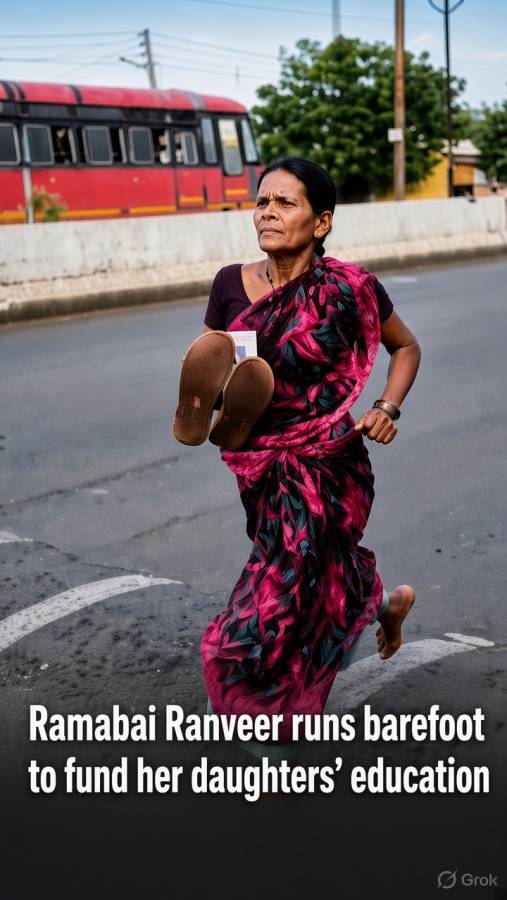
Among younger participants dressed in sportswear and running shoes, Ramabai stood out. She arrived in a simple saree and initially began the race wearing slippers. But when the slippers started slipping on the damp and uneven road, she took them off, held them in her hand and continued running barefoot.
She did not stop.
Managing her saree as she ran over cold asphalt and stones, Ramabai pushed ahead and crossed the finish line first in her category.
A video of her run, showing her saree fluttering as she held her slippers in one hand and ran with determination, quickly spread online. The images struck a chord with people across the country.
A Life Built on Quiet Resolve
Ramabai’s race was only the latest chapter in a life shaped by hardship and responsibility.
Originally from Potra, also reported as Pothra, village in Hingoli district, she moved to Ambajogai after her husband died in an accident in Mumbai more than a decade ago, around 2012.
Left to raise two daughters on her own, she worked as a daily-wage labourer and later found employment as a cook.
Today, she prepares meals at Dnyandeep Academy and related institutions in Ambajogai. Her work can involve making hundreds of chapatis. The income is modest, but it helps keep her family going and supports her daughters’ education.
Her elder daughter, Pooja, is around 22 and preparing for police recruitment examinations at the academy. Because of the family’s financial circumstances, her fees were reportedly waived or reduced. Ramabai also found work there as a cook.
Her younger daughter, Aarti, around 20, is pursuing a B.Sc. degree in Nanded. She hopes to appear for competitive examinations, including those conducted by the Maharashtra Public Service Commission, as well as banking examinations.
For Ramabai, supporting both daughters has meant constantly balancing food, books, travel, accommodation and other expenses.
There is little room for financial comfort.
But there is a clear priority.
Her daughters must study.
She Was Running for More Than a Prize
Ramabai has described her participation in the race as another way of running for her children’s future.
When she heard about the event and its prize money, she decided to participate. Her motivation was not fame or fitness. She simply wanted to win.
“I wanted to win; that is all I had on my mind,” she told the media. She said the prize money would be used to buy books and meet other educational needs of her children.
According to reports, her younger daughter had asked for books that Ramabai could not immediately afford. The possibility of winning prize money gave her a chance to meet that need.
For a family living on a modest income, ₹3,000 may seem small.
For Ramabai, it represented books, expenses and one more step towards keeping her daughters on the path they had chosen.
Her Daughter Ran Beside Her
Ramabai was not the only member of her family to take part in the race.
Her elder daughter, Pooja, also participated and finished second in her younger age category, winning additional prize money.
The achievement made the event even more meaningful for the family. Mother and daughter returned from the race with prize money that could be put towards education.
Pooja has described her mother as someone who never gives up. That determination, she said, has influenced her own approach to life.
More Than a Race
What happened in Ambajogai was technically a running event. But for Ramabai, it was something much bigger.
Organisers and spectators were surprised to see the unassuming cook in a saree running alongside younger participants in sports clothing. Her lack of professional equipment did not appear to matter once the race began.
There was no elaborate training programme.
No expensive running shoes.
No athletic gear.
There was simply a woman who knew exactly why she was running.
Her story has also drawn wider attention to the struggles faced by single mothers in rural and semi-urban India. For many such women, providing food and shelter is only one part of the struggle. Keeping their children in school and helping them build independent lives can require years of sacrifice.
Reports have also indicated that Maharashtra government representatives promised support after her story gained attention.
A Finish Line That Meant Something Else
Ramabai’s victory was not built on formal athletic training. It was built over years of physical labour, financial pressure and personal loss.
She ran in the clothes she wears every day.
When her slippers became a problem, she carried them in her hand.
And when the road became difficult, she kept going.
The ₹3,000 prize may have been the official reward for finishing first. But the real significance of her victory lies elsewhere.
She was running for books.
She was running for opportunity.
She was running for her daughters’ future.
And barefoot on an ordinary road in Ambajogai, a 47-year-old mother showed that sometimes the strongest competitors are not the ones who arrive with the best equipment, but the ones who have the strongest reason to reach the finish line.
In the dusty lanes of Ambajogai in Maharashtra’s Beed district, a quiet act of maternal determination has captured national attention.
Ramabai Ranveer, a 47-year-old cook and sole breadwinner from the Marathwada region, entered a local running event with a simple goal. She wanted to win the prize money to help pay for her daughters’ education.
She did. Ramabai won ₹3,000 after completing a roughly three-kilometre race barefoot, still wearing her everyday saree.
The event, known as the Amrut Daud or Amrit Daud, was organised in late August 2026 by the Bharatiya Shikshan Prasarak Sanstha to mark the 75th anniversary of its Kholeshwar educational complex. The race was held in Ambajogai, with the route running from Chhatrapati Shivaji Maharaj Chowk towards Bhagyanagar Chowk.
Among younger participants dressed in sportswear and running shoes, Ramabai stood out. She arrived in a simple saree and initially began the race wearing slippers. But when the slippers started slipping on the damp and uneven road, she took them off, held them in her hand and continued running barefoot.
She did not stop.
Managing her saree as she ran over cold asphalt and stones, Ramabai pushed ahead and crossed the finish line first in her category.
A video of her run, showing her saree fluttering as she held her slippers in one hand and ran with determination, quickly spread online. The images struck a chord with people across the country.
A Life Built on Quiet Resolve
Ramabai’s race was only the latest chapter in a life shaped by hardship and responsibility.
Originally from Potra, also reported as Pothra, village in Hingoli district, she moved to Ambajogai after her husband died in an accident in Mumbai more than a decade ago, around 2012.
Left to raise two daughters on her own, she worked as a daily-wage labourer and later found employment as a cook.
Today, she prepares meals at Dnyandeep Academy and related institutions in Ambajogai. Her work can involve making hundreds of chapatis. The income is modest, but it helps keep her family going and supports her daughters’ education.
Her elder daughter, Pooja, is around 22 and preparing for police recruitment examinations at the academy. Because of the family’s financial circumstances, her fees were reportedly waived or reduced. Ramabai also found work there as a cook.
Her younger daughter, Aarti, around 20, is pursuing a B.Sc. degree in Nanded. She hopes to appear for competitive examinations, including those conducted by the Maharashtra Public Service Commission, as well as banking examinations.
For Ramabai, supporting both daughters has meant constantly balancing food, books, travel, accommodation and other expenses.
There is little room for financial comfort.
But there is a clear priority.
Her daughters must study.
She Was Running for More Than a Prize
Ramabai has described her participation in the race as another way of running for her children’s future.
When she heard about the event and its prize money, she decided to participate. Her motivation was not fame or fitness. She simply wanted to win.
“I wanted to win; that is all I had on my mind,” she told the media. She said the prize money would be used to buy books and meet other educational needs of her children.
According to reports, her younger daughter had asked for books that Ramabai could not immediately afford. The possibility of winning prize money gave her a chance to meet that need.
For a family living on a modest income, ₹3,000 may seem small.
For Ramabai, it represented books, expenses and one more step towards keeping her daughters on the path they had chosen.
Her Daughter Ran Beside Her
Ramabai was not the only member of her family to take part in the race.
Her elder daughter, Pooja, also participated and finished second in her younger age category, winning additional prize money.
The achievement made the event even more meaningful for the family. Mother and daughter returned from the race with prize money that could be put towards education.
Pooja has described her mother as someone who never gives up. That determination, she said, has influenced her own approach to life.
More Than a Race
What happened in Ambajogai was technically a running event. But for Ramabai, it was something much bigger.
Organisers and spectators were surprised to see the unassuming cook in a saree running alongside younger participants in sports clothing. Her lack of professional equipment did not appear to matter once the race began.
There was no elaborate training programme.
No expensive running shoes.
No athletic gear.
There was simply a woman who knew exactly why she was running.
Her story has also drawn wider attention to the struggles faced by single mothers in rural and semi-urban India. For many such women, providing food and shelter is only one part of the struggle. Keeping their children in school and helping them build independent lives can require years of sacrifice.
Reports have also indicated that Maharashtra government representatives promised support after her story gained attention.
A Finish Line That Meant Something Else
Ramabai’s victory was not built on formal athletic training. It was built over years of physical labour, financial pressure and personal loss.
She ran in the clothes she wears every day.
When her slippers became a problem, she carried them in her hand.
And when the road became difficult, she kept going.
The ₹3,000 prize may have been the official reward for finishing first. But the real significance of her victory lies elsewhere.
She was running for books.
She was running for opportunity.
She was running for her daughters’ future.
And barefoot on an ordinary road in Ambajogai, a 47-year-old mother showed that sometimes the strongest competitors are not the ones who arrive with the best equipment, but the ones who have the strongest reason to reach the finish line.





















Leave a Comment