
India’s economy grew 8.2%, but the IMF gave its GDP data a ‘C’ grade. The reason is more technical than the headline suggests.
India’s economy grew 8.2 percent in the July to September quarter of 2025-26, the fastest pace in six quarters, according to the estimate released at the time under the old 2011-12 base year. The figure was later revised to 8.4 percent after the new GDP series took effect in February 2026.
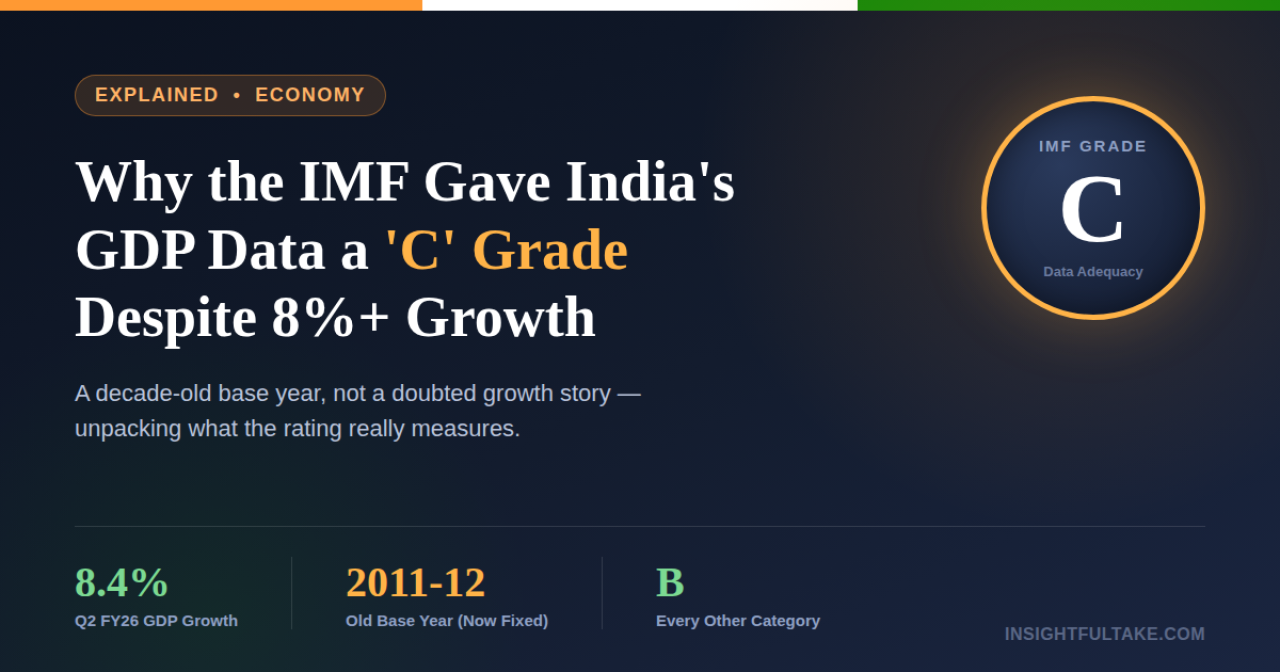
Just days earlier, the International Monetary Fund had given India’s national accounts statistics a ‘C’ grade in its annual Article IV report. It was the second-lowest rating on a four-tier scale ranging from A to D.
The timing created an obvious question. How could India report strong economic growth while its statistical system received a relatively poor assessment from the IMF?
The answer lies in understanding what the IMF actually graded. It did not judge whether India’s economy was really growing at 8.2 percent. It assessed the quality and adequacy of the statistical system used to produce the numbers.
What the IMF Actually Assessed
The ‘C’ grade comes from the IMF’s Data Adequacy Assessment, a regular exercise that examines the statistical framework used by countries to produce economic data.
The assessment looks at several factors, including the age of the base year, the transparency of revisions, the consistency between production and expenditure estimates, and the timeliness of data releases.
In simple terms, it is an assessment of the machinery behind the numbers, not a verdict on the numbers themselves.
India’s national accounts, which include GDP, Gross Value Added and related measures, received a ‘C’. According to the IMF, this indicated that the data had "some shortcomings that somewhat hamper surveillance."
Other major statistical areas received better ratings. Consumer Price Index data, external sector statistics, monetary and financial statistics, government finance statistics and inter-sectoral consistency were rated ‘B’.
This distinction is important. The IMF did not give India’s entire statistical system a ‘C’. The concern was concentrated largely in the national accounts framework.
The Base Year Problem
The biggest issue was the age of India’s GDP base year.
For years, India’s GDP calculations had been based on 2011-12. A base year provides the reference point for assigning weights to different parts of the economy.
But the Indian economy has changed considerably since 2011-12. Digital services have expanded, the gig economy has grown, financial and business services have become more important, and patterns of production and consumption have shifted.
An old base year can therefore make it harder for national accounts to accurately reflect the structure of the economy today.
Finance Minister Nirmala Sitharaman also linked the ‘C’ rating primarily to the outdated base year, noting that India had received ‘B’ ratings in other areas of its statistical system.
The government has since addressed the issue.
On February 27, 2026, the Ministry of Statistics and Programme Implementation introduced a new GDP series with 2022-23 as its base year, replacing the earlier 2011-12 base.
The new series also brought a revised Consumer Price Index into the statistical framework.
Under the new methodology, full-year GDP growth for 2025-26 was estimated at 7.6 percent. The July to September quarter growth figure was also revised from the earlier 8.2 percent to 8.4 percent.
Other Concerns Raised by the IMF
The base year was not the only issue.
The IMF also pointed to India’s continued use of single deflation methods in parts of the economy, rather than the double deflation approach used by many advanced statistical systems.
The Fund also noted differences between production-side and expenditure-side estimates and delays in updated Census data, which can affect demographic weights used in economic calculations.
These are technical issues, but they matter because national accounts are ultimately only as reliable as the methods and information used to construct them.
The assessment is also not necessarily permanent. The IMF’s data adequacy framework is reviewed over time, and officials have indicated that India’s rating could be reconsidered following the introduction of the new GDP series.
Why the Two Stories Are Not in Conflict
The apparent contradiction between an 8.2 percent growth rate and a ‘C’ grade largely disappears once measurement is separated from methodology.
A country can produce a credible estimate of the direction and pace of economic activity while still having statistical systems that require improvement.
Critics of India’s growth figures, including Congress leader Jairam Ramesh, have argued that strong GDP numbers should be viewed with caution. They have pointed to factors such as weak private investment and concerns about Gross Fixed Capital Formation as evidence that headline growth may not fully capture conditions on the ground.
That is a legitimate economic debate.
But it is different from the IMF’s data adequacy assessment.
The IMF was not saying that India’s 8.2 percent growth figure was fabricated. It was saying that some aspects of the statistical framework used to produce national accounts had shortcomings that affected the quality of economic surveillance.
Those two statements can exist at the same time.
India’s Statistical Rating Has Changed Over Time
India’s data assessment has also evolved over the years.
The country’s statistical framework was described as "adequate for surveillance" in 2016. The assessment later moved toward "broadly adequate" and has been rated ‘C’ in recent Article IV assessments.
Part of this change reflects developments in India’s statistical practices. But it also reflects changes in the IMF’s own assessment framework.
As the Fund has strengthened and formalised its data adequacy methodology, countries have faced more detailed scrutiny of their statistical systems.
India is therefore not the only major economy facing questions about the quality, timeliness and comparability of economic data.
The Fix Has Already Begun
The concerns raised by the IMF should not simply be dismissed as a technicality.
A base year that is more than a decade old can struggle to represent a rapidly changing economy. Modernising the national accounts system was therefore necessary.
India has now moved to a 2022-23 base year and introduced a new GDP series. The government has also adopted a stricter Advance Release Calendar aimed at improving the predictability and discipline of statistical releases.
The next question is whether these changes will be enough to improve India’s assessment in the IMF’s future reviews.
What the ‘C’ Grade Really Means
The IMF’s ‘C’ rating should neither be dismissed nor exaggerated.
It is not a finding that India’s GDP growth numbers are fake. Nor does it mean that India’s entire statistical system is unreliable.
It is a warning that parts of the national accounts framework needed modernisation.
That process has already begun.
For readers trying to make sense of economic headlines, the distinction matters. A statistical system can have weaknesses without making every number it produces meaningless. At the same time, strong growth figures should always be examined alongside investment, employment, consumption, productivity and other economic indicators.
The real lesson from the IMF’s assessment is therefore less dramatic than the headline suggests.
India’s growth story and the quality of its statistical infrastructure are two related but separate questions. One measures what the economy is doing. The other asks how confidently we can measure it.
India’s economy grew 8.2 percent in the July to September quarter of 2025-26, the fastest pace in six quarters, according to the estimate released at the time under the old 2011-12 base year. The figure was later revised to 8.4 percent after the new GDP series took effect in February 2026.
Just days earlier, the International Monetary Fund had given India’s national accounts statistics a ‘C’ grade in its annual Article IV report. It was the second-lowest rating on a four-tier scale ranging from A to D.
The timing created an obvious question. How could India report strong economic growth while its statistical system received a relatively poor assessment from the IMF?
The answer lies in understanding what the IMF actually graded. It did not judge whether India’s economy was really growing at 8.2 percent. It assessed the quality and adequacy of the statistical system used to produce the numbers.
What the IMF Actually Assessed
The ‘C’ grade comes from the IMF’s Data Adequacy Assessment, a regular exercise that examines the statistical framework used by countries to produce economic data.
The assessment looks at several factors, including the age of the base year, the transparency of revisions, the consistency between production and expenditure estimates, and the timeliness of data releases.
In simple terms, it is an assessment of the machinery behind the numbers, not a verdict on the numbers themselves.
India’s national accounts, which include GDP, Gross Value Added and related measures, received a ‘C’. According to the IMF, this indicated that the data had "some shortcomings that somewhat hamper surveillance."
Other major statistical areas received better ratings. Consumer Price Index data, external sector statistics, monetary and financial statistics, government finance statistics and inter-sectoral consistency were rated ‘B’.
This distinction is important. The IMF did not give India’s entire statistical system a ‘C’. The concern was concentrated largely in the national accounts framework.
The Base Year Problem
The biggest issue was the age of India’s GDP base year.
For years, India’s GDP calculations had been based on 2011-12. A base year provides the reference point for assigning weights to different parts of the economy.
But the Indian economy has changed considerably since 2011-12. Digital services have expanded, the gig economy has grown, financial and business services have become more important, and patterns of production and consumption have shifted.
An old base year can therefore make it harder for national accounts to accurately reflect the structure of the economy today.
Finance Minister Nirmala Sitharaman also linked the ‘C’ rating primarily to the outdated base year, noting that India had received ‘B’ ratings in other areas of its statistical system.
The government has since addressed the issue.
On February 27, 2026, the Ministry of Statistics and Programme Implementation introduced a new GDP series with 2022-23 as its base year, replacing the earlier 2011-12 base.
The new series also brought a revised Consumer Price Index into the statistical framework.
Under the new methodology, full-year GDP growth for 2025-26 was estimated at 7.6 percent. The July to September quarter growth figure was also revised from the earlier 8.2 percent to 8.4 percent.
Other Concerns Raised by the IMF
The base year was not the only issue.
The IMF also pointed to India’s continued use of single deflation methods in parts of the economy, rather than the double deflation approach used by many advanced statistical systems.
The Fund also noted differences between production-side and expenditure-side estimates and delays in updated Census data, which can affect demographic weights used in economic calculations.
These are technical issues, but they matter because national accounts are ultimately only as reliable as the methods and information used to construct them.
The assessment is also not necessarily permanent. The IMF’s data adequacy framework is reviewed over time, and officials have indicated that India’s rating could be reconsidered following the introduction of the new GDP series.
Why the Two Stories Are Not in Conflict
The apparent contradiction between an 8.2 percent growth rate and a ‘C’ grade largely disappears once measurement is separated from methodology.
A country can produce a credible estimate of the direction and pace of economic activity while still having statistical systems that require improvement.
Critics of India’s growth figures, including Congress leader Jairam Ramesh, have argued that strong GDP numbers should be viewed with caution. They have pointed to factors such as weak private investment and concerns about Gross Fixed Capital Formation as evidence that headline growth may not fully capture conditions on the ground.
That is a legitimate economic debate.
But it is different from the IMF’s data adequacy assessment.
The IMF was not saying that India’s 8.2 percent growth figure was fabricated. It was saying that some aspects of the statistical framework used to produce national accounts had shortcomings that affected the quality of economic surveillance.
Those two statements can exist at the same time.
India’s Statistical Rating Has Changed Over Time
India’s data assessment has also evolved over the years.
The country’s statistical framework was described as "adequate for surveillance" in 2016. The assessment later moved toward "broadly adequate" and has been rated ‘C’ in recent Article IV assessments.
Part of this change reflects developments in India’s statistical practices. But it also reflects changes in the IMF’s own assessment framework.
As the Fund has strengthened and formalised its data adequacy methodology, countries have faced more detailed scrutiny of their statistical systems.
India is therefore not the only major economy facing questions about the quality, timeliness and comparability of economic data.
The Fix Has Already Begun
The concerns raised by the IMF should not simply be dismissed as a technicality.
A base year that is more than a decade old can struggle to represent a rapidly changing economy. Modernising the national accounts system was therefore necessary.
India has now moved to a 2022-23 base year and introduced a new GDP series. The government has also adopted a stricter Advance Release Calendar aimed at improving the predictability and discipline of statistical releases.
The next question is whether these changes will be enough to improve India’s assessment in the IMF’s future reviews.
What the ‘C’ Grade Really Means
The IMF’s ‘C’ rating should neither be dismissed nor exaggerated.
It is not a finding that India’s GDP growth numbers are fake. Nor does it mean that India’s entire statistical system is unreliable.
It is a warning that parts of the national accounts framework needed modernisation.
That process has already begun.
For readers trying to make sense of economic headlines, the distinction matters. A statistical system can have weaknesses without making every number it produces meaningless. At the same time, strong growth figures should always be examined alongside investment, employment, consumption, productivity and other economic indicators.
The real lesson from the IMF’s assessment is therefore less dramatic than the headline suggests.
India’s growth story and the quality of its statistical infrastructure are two related but separate questions. One measures what the economy is doing. The other asks how confidently we can measure it.























Leave a Comment