
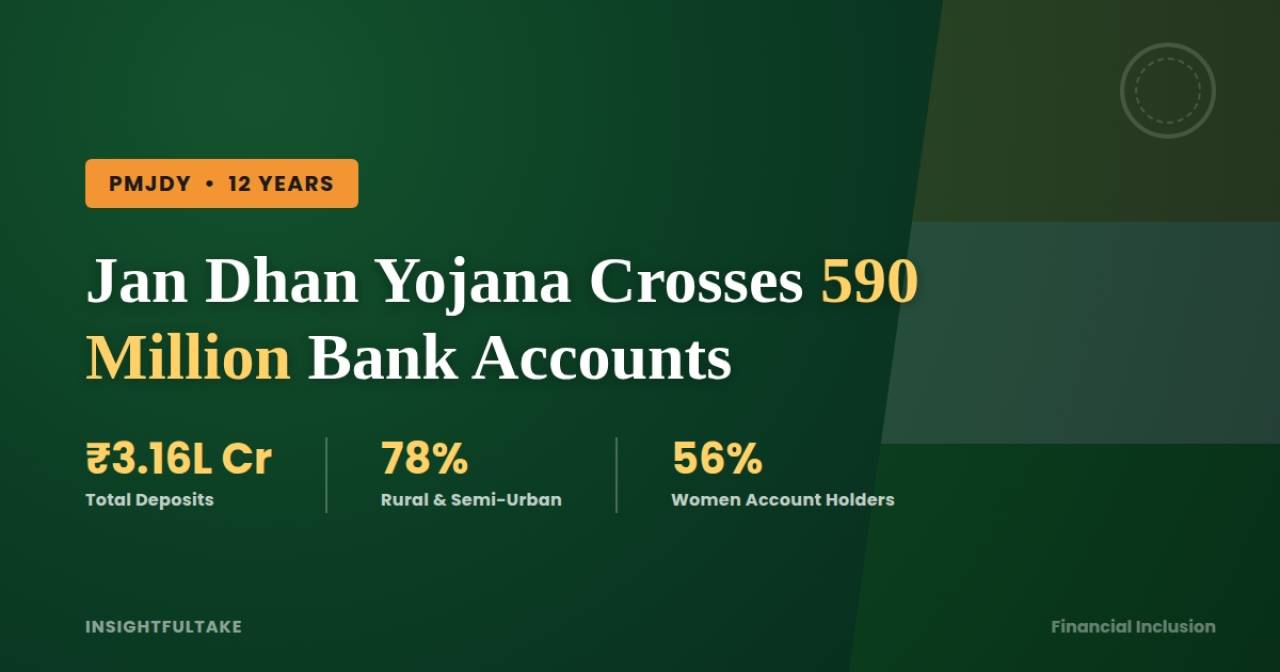
The Pradhan Mantri Jan Dhan Yojana has crossed 590 million accounts, with deposits reaching ₹3.16 lakh crore, highlighting the scale of India’s financial inclusion drive.
Prime Minister Narendra Modi on Friday praised the Pradhan Mantri Jan Dhan Yojana (PMJDY) as its total number of bank accounts crossed the 590 million mark in its twelfth year.
Calling the scheme’s impact “unparalleled,” Modi highlighted its scale and role in expanding access to formal banking across India. According to the latest government data, deposits in Jan Dhan accounts have reached ₹3.16 lakh crore.
Launched on August 28, 2014, PMJDY was designed to bring unbanked people into the formal financial system by making basic banking services accessible without the traditional barriers associated with opening and maintaining an account.
Reaching Rural and Semi-Urban India
The geographical reach of the scheme is one of its most significant features.
Government data shows that around 78 percent of Jan Dhan accounts are held by people in rural and semi-urban areas. These communities have historically faced greater barriers to formal banking, particularly because of distance from bank branches, limited financial infrastructure and low access to conventional banking services.
For many households, the absence of formal banking meant depending on cash transactions or informal sources of credit. A bank account, therefore, represents more than a place to keep money. It provides a gateway to savings, payments, government benefits and other financial services.
Women account for approximately 56 percent of Jan Dhan account holders, another important indicator of the scheme's reach.
Access to an account in a woman's own name can strengthen her ability to receive government transfers directly and participate more independently in household financial decisions.
What Does Jan Dhan Yojana Offer?
At its core, PMJDY was created to provide basic banking access to unbanked adults.
One of its key features is the availability of basic savings bank accounts without a mandatory minimum balance. This was aimed at removing a major obstacle for low-income households that could find it difficult to maintain conventional bank-account requirements.
Eligible account holders are also provided with a RuPay debit card, along with an accident insurance cover subject to the applicable scheme conditions.
The wider significance of the account, however, extends beyond the debit card.
For millions of first-time banking customers, Jan Dhan accounts have provided an entry point into ATMs, electronic payments, mobile banking and other formal financial services. As India's digital payments ecosystem has expanded, these accounts have increasingly connected previously underserved households to the broader financial system.
Government Hails the Transformation
Union Finance Minister Nirmala Sitharaman has also highlighted PMJDY's role in expanding banking access, describing the transformation as a move from “banking the few to banking for all.”
The Finance Ministry has linked the rising deposits in Jan Dhan accounts to deeper participation in formal banking.
The growth in deposits is important because opening an account is only the first step toward financial inclusion. An account that is actively used for saving, receiving payments and making transactions has considerably greater economic value than one that remains dormant.
The increase in deposits therefore offers an indication that at least a substantial share of account holders are engaging with the formal financial system beyond simply holding an account.
Why 590 Million Accounts Matter
For a country as large and diverse as India, establishing hundreds of millions of formal bank accounts represents a substantial administrative and logistical exercise.
But the significance of PMJDY goes beyond the headline number.
The scheme has become closely connected with Direct Benefit Transfer (DBT), through which government welfare payments and subsidies can be transferred directly into beneficiaries' bank accounts.
This architecture reduces dependence on intermediaries and can help minimise delays and leakages in the delivery of government assistance.
Jan Dhan accounts have consequently become an important component of India's welfare-delivery infrastructure, supporting the transfer of various benefits, including subsidies, pensions and other government payments.
The existence of a bank account also proved valuable during periods of economic distress. When emergency financial assistance needed to reach vulnerable households, an existing banking network provided the government with a mechanism to transfer funds without first having to create an entirely new distribution system.
The Bigger Challenge Is Usage
The 590-million-account milestone is significant, but account numbers alone cannot determine the long-term success of financial inclusion.
The more important question is how actively these accounts are being used.
An account that remains dormant contributes little to household financial security or economic participation. Regular deposits, withdrawals, digital transactions, savings and access to other financial services provide a stronger indication of meaningful financial inclusion.
The government's emphasis on the growth of deposits is therefore important. It suggests a broader shift in focus from simply bringing people into the banking system to encouraging sustained participation in it.
The Road Ahead
More than a decade after its launch, PMJDY has fundamentally expanded the scale of formal banking access in India.
The next phase of financial inclusion, however, will require more than opening accounts. It will involve ensuring that account holders can confidently use banking and digital financial services, build savings, access appropriate credit and understand the risks associated with financial products.
The 590 million-account milestone demonstrates the extraordinary reach of a sustained public policy programme. Its ultimate legacy will depend on whether those accounts continue to evolve from basic gateways to banking into active instruments of household financial security and economic opportunity.
For now, Jan Dhan Yojana stands as one of India's largest experiments in financial inclusion, connecting hundreds of millions of people with the formal financial system and reshaping how welfare payments, savings and everyday transactions reach households across the country.
Prime Minister Narendra Modi on Friday praised the Pradhan Mantri Jan Dhan Yojana (PMJDY) as its total number of bank accounts crossed the 590 million mark in its twelfth year.
Calling the scheme’s impact “unparalleled,” Modi highlighted its scale and role in expanding access to formal banking across India. According to the latest government data, deposits in Jan Dhan accounts have reached ₹3.16 lakh crore.
Launched on August 28, 2014, PMJDY was designed to bring unbanked people into the formal financial system by making basic banking services accessible without the traditional barriers associated with opening and maintaining an account.
Reaching Rural and Semi-Urban India
The geographical reach of the scheme is one of its most significant features.
Government data shows that around 78 percent of Jan Dhan accounts are held by people in rural and semi-urban areas. These communities have historically faced greater barriers to formal banking, particularly because of distance from bank branches, limited financial infrastructure and low access to conventional banking services.
For many households, the absence of formal banking meant depending on cash transactions or informal sources of credit. A bank account, therefore, represents more than a place to keep money. It provides a gateway to savings, payments, government benefits and other financial services.
Women account for approximately 56 percent of Jan Dhan account holders, another important indicator of the scheme's reach.
Access to an account in a woman's own name can strengthen her ability to receive government transfers directly and participate more independently in household financial decisions.
What Does Jan Dhan Yojana Offer?
At its core, PMJDY was created to provide basic banking access to unbanked adults.
One of its key features is the availability of basic savings bank accounts without a mandatory minimum balance. This was aimed at removing a major obstacle for low-income households that could find it difficult to maintain conventional bank-account requirements.
Eligible account holders are also provided with a RuPay debit card, along with an accident insurance cover subject to the applicable scheme conditions.
The wider significance of the account, however, extends beyond the debit card.
For millions of first-time banking customers, Jan Dhan accounts have provided an entry point into ATMs, electronic payments, mobile banking and other formal financial services. As India's digital payments ecosystem has expanded, these accounts have increasingly connected previously underserved households to the broader financial system.
Government Hails the Transformation
Union Finance Minister Nirmala Sitharaman has also highlighted PMJDY's role in expanding banking access, describing the transformation as a move from “banking the few to banking for all.”
The Finance Ministry has linked the rising deposits in Jan Dhan accounts to deeper participation in formal banking.
The growth in deposits is important because opening an account is only the first step toward financial inclusion. An account that is actively used for saving, receiving payments and making transactions has considerably greater economic value than one that remains dormant.
The increase in deposits therefore offers an indication that at least a substantial share of account holders are engaging with the formal financial system beyond simply holding an account.
Why 590 Million Accounts Matter
For a country as large and diverse as India, establishing hundreds of millions of formal bank accounts represents a substantial administrative and logistical exercise.
But the significance of PMJDY goes beyond the headline number.
The scheme has become closely connected with Direct Benefit Transfer (DBT), through which government welfare payments and subsidies can be transferred directly into beneficiaries' bank accounts.
This architecture reduces dependence on intermediaries and can help minimise delays and leakages in the delivery of government assistance.
Jan Dhan accounts have consequently become an important component of India's welfare-delivery infrastructure, supporting the transfer of various benefits, including subsidies, pensions and other government payments.
The existence of a bank account also proved valuable during periods of economic distress. When emergency financial assistance needed to reach vulnerable households, an existing banking network provided the government with a mechanism to transfer funds without first having to create an entirely new distribution system.
The Bigger Challenge Is Usage
The 590-million-account milestone is significant, but account numbers alone cannot determine the long-term success of financial inclusion.
The more important question is how actively these accounts are being used.
An account that remains dormant contributes little to household financial security or economic participation. Regular deposits, withdrawals, digital transactions, savings and access to other financial services provide a stronger indication of meaningful financial inclusion.
The government's emphasis on the growth of deposits is therefore important. It suggests a broader shift in focus from simply bringing people into the banking system to encouraging sustained participation in it.
The Road Ahead
More than a decade after its launch, PMJDY has fundamentally expanded the scale of formal banking access in India.
The next phase of financial inclusion, however, will require more than opening accounts. It will involve ensuring that account holders can confidently use banking and digital financial services, build savings, access appropriate credit and understand the risks associated with financial products.
The 590 million-account milestone demonstrates the extraordinary reach of a sustained public policy programme. Its ultimate legacy will depend on whether those accounts continue to evolve from basic gateways to banking into active instruments of household financial security and economic opportunity.
For now, Jan Dhan Yojana stands as one of India's largest experiments in financial inclusion, connecting hundreds of millions of people with the formal financial system and reshaping how welfare payments, savings and everyday transactions reach households across the country.



















Leave a Comment