
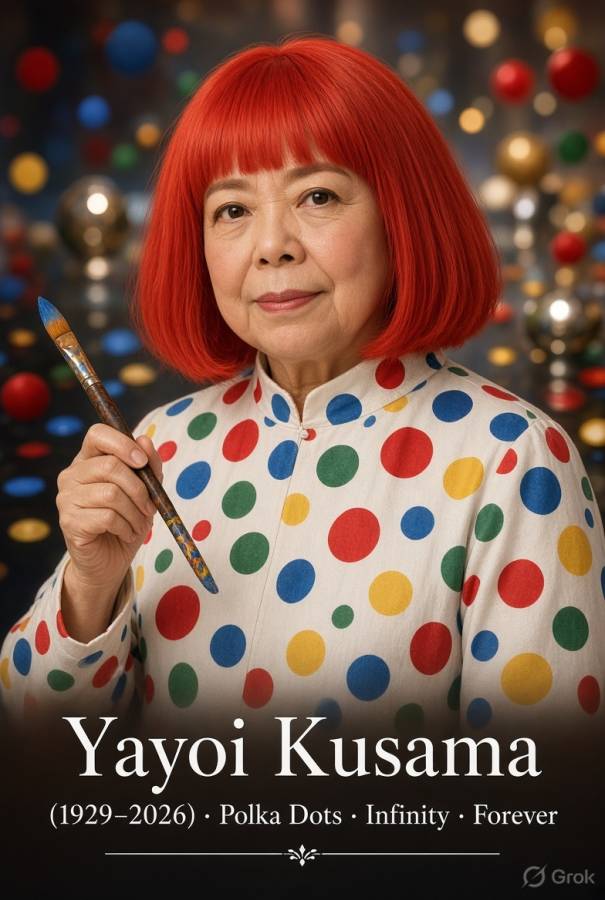
What began as a childhood vision of endless dots became one of the most recognisable artistic languages in the world.
Yayoi Kusama, the Japanese artist whose polka dots, pumpkins and mirrored rooms became some of the most recognisable images in contemporary art, died on August 14, 2026, at a Tokyo hospital. She was 97.
Her studio said she continued working until her final days.
It was a fitting end for an artist who spent almost her entire life making art. Even as her work became internationally famous, Kusama remained remarkably disciplined about her practice. Painting, writing and creating installations were not simply parts of her career. They were central to the way she understood the world.
Kusama was born in 1929 in Matsumoto, Japan. Her childhood was difficult, and her family did not encourage her artistic ambitions. From an early age, she experienced vivid visions and hallucinations. She saw patterns, lights and fields of dots that seemed to spread across objects and spaces around her.
She began drawing what she saw.
Those dots would eventually become her signature.
But Kusama's story is not simply one of an artist turning personal suffering into art. It is also the story of a woman who fought her way into an international art world that was not always ready to recognise her.
Leaving Japan for New York
Kusama moved to the United States in the late 1950s, eventually settling in New York. She arrived with limited money and little support, but she was determined to establish herself as an artist.
New York's art scene was competitive and overwhelmingly dominated by men. Kusama's work stood apart from much of what was being produced at the time. She covered canvases with thousands of small, repeated marks, creating works that seemed to stretch endlessly beyond their physical boundaries.
Her early Infinity Net paintings attracted attention.
Recognition, however, did not come easily.
Kusama later spoke about occasions when ideas similar to those she had explored earlier appeared in the work of better-known male artists. She believed she had not received the credit she deserved.
Still, she continued working.
During the 1960s, she experimented with sculpture, performance and happenings, pushing against conventional definitions of what an artwork could be. Her work addressed repetition, sexuality, identity, consumer culture and the relationship between the individual and the larger world.
It was unconventional.
It was also ahead of its time.
Art as a Way of Living
Kusama returned to Japan in the early 1970s. In 1977, she voluntarily began living at a psychiatric hospital in Tokyo. She continued to work from a nearby studio and maintained a remarkably productive artistic career.
She was open about her mental health and about the role art played in helping her deal with her experiences.
That openness became an important part of the public understanding of her life.
But Kusama resisted being defined by her illness.
Her career was far larger than that.
She produced paintings, sculptures, installations, performances, novels and poetry. Her work continued to evolve while returning again and again to the themes that had followed her since childhood: repetition, infinity, disappearance and the relationship between the individual and the universe.
The Infinity Mirror Rooms
Kusama became a global cultural phenomenon through her Infinity Mirror Rooms.
The concept was deceptively simple. Mirrors, lights and repeated forms were placed inside enclosed spaces, creating an illusion of endless depth.
Standing inside one of these rooms can make a person feel surrounded by an infinite number of lights or objects. The boundaries of the room appear to disappear.
The installations became hugely popular with audiences around the world.
Their success also came at a time when museums were increasingly looking for ways to make visitors active participants in exhibitions rather than passive observers. Kusama's work was particularly suited to that shift.
Interestingly, she had developed the idea decades before smartphones and social media turned immersive art into a global phenomenon.
Her installations eventually became among the most photographed museum experiences in the world.
The Pumpkin Becomes a Symbol
Kusama's pumpkins followed a similar path from personal artistic expression to global recognition.
Her bright yellow pumpkins covered with black dots became instantly identifiable. They appeared in exhibitions and public spaces and eventually became part of collaborations with major fashion and luxury brands.
Her work with Louis Vuitton introduced her visual language to an audience far beyond the traditional art world.
For some artists, commercial collaborations can create tension between art and business.
For Kusama, the boundary was less straightforward.
Her dots were already everywhere in her work. Putting them on fashion products simply extended a visual language that audiences had already learned to recognise.
From an Overlooked Artist to a Global Star
The financial value of Kusama's work also tells part of the story.
Her 1959 painting Untitled (Nets) sold for $10.5 million at auction in 2022.
It was a striking measure of how dramatically her position had changed.
The artist who had once struggled for recognition had become one of the most commercially successful figures in contemporary art.
But money was only one measure of her influence.
Her work entered major museums and collections around the world. Younger artists drew inspiration from her use of repetition and immersive environments. Her images became familiar even to people who might never have considered themselves followers of contemporary art.
Kusama had crossed a boundary that few artists manage to cross.
She had become part of popular culture without becoming detached from the ideas that had driven her work.
Kusama and India
Indian audiences also had the opportunity to experience her work more directly.
In 2023, the Nita Mukesh Ambani Cultural Centre in Mumbai presented Kusama's Infinity Mirrored Room along with her installation Clouds.
For many visitors, it was an opportunity to experience the artist's work physically rather than through photographs.
That distinction matters with Kusama.
Her art is not always meant to be viewed from a distance. In her mirrored rooms especially, the visitor becomes part of the work.
You do not simply look at infinity.
You stand inside it.
A Life That Refused to Stop
Tributes followed news of Kusama's death from across the international art world.
Her career had lasted for more than seven decades and had survived enormous changes in the way art was produced, exhibited and consumed.
She began working at a time when women artists faced significant barriers to recognition. She experienced periods of obscurity and financial difficulty. She lived through profound personal struggles.
Yet she kept working.
That may ultimately be the simplest way to understand Yayoi Kusama.
She kept working.
The dots continued.
The paintings continued.
The mirrors continued.
The pumpkins continued.
And the questions at the centre of her work remained the same: Where does the individual end? Where does the universe begin? And what happens when the boundary between the two disappears?
Kusama spent her life exploring those questions.
She never offered easy answers.
Instead, she built rooms in which millions of people could ask them for themselves.
Yayoi Kusama is gone.
Her universe, however, is still expanding.
Yayoi Kusama, the Japanese artist whose polka dots, pumpkins and mirrored rooms became some of the most recognisable images in contemporary art, died on August 14, 2026, at a Tokyo hospital. She was 97.
Her studio said she continued working until her final days.
It was a fitting end for an artist who spent almost her entire life making art. Even as her work became internationally famous, Kusama remained remarkably disciplined about her practice. Painting, writing and creating installations were not simply parts of her career. They were central to the way she understood the world.
Kusama was born in 1929 in Matsumoto, Japan. Her childhood was difficult, and her family did not encourage her artistic ambitions. From an early age, she experienced vivid visions and hallucinations. She saw patterns, lights and fields of dots that seemed to spread across objects and spaces around her.
She began drawing what she saw.
Those dots would eventually become her signature.
But Kusama's story is not simply one of an artist turning personal suffering into art. It is also the story of a woman who fought her way into an international art world that was not always ready to recognise her.
Leaving Japan for New York
Kusama moved to the United States in the late 1950s, eventually settling in New York. She arrived with limited money and little support, but she was determined to establish herself as an artist.
New York's art scene was competitive and overwhelmingly dominated by men. Kusama's work stood apart from much of what was being produced at the time. She covered canvases with thousands of small, repeated marks, creating works that seemed to stretch endlessly beyond their physical boundaries.
Her early Infinity Net paintings attracted attention.
Recognition, however, did not come easily.
Kusama later spoke about occasions when ideas similar to those she had explored earlier appeared in the work of better-known male artists. She believed she had not received the credit she deserved.
Still, she continued working.
During the 1960s, she experimented with sculpture, performance and happenings, pushing against conventional definitions of what an artwork could be. Her work addressed repetition, sexuality, identity, consumer culture and the relationship between the individual and the larger world.
It was unconventional.
It was also ahead of its time.
Art as a Way of Living
Kusama returned to Japan in the early 1970s. In 1977, she voluntarily began living at a psychiatric hospital in Tokyo. She continued to work from a nearby studio and maintained a remarkably productive artistic career.
She was open about her mental health and about the role art played in helping her deal with her experiences.
That openness became an important part of the public understanding of her life.
But Kusama resisted being defined by her illness.
Her career was far larger than that.
She produced paintings, sculptures, installations, performances, novels and poetry. Her work continued to evolve while returning again and again to the themes that had followed her since childhood: repetition, infinity, disappearance and the relationship between the individual and the universe.
The Infinity Mirror Rooms
Kusama became a global cultural phenomenon through her Infinity Mirror Rooms.
The concept was deceptively simple. Mirrors, lights and repeated forms were placed inside enclosed spaces, creating an illusion of endless depth.
Standing inside one of these rooms can make a person feel surrounded by an infinite number of lights or objects. The boundaries of the room appear to disappear.
The installations became hugely popular with audiences around the world.
Their success also came at a time when museums were increasingly looking for ways to make visitors active participants in exhibitions rather than passive observers. Kusama's work was particularly suited to that shift.
Interestingly, she had developed the idea decades before smartphones and social media turned immersive art into a global phenomenon.
Her installations eventually became among the most photographed museum experiences in the world.
The Pumpkin Becomes a Symbol
Kusama's pumpkins followed a similar path from personal artistic expression to global recognition.
Her bright yellow pumpkins covered with black dots became instantly identifiable. They appeared in exhibitions and public spaces and eventually became part of collaborations with major fashion and luxury brands.
Her work with Louis Vuitton introduced her visual language to an audience far beyond the traditional art world.
For some artists, commercial collaborations can create tension between art and business.
For Kusama, the boundary was less straightforward.
Her dots were already everywhere in her work. Putting them on fashion products simply extended a visual language that audiences had already learned to recognise.
From an Overlooked Artist to a Global Star
The financial value of Kusama's work also tells part of the story.
Her 1959 painting Untitled (Nets) sold for $10.5 million at auction in 2022.
It was a striking measure of how dramatically her position had changed.
The artist who had once struggled for recognition had become one of the most commercially successful figures in contemporary art.
But money was only one measure of her influence.
Her work entered major museums and collections around the world. Younger artists drew inspiration from her use of repetition and immersive environments. Her images became familiar even to people who might never have considered themselves followers of contemporary art.
Kusama had crossed a boundary that few artists manage to cross.
She had become part of popular culture without becoming detached from the ideas that had driven her work.
Kusama and India
Indian audiences also had the opportunity to experience her work more directly.
In 2023, the Nita Mukesh Ambani Cultural Centre in Mumbai presented Kusama's Infinity Mirrored Room along with her installation Clouds.
For many visitors, it was an opportunity to experience the artist's work physically rather than through photographs.
That distinction matters with Kusama.
Her art is not always meant to be viewed from a distance. In her mirrored rooms especially, the visitor becomes part of the work.
You do not simply look at infinity.
You stand inside it.
A Life That Refused to Stop
Tributes followed news of Kusama's death from across the international art world.
Her career had lasted for more than seven decades and had survived enormous changes in the way art was produced, exhibited and consumed.
She began working at a time when women artists faced significant barriers to recognition. She experienced periods of obscurity and financial difficulty. She lived through profound personal struggles.
Yet she kept working.
That may ultimately be the simplest way to understand Yayoi Kusama.
She kept working.
The dots continued.
The paintings continued.
The mirrors continued.
The pumpkins continued.
And the questions at the centre of her work remained the same: Where does the individual end? Where does the universe begin? And what happens when the boundary between the two disappears?
Kusama spent her life exploring those questions.
She never offered easy answers.
Instead, she built rooms in which millions of people could ask them for themselves.
Yayoi Kusama is gone.
Her universe, however, is still expanding.























Leave a Comment