
A single rocket launch has done more than place satellites in orbit. It has placed India's private space industry among the world's elite.
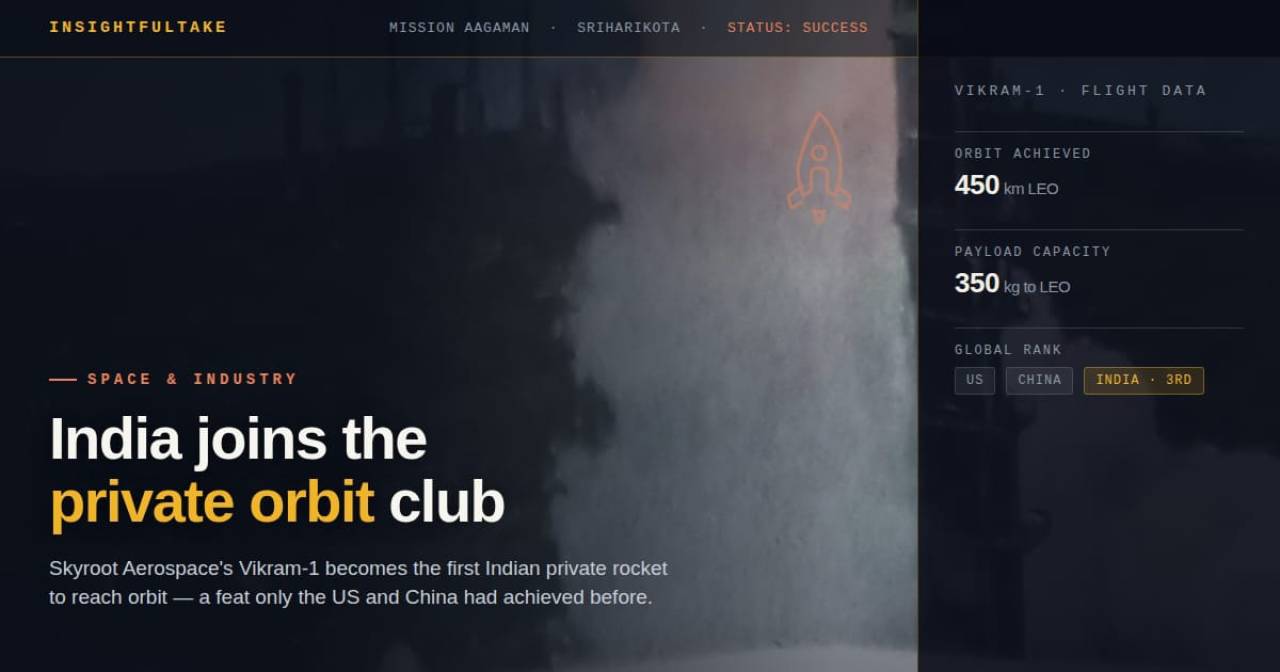
India became only the third country in the world to achieve private orbital launch capability on July 18, 2026, after Hyderabad-based Skyroot Aerospace successfully flew its Vikram-1 rocket from the Satish Dhawan Space Centre in Sriharikota. The achievement places India alongside the United States and China, the only other nations where a privately built rocket has carried payloads into orbit around Earth rather than just into space and back down.
What Happened
Vikram-1 lifted off at 12:05 pm as part of a mission named "Aagaman," Sanskrit for "arrival." The original launch window was 11:30 am, but the countdown was paused briefly after a minor issue in the automatic launch sequence. Engineers fixed the glitch quickly, and the rocket flew smoothly soon after. Within 17 to 20 minutes of liftoff, Vikram-1 had placed four technology demonstration payloads into a 450-km low Earth orbit at a 60-degree inclination, precisely the outcome the mission was designed to achieve.
The four payloads reflected genuine commercial interest in the flight rather than mere symbolism. They included Solaras S3 from Bengaluru start-up Grahaa Space, a debris-clearing robotic arm called Embrace from Hyderabad-based Cosmoserve Space, a payload called Scope built by Skyroot itself, and a demonstration unit from a German hardware maker. Union Minister Jitendra Singh, who attended the launch, pointed out that carrying live experimental payloads instead of dummy weights, the usual practice for debut flights worldwide, signalled real confidence in the rocket's design.
The Rocket Itself
Vikram-1 stands roughly as tall as a seven-storey building and can carry satellites weighing up to 350 kg into low Earth orbit. It is built almost entirely from carbon composite material, a lightweight but strong alternative to metal, and uses 3D-printed engines along with high-thrust solid-fuel boosters. Skyroot has repeatedly stressed that the rocket was "100% designed in India, 100% manufactured in India," built from hundreds of components engineered from scratch to function together, a claim the company's co-founders describe as central to why "building a rocket is the toughest feat in engineering."
From Idea to Orbit
Skyroot was founded in 2018 by Pawan Kumar Chandana and Naga Bharath Daka, both IIT alumni and former ISRO scientists. According to Chandana, the company began at a time when India had "no policy, no funding and no talent" for private rocket-building, a gap that only closed after the government opened the space sector to private players. That policy shift traces back to 2020, when India's space reforms allowed companies outside ISRO to design, build, and launch their own vehicles for the first time.
Progress since then has been rapid by any global standard. In November 2022, Skyroot's suborbital Vikram-S rocket became the first privately built Indian rocket to reach space at all, though it was a smaller, single-stage vehicle not meant for carrying commercial satellites. Less than four years later, its successor Vikram-1 has gone further, becoming a genuine orbital-class launch vehicle. Along the way, in May, Skyroot became India's first space-tech unicorn, raising $60 million at a valuation of $1.1 billion.
Why the Comparison to the US and China Matters
Private orbital launch is a far higher bar than most people realise. Dozens of countries have government space agencies capable of reaching orbit, but only a handful of companies anywhere in the world have done it independently of state-run programmes. American firms such as SpaceX and Rocket Lab, and a small number of Chinese private launch companies, are among the most prominent examples. By joining that list, Skyroot has shown that India's private sector can now compete on rocket engineering rather than only on satellite-building or ground services, where Indian companies were already active.
Final Take
The success of Vikram-1 arrives as ISRO itself is scaling up. Chairman V. Narayanan said the agency is targeting at least seven launches in the current financial year, with two satellites fully built and five to six more in the final stages of integration. He also confirmed that ISRO's second launch complex, at Kulasekarapattinam, is expected to be commissioned within six months, since Sriharikota's existing pads are not optimised for satellites in the 300 to 350 kg range that private players like Skyroot are increasingly building for.
Pawan Goenka, chairman of IN-SPACe, the government body created to enable private space players, called the mission proof that India can "trust the youth of the country to do the work." Prime Minister Narendra Modi, who sent a handwritten "Vande Mataram" postcard aboard the rocket, described the launch as vindication of the decision to open India's space sector to private industry, adding that it should "encourage countless youngsters to dream bigger."
For India's space ambitions, Vikram-1 is less an endpoint than a foundation. Skyroot is already developing a larger successor, Vikram-2, designed to carry payloads of up to 900 kg, a sign that the country's private space race has only just begun.
India became only the third country in the world to achieve private orbital launch capability on July 18, 2026, after Hyderabad-based Skyroot Aerospace successfully flew its Vikram-1 rocket from the Satish Dhawan Space Centre in Sriharikota. The achievement places India alongside the United States and China, the only other nations where a privately built rocket has carried payloads into orbit around Earth rather than just into space and back down.
What Happened
Vikram-1 lifted off at 12:05 pm as part of a mission named "Aagaman," Sanskrit for "arrival." The original launch window was 11:30 am, but the countdown was paused briefly after a minor issue in the automatic launch sequence. Engineers fixed the glitch quickly, and the rocket flew smoothly soon after. Within 17 to 20 minutes of liftoff, Vikram-1 had placed four technology demonstration payloads into a 450-km low Earth orbit at a 60-degree inclination, precisely the outcome the mission was designed to achieve.
The four payloads reflected genuine commercial interest in the flight rather than mere symbolism. They included Solaras S3 from Bengaluru start-up Grahaa Space, a debris-clearing robotic arm called Embrace from Hyderabad-based Cosmoserve Space, a payload called Scope built by Skyroot itself, and a demonstration unit from a German hardware maker. Union Minister Jitendra Singh, who attended the launch, pointed out that carrying live experimental payloads instead of dummy weights, the usual practice for debut flights worldwide, signalled real confidence in the rocket's design.
The Rocket Itself
Vikram-1 stands roughly as tall as a seven-storey building and can carry satellites weighing up to 350 kg into low Earth orbit. It is built almost entirely from carbon composite material, a lightweight but strong alternative to metal, and uses 3D-printed engines along with high-thrust solid-fuel boosters. Skyroot has repeatedly stressed that the rocket was "100% designed in India, 100% manufactured in India," built from hundreds of components engineered from scratch to function together, a claim the company's co-founders describe as central to why "building a rocket is the toughest feat in engineering."
From Idea to Orbit
Skyroot was founded in 2018 by Pawan Kumar Chandana and Naga Bharath Daka, both IIT alumni and former ISRO scientists. According to Chandana, the company began at a time when India had "no policy, no funding and no talent" for private rocket-building, a gap that only closed after the government opened the space sector to private players. That policy shift traces back to 2020, when India's space reforms allowed companies outside ISRO to design, build, and launch their own vehicles for the first time.
Progress since then has been rapid by any global standard. In November 2022, Skyroot's suborbital Vikram-S rocket became the first privately built Indian rocket to reach space at all, though it was a smaller, single-stage vehicle not meant for carrying commercial satellites. Less than four years later, its successor Vikram-1 has gone further, becoming a genuine orbital-class launch vehicle. Along the way, in May, Skyroot became India's first space-tech unicorn, raising $60 million at a valuation of $1.1 billion.
Why the Comparison to the US and China Matters
Private orbital launch is a far higher bar than most people realise. Dozens of countries have government space agencies capable of reaching orbit, but only a handful of companies anywhere in the world have done it independently of state-run programmes. American firms such as SpaceX and Rocket Lab, and a small number of Chinese private launch companies, are among the most prominent examples. By joining that list, Skyroot has shown that India's private sector can now compete on rocket engineering rather than only on satellite-building or ground services, where Indian companies were already active.
Final Take
The success of Vikram-1 arrives as ISRO itself is scaling up. Chairman V. Narayanan said the agency is targeting at least seven launches in the current financial year, with two satellites fully built and five to six more in the final stages of integration. He also confirmed that ISRO's second launch complex, at Kulasekarapattinam, is expected to be commissioned within six months, since Sriharikota's existing pads are not optimised for satellites in the 300 to 350 kg range that private players like Skyroot are increasingly building for.
Pawan Goenka, chairman of IN-SPACe, the government body created to enable private space players, called the mission proof that India can "trust the youth of the country to do the work." Prime Minister Narendra Modi, who sent a handwritten "Vande Mataram" postcard aboard the rocket, described the launch as vindication of the decision to open India's space sector to private industry, adding that it should "encourage countless youngsters to dream bigger."
For India's space ambitions, Vikram-1 is less an endpoint than a foundation. Skyroot is already developing a larger successor, Vikram-2, designed to carry payloads of up to 900 kg, a sign that the country's private space race has only just begun.























Leave a Comment