
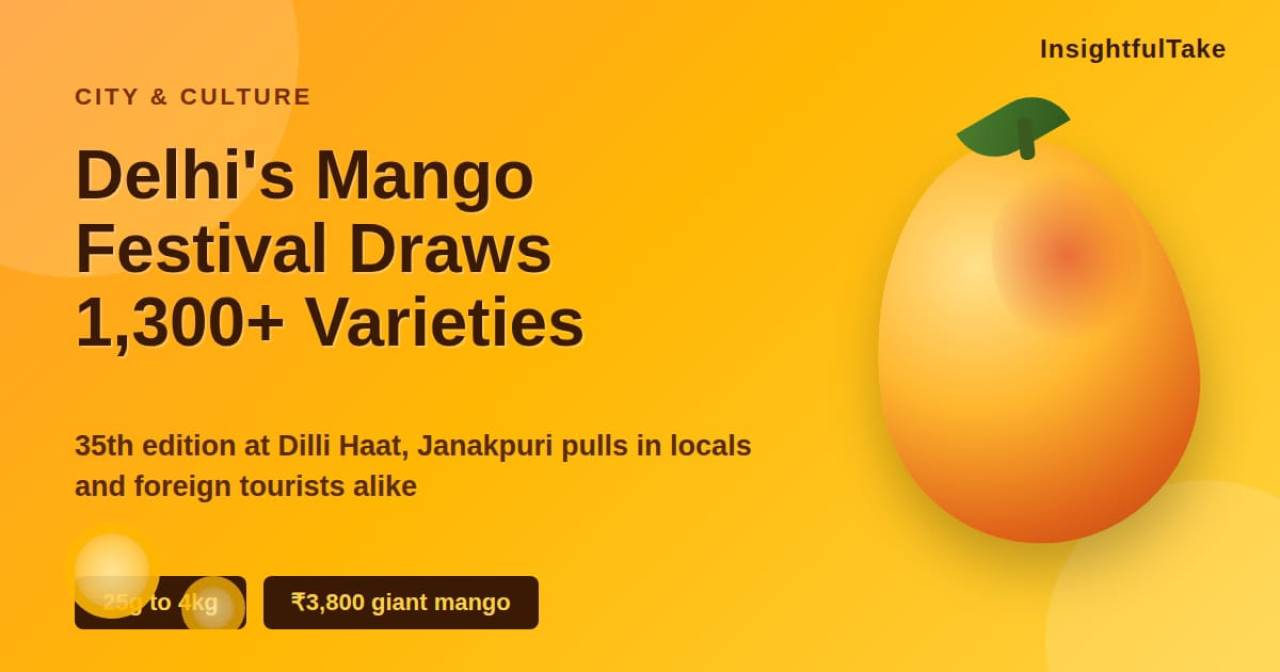
From rare mangoes to giant specimens, Delhi's Mango Festival is celebrating India's favourite fruit with more than 1,300 varieties.
The 35th Delhi Mango Festival at Dilli Haat, Janakpuri, has brought together more than 1,300 mango varieties from across the country, attracting large numbers of local residents and foreign tourists since it opened.
The festival's collection ranges from a mango weighing just 25 grams to a giant specimen weighing four kilograms, priced at ₹3,800. Among the more striking exhibits is a mango named "Sachin," after cricket legend Sachin Tendulkar, developed by the late Haji Kalimullah Khan, popularly known as India's "Mango Man" for his work grafting hundreds of mango varieties onto single trees in Uttar Pradesh. Other varieties on display include Angoor Dana and Tommy Atkins, the latter emerging as one of the festival's biggest attractions this year. According to stallholders, the Tommy Atkins variety can remain fresh for up to three weeks after ripening, making it easier to stock and sell throughout the festival.
The event has become an annual tradition for mango enthusiasts in the capital. Anjali Rawat, a Delhi-based entrepreneur, said she and her family make it a point to visit early on the festival's opening day every year, as newly introduced stalls and popular varieties tend to sell out quickly. She added that vendors usually allow visitors to sample different mangoes before making a purchase, and that her family typically buys a mix of varieties—some for eating fresh and others for preparing milkshakes, cheesecakes and other desserts.
The festival has also attracted visitors from overseas. A tourist from the United Kingdom said she and a friend travelling in India from South Korea had not expected to encounter such an extraordinary range of mangoes. She said they had already purchased more than a kilogram of Kesar mangoes despite wondering how they would carry them home. According to her, the fruit was unlike anything available back home, and she did not want to leave without buying more.
A large mascot dressed as a mango, wearing a green cap and displaying the festival's branding, has become one of the event's most popular attractions, drawing children and adults alike for photographs near the entrance.
Held at Dilli Haat, a venue well known for showcasing regional crafts and cuisine from across India, the Delhi Mango Festival has steadily grown over its 35 editions into one of the city's most anticipated summer events. Stalls are arranged in rows displaying mangoes by region and variety, with vendors often explaining the origin, flavour profile and characteristics of lesser-known cultivars to curious buyers. For many growers and sellers, the festival represents one of the most important sales opportunities of the year, given the short shelf life of most mango varieties and the large crowds the event attracts.
Delhi's mango season typically peaks between May and July, and festivals like this have increasingly helped connect farmers with urban consumers who might otherwise never encounter the remarkable diversity of mangoes grown across India. States such as Uttar Pradesh, Andhra Pradesh and Maharashtra are among the country's leading mango producers, offering hundreds of regional varieties. With more than 1,300 varieties on display this year, the festival highlights both the scale of India's mango cultivation and the enduring popularity of the country's favourite summer fruit among residents and visitors alike.
The festival continues at Dilli Haat, Janakpuri, with organisers expecting visitor numbers to remain strong in the coming weeks as more mango varieties reach peak ripeness.
The 35th Delhi Mango Festival at Dilli Haat, Janakpuri, has brought together more than 1,300 mango varieties from across the country, attracting large numbers of local residents and foreign tourists since it opened.
The festival's collection ranges from a mango weighing just 25 grams to a giant specimen weighing four kilograms, priced at ₹3,800. Among the more striking exhibits is a mango named "Sachin," after cricket legend Sachin Tendulkar, developed by the late Haji Kalimullah Khan, popularly known as India's "Mango Man" for his work grafting hundreds of mango varieties onto single trees in Uttar Pradesh. Other varieties on display include Angoor Dana and Tommy Atkins, the latter emerging as one of the festival's biggest attractions this year. According to stallholders, the Tommy Atkins variety can remain fresh for up to three weeks after ripening, making it easier to stock and sell throughout the festival.
The event has become an annual tradition for mango enthusiasts in the capital. Anjali Rawat, a Delhi-based entrepreneur, said she and her family make it a point to visit early on the festival's opening day every year, as newly introduced stalls and popular varieties tend to sell out quickly. She added that vendors usually allow visitors to sample different mangoes before making a purchase, and that her family typically buys a mix of varieties—some for eating fresh and others for preparing milkshakes, cheesecakes and other desserts.
The festival has also attracted visitors from overseas. A tourist from the United Kingdom said she and a friend travelling in India from South Korea had not expected to encounter such an extraordinary range of mangoes. She said they had already purchased more than a kilogram of Kesar mangoes despite wondering how they would carry them home. According to her, the fruit was unlike anything available back home, and she did not want to leave without buying more.
A large mascot dressed as a mango, wearing a green cap and displaying the festival's branding, has become one of the event's most popular attractions, drawing children and adults alike for photographs near the entrance.
Held at Dilli Haat, a venue well known for showcasing regional crafts and cuisine from across India, the Delhi Mango Festival has steadily grown over its 35 editions into one of the city's most anticipated summer events. Stalls are arranged in rows displaying mangoes by region and variety, with vendors often explaining the origin, flavour profile and characteristics of lesser-known cultivars to curious buyers. For many growers and sellers, the festival represents one of the most important sales opportunities of the year, given the short shelf life of most mango varieties and the large crowds the event attracts.
Delhi's mango season typically peaks between May and July, and festivals like this have increasingly helped connect farmers with urban consumers who might otherwise never encounter the remarkable diversity of mangoes grown across India. States such as Uttar Pradesh, Andhra Pradesh and Maharashtra are among the country's leading mango producers, offering hundreds of regional varieties. With more than 1,300 varieties on display this year, the festival highlights both the scale of India's mango cultivation and the enduring popularity of the country's favourite summer fruit among residents and visitors alike.
The festival continues at Dilli Haat, Janakpuri, with organisers expecting visitor numbers to remain strong in the coming weeks as more mango varieties reach peak ripeness.






















Leave a Comment