
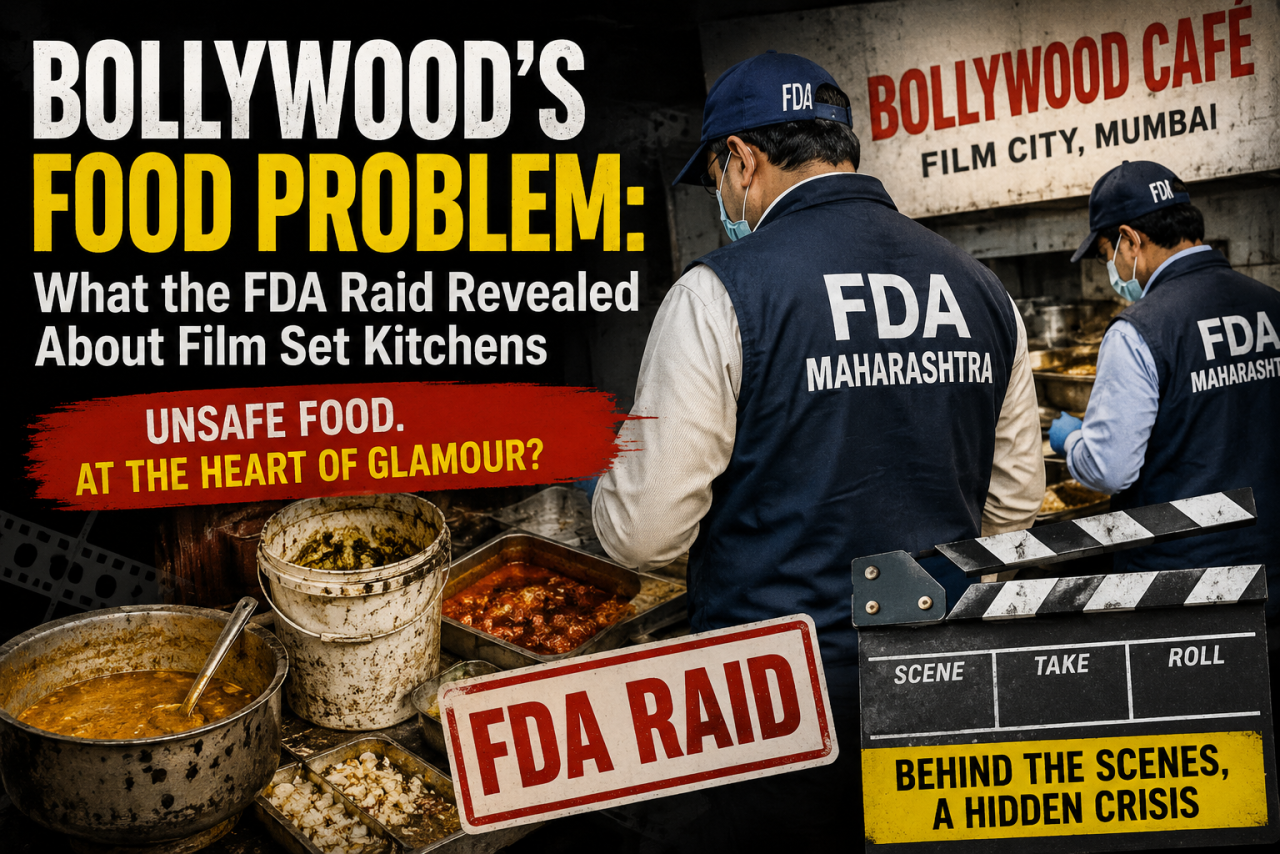
An FDA raid at Mumbai’s Film City has exposed troubling questions about food hygiene, catering standards and the safety of Bollywood’s largely invisible workforce.
A recent raid by the Maharashtra Food and Drug Administration (FDA) at a catering setup inside Mumbai's Film City has brought an uncomfortable issue into the spotlight: the quality and safety of food served to the thousands of technicians, workers and crew members who keep film productions running.
The raid targeted Bollywood Café in Goregaon's Film City, one of Mumbai's busiest shooting hubs. FDA officials reportedly found serious hygiene lapses at the premises. The action followed a formal complaint from the Federation of Western India Cine Employees (FWICE), the umbrella body representing technicians and other film crew members, which had raised concerns with the FDA Commissioner over the food being served on sets.
A Long-Standing Complaint Finally Gets Attention
For FWICE, the raid is more than a routine regulatory action. The federation has been raising concerns about food quality and hygiene on film sets for years.
Its general secretary said the raid should send a clear message to production houses that similar inspections can happen anywhere and at any time. FWICE's chief advisor has also pointed to repeated complaints about poor-quality food and alleged use of caustic soda, a chemical whose improper use in food preparation can pose serious safety concerns.
The larger issue, therefore, is not one catering unit or one production. It is whether the film industry's catering system has adequate monitoring, accountability and food-safety standards.
Why Workers Often Remain Silent
One of the most uncomfortable aspects of the problem is the reluctance of daily wage workers to complain.
Film crews often work long hours under intense production pressure. For workers whose income depends on getting the next day's assignment, raising complaints about food can seem like an unnecessary risk. Many simply eat whatever is provided because the alternative is spending their own money on meals during an already demanding shoot.
That silence can create a dangerous cycle. If workers do not complain and production schedules continue without disruption, there is little immediate pressure on catering contractors or production houses to improve standards.
What Crew Members Say They Face
Accounts from technicians reveal how uneven the situation can be across productions.
Some workers say they have begun avoiding smaller-budget projects because of concerns over food quality, preferring productions where meals are more reliably managed. Others take a more resigned view, saying that at least the provision of food saves them the expense of buying meals separately during long shooting schedules.
But being grateful that food is provided is not the same as being provided safe food.
There have also been accounts of meals being served in paint containers and rotis being wrapped in newspaper rather than proper food-grade packaging. Such practices raise basic questions about hygiene, storage and handling, particularly when food is being served to large numbers of workers over extended shooting hours.
The problem becomes more acute when cost-cutting takes precedence over basic food-safety practices.
The Producers' Side of the Story
Production houses and producers, however, offer a different perspective.
They argue that food safety is in their own interest because an illness affecting even a few crew members can disrupt a shooting schedule and cause significant financial losses. Some production teams say they inspect food deliveries and attempt to maintain standards comparable to professional catering services.
Directors and other industry figures have similarly stressed that hygiene should be treated as a collective responsibility rather than an issue confined to individual catering contractors.
There is logic to that argument. A major production with a sizeable budget can afford dedicated staff to supervise catering and inspect meals. A smaller production operating under financial pressure may have far less oversight.
That difference can create two very different realities within the same industry.
Why the FDA Raid Matters
The significance of the Film City raid lies partly in its timing.
The action comes amid a wider food-safety crackdown by Maharashtra authorities. If regulatory scrutiny genuinely extends beyond conventional restaurants and food outlets, catering units operating inside film studios and shooting locations could increasingly come under the scanner.
That would be important because film-set kitchens are not simply private arrangements. They can prepare and distribute hundreds of meals to workers during long production schedules, making food safety a public-health concern as well as a workplace issue.
Regular inspections could also create greater accountability for catering contractors and production houses.
Beyond One Raid
The raid may have exposed a problem that has remained largely invisible to audiences outside the film industry.
Cinema is often associated with glamour, celebrities and elaborate sets. Behind that image is a workforce of technicians, spot boys, light workers, drivers, junior artists, catering staff and other daily wage employees who spend long hours making productions possible.
Their basic needs should not become an afterthought.
The FDA action will matter only if it becomes the beginning of sustained monitoring rather than a one-time intervention triggered by a complaint. The film industry needs clear food-safety standards, accountable catering contractors, regular inspections and a mechanism through which workers can report problems without fearing professional consequences.
For an industry that employs thousands of people and operates on tightly controlled schedules, safe food should not be treated as a luxury or a favour.
It should simply be part of the job.
A recent raid by the Maharashtra Food and Drug Administration (FDA) at a catering setup inside Mumbai's Film City has brought an uncomfortable issue into the spotlight: the quality and safety of food served to the thousands of technicians, workers and crew members who keep film productions running.
The raid targeted Bollywood Café in Goregaon's Film City, one of Mumbai's busiest shooting hubs. FDA officials reportedly found serious hygiene lapses at the premises. The action followed a formal complaint from the Federation of Western India Cine Employees (FWICE), the umbrella body representing technicians and other film crew members, which had raised concerns with the FDA Commissioner over the food being served on sets.
A Long-Standing Complaint Finally Gets Attention
For FWICE, the raid is more than a routine regulatory action. The federation has been raising concerns about food quality and hygiene on film sets for years.
Its general secretary said the raid should send a clear message to production houses that similar inspections can happen anywhere and at any time. FWICE's chief advisor has also pointed to repeated complaints about poor-quality food and alleged use of caustic soda, a chemical whose improper use in food preparation can pose serious safety concerns.
The larger issue, therefore, is not one catering unit or one production. It is whether the film industry's catering system has adequate monitoring, accountability and food-safety standards.
Why Workers Often Remain Silent
One of the most uncomfortable aspects of the problem is the reluctance of daily wage workers to complain.
Film crews often work long hours under intense production pressure. For workers whose income depends on getting the next day's assignment, raising complaints about food can seem like an unnecessary risk. Many simply eat whatever is provided because the alternative is spending their own money on meals during an already demanding shoot.
That silence can create a dangerous cycle. If workers do not complain and production schedules continue without disruption, there is little immediate pressure on catering contractors or production houses to improve standards.
What Crew Members Say They Face
Accounts from technicians reveal how uneven the situation can be across productions.
Some workers say they have begun avoiding smaller-budget projects because of concerns over food quality, preferring productions where meals are more reliably managed. Others take a more resigned view, saying that at least the provision of food saves them the expense of buying meals separately during long shooting schedules.
But being grateful that food is provided is not the same as being provided safe food.
There have also been accounts of meals being served in paint containers and rotis being wrapped in newspaper rather than proper food-grade packaging. Such practices raise basic questions about hygiene, storage and handling, particularly when food is being served to large numbers of workers over extended shooting hours.
The problem becomes more acute when cost-cutting takes precedence over basic food-safety practices.
The Producers' Side of the Story
Production houses and producers, however, offer a different perspective.
They argue that food safety is in their own interest because an illness affecting even a few crew members can disrupt a shooting schedule and cause significant financial losses. Some production teams say they inspect food deliveries and attempt to maintain standards comparable to professional catering services.
Directors and other industry figures have similarly stressed that hygiene should be treated as a collective responsibility rather than an issue confined to individual catering contractors.
There is logic to that argument. A major production with a sizeable budget can afford dedicated staff to supervise catering and inspect meals. A smaller production operating under financial pressure may have far less oversight.
That difference can create two very different realities within the same industry.
Why the FDA Raid Matters
The significance of the Film City raid lies partly in its timing.
The action comes amid a wider food-safety crackdown by Maharashtra authorities. If regulatory scrutiny genuinely extends beyond conventional restaurants and food outlets, catering units operating inside film studios and shooting locations could increasingly come under the scanner.
That would be important because film-set kitchens are not simply private arrangements. They can prepare and distribute hundreds of meals to workers during long production schedules, making food safety a public-health concern as well as a workplace issue.
Regular inspections could also create greater accountability for catering contractors and production houses.
Beyond One Raid
The raid may have exposed a problem that has remained largely invisible to audiences outside the film industry.
Cinema is often associated with glamour, celebrities and elaborate sets. Behind that image is a workforce of technicians, spot boys, light workers, drivers, junior artists, catering staff and other daily wage employees who spend long hours making productions possible.
Their basic needs should not become an afterthought.
The FDA action will matter only if it becomes the beginning of sustained monitoring rather than a one-time intervention triggered by a complaint. The film industry needs clear food-safety standards, accountable catering contractors, regular inspections and a mechanism through which workers can report problems without fearing professional consequences.
For an industry that employs thousands of people and operates on tightly controlled schedules, safe food should not be treated as a luxury or a favour.
It should simply be part of the job.

























Leave a Comment