
Is the fine print on packaged food enough to protect consumers, or is India ready for clear health warnings on the front of every packet?
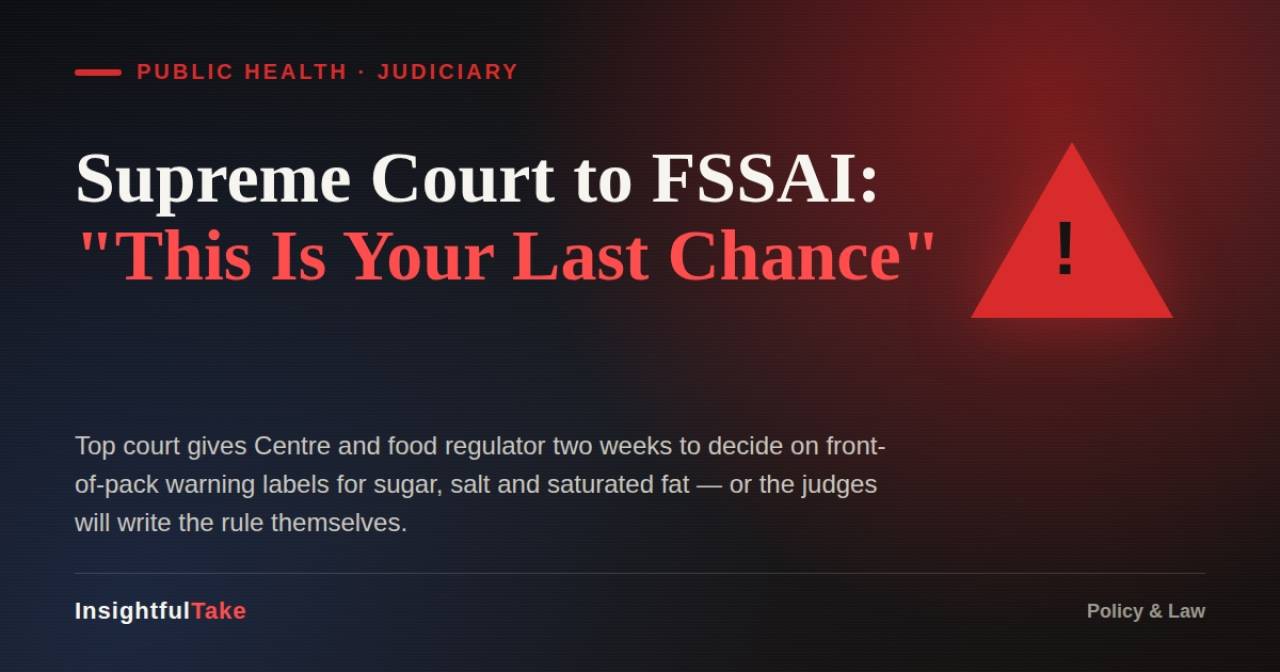
The Supreme Court has given the Food Safety and Standards Authority of India (FSSAI) a clear deadline to resolve the long-running dispute over front-of-pack warning labels on packaged foods, warning that it may otherwise take the matter into its own hands.
A bench of Justices JB Pardiwala and K Vinod Chandran, hearing a public interest litigation seeking mandatory warning labels for foods high in salt, sugar and saturated fat, gave the Centre and FSSAI two weeks to place their final decision on record.
The message from the bench was unequivocal. If the regulator fails to act, the court indicated that it could proceed to decide the issue itself.
A Demand for Clearer Food Labels
The case concerns an issue that affects millions of Indian households. Packaged snacks, namkeens, biscuits, instant foods and other processed products have become commonplace in kitchens and children's school tiffin boxes.
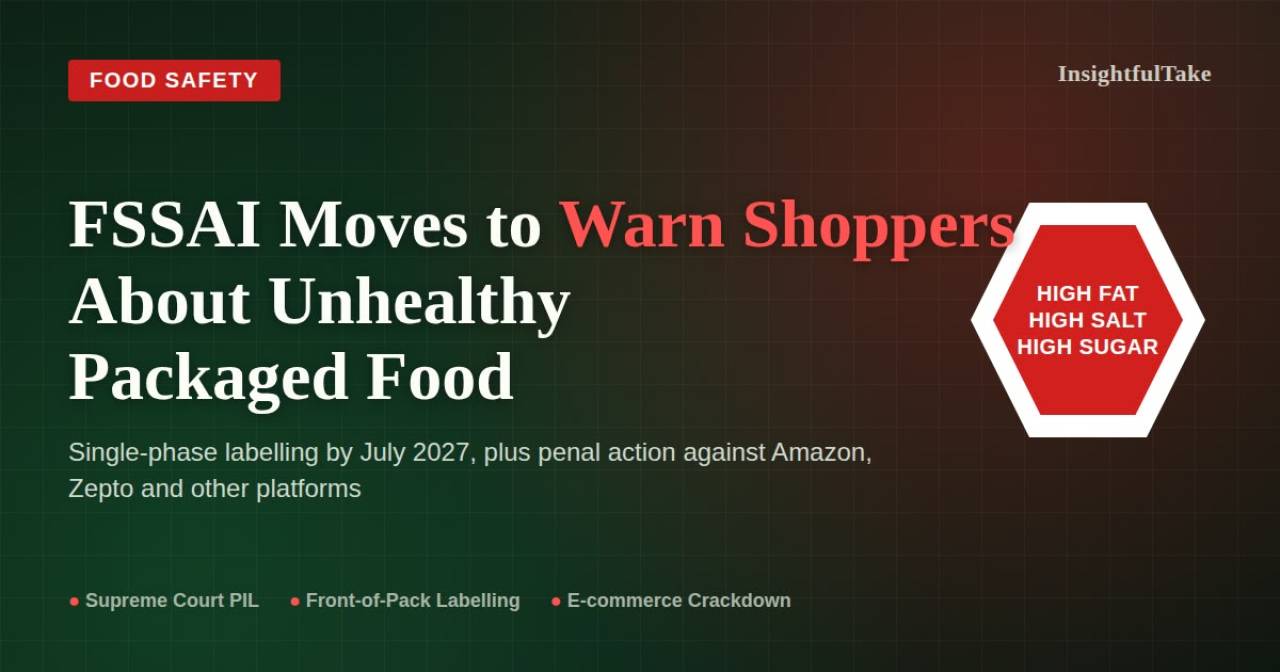
The petitioners, non-profit organisations 3S and Our Health, are seeking mandatory front-of-pack warning labels that clearly flag high levels of salt, sugar and saturated fat.
Their argument is straightforward. Nutritional information buried in small print on the back of a packet may technically provide consumers with the required information, but it does not necessarily help them make quick and informed choices.
Front-of-pack warnings, by contrast, would place key nutritional concerns where consumers can see them before buying or eating a product.
Supreme Court Questions FSSAI's Delay
What made the latest hearing particularly significant was the court's sharp criticism of FSSAI's handling of the issue.
The bench referred to minutes of a recent FSSAI meeting that appeared to indicate continued hesitation over the proposed labelling changes, despite earlier directions from the court to consider the matter.
"Are you taking the court for a toss?" the bench asked.
The judges also questioned whether pressure from food manufacturers was influencing the regulator's position and expressed concern that FSSAI appeared to be yielding to corporate interests while claiming to act in the public interest.
The remarks underline the court's growing frustration with what it sees as prolonged indecision over an issue directly connected with public health.
Government Raises Concerns Over Traditional Foods
The Centre, represented by Additional Solicitor General Brijender Chahar, defended the government's position by arguing that India's food habits are different from those in developed countries.
He pointed out that traditional Indian foods such as namkeen could potentially receive the same warning symbol as highly processed snacks under a blanket labelling system.
The government also raised concerns about the impact on small manufacturers, noting that nearly a third of MSME revenue comes from traditional foods.
Another example cited during the hearing was eggs, which could potentially cross proposed fat thresholds under certain formulations of the system.
The broader argument was that India's diverse food culture and large traditional-food sector need to be considered before adopting a warning-label regime.
Court Puts Consumer Choice at the Centre
The bench, however, made it clear that the proposed system was not about banning products or dictating what people should eat.
The central issue, according to the court, is informed choice.
Consumers should be able to understand what they are buying and consuming without having to search through complicated nutritional information. The concern becomes even more significant when children are involved.
The court's reference to Kurkure illustrated the point. Not every child can afford dry fruits or other premium snacks, while inexpensive packaged snacks are widely accessible.
The question, therefore, is not simply whether a product should be available. It is whether consumers should be given clear information about its nutritional composition before making a choice.
A Dispute That Has Dragged On
The controversy is not new. The underlying public interest litigation has been pending for more than a year.
An earlier proceeding was disposed of in April 2025 after FSSAI informed the court that an expert committee would recommend changes to food-labelling regulations.
The committee subsequently proposed the Indian Nutrition Rating system, under which packaged foods would receive a rating between 0.5 and 5 stars based on factors including sugar, salt, saturated fat, energy, protein and fibre.
However, progress on the proposed system has been slow.
FSSAI said it received more than 14,000 public comments on the proposal and conducted five expert committee meetings. Despite the consultations, the regulator reported that there was no consensus on the proposed rating format.
Further amendments, research and stakeholder consultations followed, prolonging the process.
By early August, the Supreme Court had already expressed dissatisfaction with FSSAI's compliance affidavit and directed the regulator to respond within four weeks. The bench also noted that front-of-pack labelling systems are already used in several countries.
Court Rejects Argument Based on India's Economic Status
The government also argued that India should not necessarily be required to follow international food-labelling standards.
The Supreme Court rejected that line of reasoning.
The bench indicated that India's economic status should not become a justification for maintaining weaker public-health standards. Instead, it suggested that India should demonstrate its commitment to protecting citizens' health.
The observation adds another dimension to the dispute. The issue is no longer merely about the technical design of a food label. It also raises questions about how seriously India approaches consumer protection and preventive public health.
Final Take
The next two weeks could prove decisive.
The Centre and FSSAI are expected to place their final position before the Supreme Court. If they fail to provide a satisfactory resolution, the court has signalled that it may itself determine the course of action.
For consumers, the larger question is simple. Will packaged foods eventually carry clear, visible warnings that allow people to understand their salt, sugar and saturated-fat content at a glance?
Or will prolonged regulatory uncertainty force the judiciary to step further into an area normally handled by the country's food regulator?
For now, one thing is clear. The Supreme Court's patience with FSSAI's delay appears to have run out. The next hearing could therefore mark a turning point in India's long-running debate over how clearly packaged food should disclose the risks hidden behind the label.
The Supreme Court has given the Food Safety and Standards Authority of India (FSSAI) a clear deadline to resolve the long-running dispute over front-of-pack warning labels on packaged foods, warning that it may otherwise take the matter into its own hands.
A bench of Justices JB Pardiwala and K Vinod Chandran, hearing a public interest litigation seeking mandatory warning labels for foods high in salt, sugar and saturated fat, gave the Centre and FSSAI two weeks to place their final decision on record.
The message from the bench was unequivocal. If the regulator fails to act, the court indicated that it could proceed to decide the issue itself.
A Demand for Clearer Food Labels
The case concerns an issue that affects millions of Indian households. Packaged snacks, namkeens, biscuits, instant foods and other processed products have become commonplace in kitchens and children's school tiffin boxes.
The petitioners, non-profit organisations 3S and Our Health, are seeking mandatory front-of-pack warning labels that clearly flag high levels of salt, sugar and saturated fat.
Their argument is straightforward. Nutritional information buried in small print on the back of a packet may technically provide consumers with the required information, but it does not necessarily help them make quick and informed choices.
Front-of-pack warnings, by contrast, would place key nutritional concerns where consumers can see them before buying or eating a product.
Supreme Court Questions FSSAI's Delay
What made the latest hearing particularly significant was the court's sharp criticism of FSSAI's handling of the issue.
The bench referred to minutes of a recent FSSAI meeting that appeared to indicate continued hesitation over the proposed labelling changes, despite earlier directions from the court to consider the matter.
"Are you taking the court for a toss?" the bench asked.
The judges also questioned whether pressure from food manufacturers was influencing the regulator's position and expressed concern that FSSAI appeared to be yielding to corporate interests while claiming to act in the public interest.
The remarks underline the court's growing frustration with what it sees as prolonged indecision over an issue directly connected with public health.
Government Raises Concerns Over Traditional Foods
The Centre, represented by Additional Solicitor General Brijender Chahar, defended the government's position by arguing that India's food habits are different from those in developed countries.
He pointed out that traditional Indian foods such as namkeen could potentially receive the same warning symbol as highly processed snacks under a blanket labelling system.
The government also raised concerns about the impact on small manufacturers, noting that nearly a third of MSME revenue comes from traditional foods.
Another example cited during the hearing was eggs, which could potentially cross proposed fat thresholds under certain formulations of the system.
The broader argument was that India's diverse food culture and large traditional-food sector need to be considered before adopting a warning-label regime.
Court Puts Consumer Choice at the Centre
The bench, however, made it clear that the proposed system was not about banning products or dictating what people should eat.
The central issue, according to the court, is informed choice.
Consumers should be able to understand what they are buying and consuming without having to search through complicated nutritional information. The concern becomes even more significant when children are involved.
The court's reference to Kurkure illustrated the point. Not every child can afford dry fruits or other premium snacks, while inexpensive packaged snacks are widely accessible.
The question, therefore, is not simply whether a product should be available. It is whether consumers should be given clear information about its nutritional composition before making a choice.
A Dispute That Has Dragged On
The controversy is not new. The underlying public interest litigation has been pending for more than a year.
An earlier proceeding was disposed of in April 2025 after FSSAI informed the court that an expert committee would recommend changes to food-labelling regulations.
The committee subsequently proposed the Indian Nutrition Rating system, under which packaged foods would receive a rating between 0.5 and 5 stars based on factors including sugar, salt, saturated fat, energy, protein and fibre.
However, progress on the proposed system has been slow.
FSSAI said it received more than 14,000 public comments on the proposal and conducted five expert committee meetings. Despite the consultations, the regulator reported that there was no consensus on the proposed rating format.
Further amendments, research and stakeholder consultations followed, prolonging the process.
By early August, the Supreme Court had already expressed dissatisfaction with FSSAI's compliance affidavit and directed the regulator to respond within four weeks. The bench also noted that front-of-pack labelling systems are already used in several countries.
Court Rejects Argument Based on India's Economic Status
The government also argued that India should not necessarily be required to follow international food-labelling standards.
The Supreme Court rejected that line of reasoning.
The bench indicated that India's economic status should not become a justification for maintaining weaker public-health standards. Instead, it suggested that India should demonstrate its commitment to protecting citizens' health.
The observation adds another dimension to the dispute. The issue is no longer merely about the technical design of a food label. It also raises questions about how seriously India approaches consumer protection and preventive public health.
Final Take
The next two weeks could prove decisive.
The Centre and FSSAI are expected to place their final position before the Supreme Court. If they fail to provide a satisfactory resolution, the court has signalled that it may itself determine the course of action.
For consumers, the larger question is simple. Will packaged foods eventually carry clear, visible warnings that allow people to understand their salt, sugar and saturated-fat content at a glance?
Or will prolonged regulatory uncertainty force the judiciary to step further into an area normally handled by the country's food regulator?
For now, one thing is clear. The Supreme Court's patience with FSSAI's delay appears to have run out. The next hearing could therefore mark a turning point in India's long-running debate over how clearly packaged food should disclose the risks hidden behind the label.
























Leave a Comment