
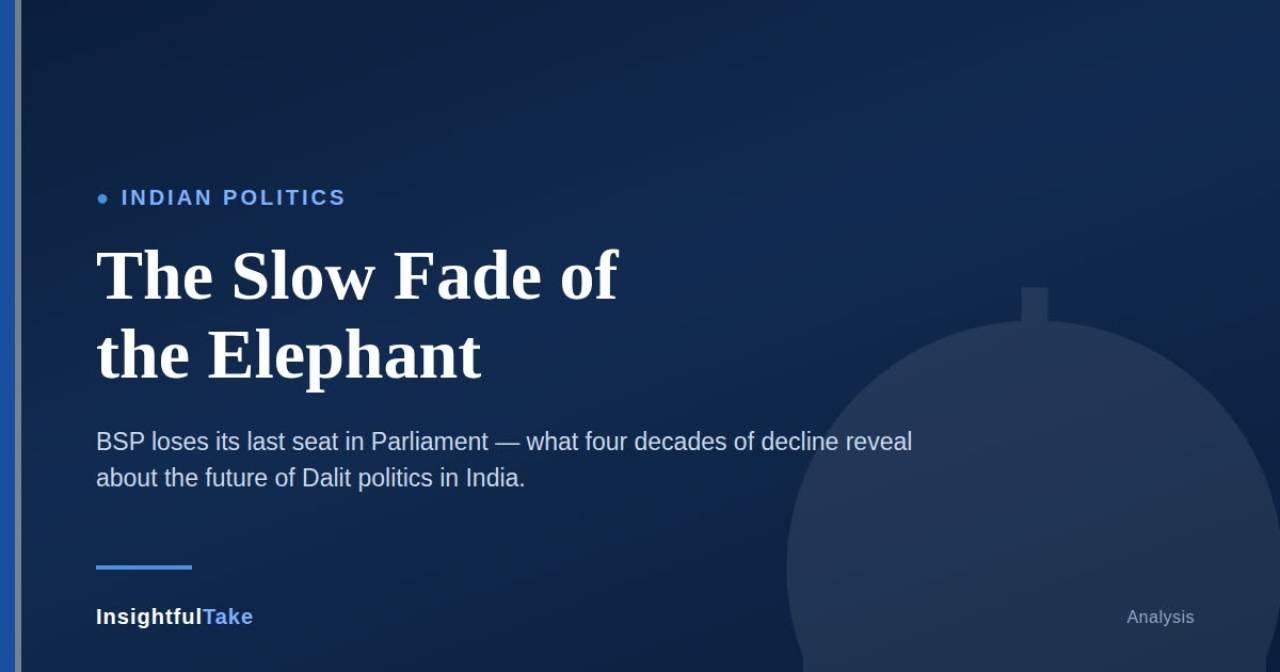
The BSP once transformed Dalit politics and reshaped Uttar Pradesh. Its exit from Parliament now raises a larger question about who will represent that political space next.
For the first time in nearly four decades, the Bahujan Samaj Party has no voice in India's national legislature. With its lone Rajya Sabha member set to retire in the upcoming round of elections, the party founded by Kanshi Ram now holds zero seats in either House of Parliament and zero seats in either House of the Uttar Pradesh legislature. This is not a minor electoral setback. It is the quiet unraveling of one of the most consequential political movements in independent India's history, and it deserves far more attention than it is getting.
To understand why this moment matters, it helps to remember what the BSP once represented. Kanshi Ram did not build the party from press conferences or television debates. He built it village by village, organizing first among government employees and then cycling across rural India to stitch together a coalition of voters that mainstream parties had long treated as an afterthought. His successor, Mayawati, took that base and turned it into genuine governing power in India's most politically important state.
For millions of Dalit voters, the BSP's rise was never just about electoral arithmetic. It was about the possibility of walking into a government hospital without being humiliated, having a police complaint taken seriously, or a child not being pulled out of school or forced to sit apart from other students. The party's promise was dignity, a currency no other political outfit was offering with the same conviction.
That promise has curdled into irrelevance.
The reasons are structural as much as they are personal. Since Kanshi Ram's death, the party has never developed a second layer of leadership capable of carrying his organizational instincts forward. Mayawati's control has remained absolute, but her decision-making has grown erratic, and the party's inner workings have become opaque even to its own cadre.
The recent, very public back-and-forth over her nephew Akash Anand, elevated as heir apparent, stripped of the role, then partially reinstated, was not just an awkward family drama playing out in public. It was a symptom of an organization that no longer has a clear answer to the most basic question any party must answer: who leads after the founder?
Beyond internal dysfunction, the ground itself has shifted.
Dalit politics in India is no longer a single, unified bloc waiting for one party to represent it. A new generation of Dalit voters, younger, more educated and more mobile, has different aspirations than their parents did, and they no longer see the BSP as the automatic vehicle for those aspirations.
Meanwhile, the BJP has invested heavily and strategically in courting Dalit voters through targeted welfare delivery and symbolic representation, chipping away at what was once BSP's unquestioned base. The Samajwadi Party has made its own overtures. And perhaps most tellingly, an entirely new formation, Chandrasekhar Azad's Azad Samaj Party, has emerged specifically to capture the space of assertive, younger Dalit politics that the BSP under Mayawati has seemed unable or unwilling to occupy.
What makes this decline particularly striking is that it has happened despite Uttar Pradesh remaining the most electorally significant state in the country. A party that once formed government there on its own, that once commanded a vote share in the twenties, has been reduced to a rump presence with no institutional foothold left in Delhi or Lucknow.
Political scientists will likely debate for years whether this represents the failure of a single leader or the natural life cycle of an identity-based party once its founding generation passes from the scene.
Either way, the implications extend well beyond the BSP itself.
Indian democracy has long relied on parties like the BSP to keep questions of caste-based dignity and representation on the national agenda, forcing larger parties to respond rather than ignore. Its marginalization does not mean those underlying grievances have disappeared. It means the political vehicle for addressing them is being renegotiated, and it is not yet clear who will inherit that mantle.
Whether it is Chandrasekhar Azad, a reshaped BSP, or something not yet visible, the coming years will determine who speaks for the constituency Kanshi Ram spent a lifetime building.
For the first time in nearly four decades, the Bahujan Samaj Party has no voice in India's national legislature. With its lone Rajya Sabha member set to retire in the upcoming round of elections, the party founded by Kanshi Ram now holds zero seats in either House of Parliament and zero seats in either House of the Uttar Pradesh legislature. This is not a minor electoral setback. It is the quiet unraveling of one of the most consequential political movements in independent India's history, and it deserves far more attention than it is getting.
To understand why this moment matters, it helps to remember what the BSP once represented. Kanshi Ram did not build the party from press conferences or television debates. He built it village by village, organizing first among government employees and then cycling across rural India to stitch together a coalition of voters that mainstream parties had long treated as an afterthought. His successor, Mayawati, took that base and turned it into genuine governing power in India's most politically important state.
For millions of Dalit voters, the BSP's rise was never just about electoral arithmetic. It was about the possibility of walking into a government hospital without being humiliated, having a police complaint taken seriously, or a child not being pulled out of school or forced to sit apart from other students. The party's promise was dignity, a currency no other political outfit was offering with the same conviction.
That promise has curdled into irrelevance.
The reasons are structural as much as they are personal. Since Kanshi Ram's death, the party has never developed a second layer of leadership capable of carrying his organizational instincts forward. Mayawati's control has remained absolute, but her decision-making has grown erratic, and the party's inner workings have become opaque even to its own cadre.
The recent, very public back-and-forth over her nephew Akash Anand, elevated as heir apparent, stripped of the role, then partially reinstated, was not just an awkward family drama playing out in public. It was a symptom of an organization that no longer has a clear answer to the most basic question any party must answer: who leads after the founder?
Beyond internal dysfunction, the ground itself has shifted.
Dalit politics in India is no longer a single, unified bloc waiting for one party to represent it. A new generation of Dalit voters, younger, more educated and more mobile, has different aspirations than their parents did, and they no longer see the BSP as the automatic vehicle for those aspirations.
Meanwhile, the BJP has invested heavily and strategically in courting Dalit voters through targeted welfare delivery and symbolic representation, chipping away at what was once BSP's unquestioned base. The Samajwadi Party has made its own overtures. And perhaps most tellingly, an entirely new formation, Chandrasekhar Azad's Azad Samaj Party, has emerged specifically to capture the space of assertive, younger Dalit politics that the BSP under Mayawati has seemed unable or unwilling to occupy.
What makes this decline particularly striking is that it has happened despite Uttar Pradesh remaining the most electorally significant state in the country. A party that once formed government there on its own, that once commanded a vote share in the twenties, has been reduced to a rump presence with no institutional foothold left in Delhi or Lucknow.
Political scientists will likely debate for years whether this represents the failure of a single leader or the natural life cycle of an identity-based party once its founding generation passes from the scene.
Either way, the implications extend well beyond the BSP itself.
Indian democracy has long relied on parties like the BSP to keep questions of caste-based dignity and representation on the national agenda, forcing larger parties to respond rather than ignore. Its marginalization does not mean those underlying grievances have disappeared. It means the political vehicle for addressing them is being renegotiated, and it is not yet clear who will inherit that mantle.
Whether it is Chandrasekhar Azad, a reshaped BSP, or something not yet visible, the coming years will determine who speaks for the constituency Kanshi Ram spent a lifetime building.


















Leave a Comment