
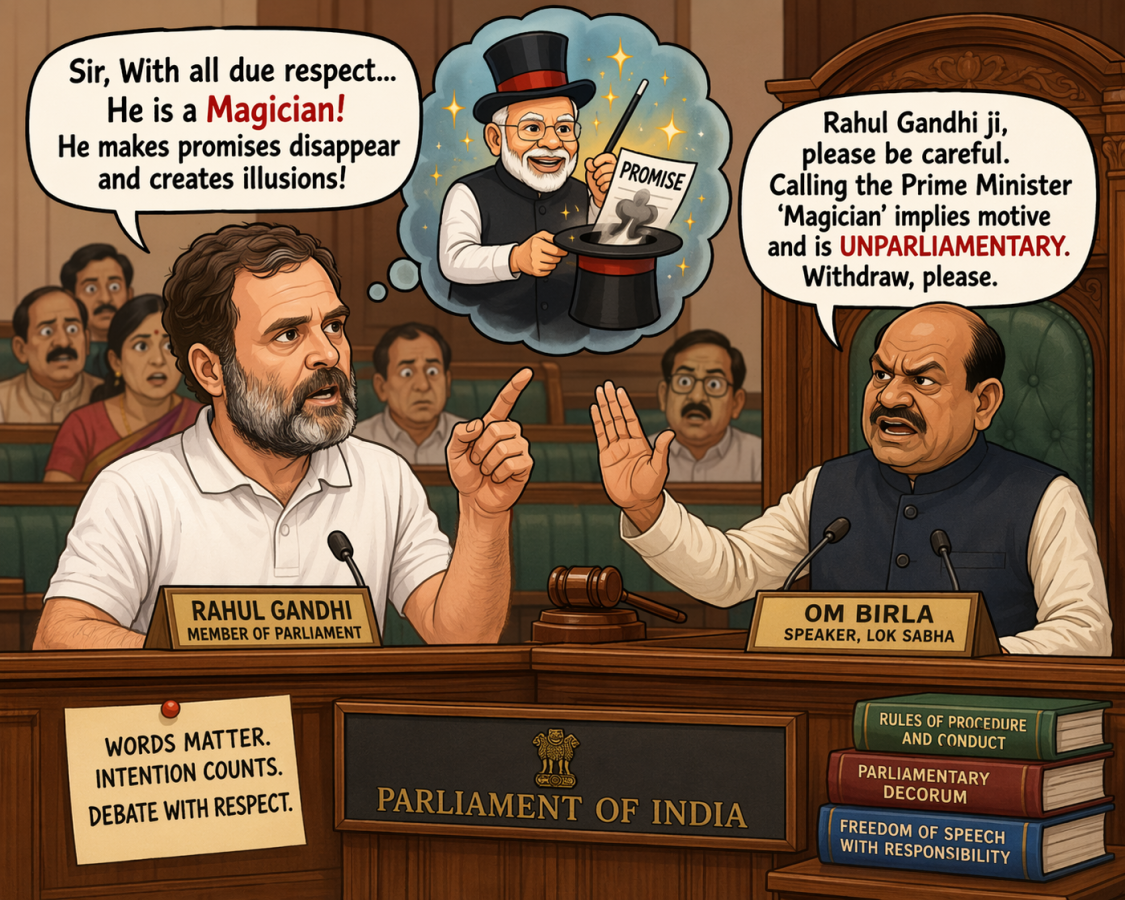
When Rahul Gandhi used the word “magician,” Om Birla intervened—but was it about the word or the intent behind it? This Parliament debate shows how even simple words can turn controversial when shaped by tone, context, and political meaning.
A recent exchange in India’s Parliament involving Rahul Gandhi and Speaker Om Birla has sparked an interesting debate: can the word “magician” be considered unparliamentary? At first glance, the objection may seem surprising. After all, a magician is an entertainer—someone who creates wonder, illusion, and delight. But inside the charged environment of Parliament, words are rarely judged in isolation. Context, tone, and intent often carry more weight than the dictionary meaning itself.
In legislative spaces, language is governed not just by vocabulary but by decorum. Parliamentary rules in India do not maintain a rigid blacklist of permanently banned words. Instead, they rely on interpretation. A word becomes “unparliamentary” if it is seen as offensive, derogatory, or imputing motives to another member or the government. This means even seemingly harmless words can be flagged if used with sarcasm, ridicule, or insinuation.
In the case in question, the term “magician” appears to have been used metaphorically—likely to suggest illusion, trickery, or the act of making something appear different from reality. Such usage can easily cross into political criticism. If a leader is described as a “magician,” the underlying implication might be that they are misleading the public or masking the truth. In that sense, the objection raised by the Speaker was less about the profession itself and more about the implied accusation embedded in the remark.
This raises a deeper question: if “magician” can be treated as objectionable in Parliament, does it diminish the dignity of the profession? The answer is clearly no. Across the world, magicians are respected artists who combine skill, psychology, and creativity to entertain audiences. Figures like Harry Houdini and David Copperfield have elevated magic into a celebrated art form. In India too, performers like P. C. Sorcar brought global recognition to the craft. Their work is not about deception in a negative sense, but about creating controlled illusions that audiences willingly engage with.
The contrast lies in intention. In entertainment, magic is a shared understanding between performer and audience—everyone knows it’s an illusion, yet chooses to be amazed. In politics, however, suggesting “illusion” can imply dishonesty or manipulation. That is where the line becomes sensitive. Parliament, as a forum of accountability, demands that criticism be expressed directly and respectfully, without resorting to language that could be interpreted as mocking or imputing motives.
This incident also highlights how language evolves within institutional frameworks. Words are not static; their meanings shift based on context. A term that is celebratory in one setting can become contentious in another. For instance, calling someone a “performer” might be praise on a stage but criticism in governance. Similarly, “magician” can be admiration in art and suspicion in politics.
At a broader level, such debates reveal the delicate balance between freedom of expression and parliamentary discipline. Elected representatives are expected to critique policies and leadership, but within boundaries that maintain the dignity of the House. The Speaker’s role is crucial here—not to censor ideas, but to ensure that debate does not slip into insinuation or personal attack.
Ultimately, the controversy is less about whether “magician” is a good or bad word, and more about how language is wielded in political discourse. It reminds us that words carry power beyond their literal meaning. In the wrong tone, even a compliment can sound like an accusation. In the right context, even sharp criticism can remain respectful.
So, is “magician” an unparliamentary word? Not inherently. But in the theatre of politics—where every phrase is scrutinized—it can become one if used to suggest illusion over truth. And that distinction is what separates a respected profession from a politically sensitive metaphor.
In the end, it’s not the word that crosses the line, but the intention behind it.
A recent exchange in India’s Parliament involving Rahul Gandhi and Speaker Om Birla has sparked an interesting debate: can the word “magician” be considered unparliamentary? At first glance, the objection may seem surprising. After all, a magician is an entertainer—someone who creates wonder, illusion, and delight. But inside the charged environment of Parliament, words are rarely judged in isolation. Context, tone, and intent often carry more weight than the dictionary meaning itself.
In legislative spaces, language is governed not just by vocabulary but by decorum. Parliamentary rules in India do not maintain a rigid blacklist of permanently banned words. Instead, they rely on interpretation. A word becomes “unparliamentary” if it is seen as offensive, derogatory, or imputing motives to another member or the government. This means even seemingly harmless words can be flagged if used with sarcasm, ridicule, or insinuation.
In the case in question, the term “magician” appears to have been used metaphorically—likely to suggest illusion, trickery, or the act of making something appear different from reality. Such usage can easily cross into political criticism. If a leader is described as a “magician,” the underlying implication might be that they are misleading the public or masking the truth. In that sense, the objection raised by the Speaker was less about the profession itself and more about the implied accusation embedded in the remark.
This raises a deeper question: if “magician” can be treated as objectionable in Parliament, does it diminish the dignity of the profession? The answer is clearly no. Across the world, magicians are respected artists who combine skill, psychology, and creativity to entertain audiences. Figures like Harry Houdini and David Copperfield have elevated magic into a celebrated art form. In India too, performers like P. C. Sorcar brought global recognition to the craft. Their work is not about deception in a negative sense, but about creating controlled illusions that audiences willingly engage with.
The contrast lies in intention. In entertainment, magic is a shared understanding between performer and audience—everyone knows it’s an illusion, yet chooses to be amazed. In politics, however, suggesting “illusion” can imply dishonesty or manipulation. That is where the line becomes sensitive. Parliament, as a forum of accountability, demands that criticism be expressed directly and respectfully, without resorting to language that could be interpreted as mocking or imputing motives.
This incident also highlights how language evolves within institutional frameworks. Words are not static; their meanings shift based on context. A term that is celebratory in one setting can become contentious in another. For instance, calling someone a “performer” might be praise on a stage but criticism in governance. Similarly, “magician” can be admiration in art and suspicion in politics.
At a broader level, such debates reveal the delicate balance between freedom of expression and parliamentary discipline. Elected representatives are expected to critique policies and leadership, but within boundaries that maintain the dignity of the House. The Speaker’s role is crucial here—not to censor ideas, but to ensure that debate does not slip into insinuation or personal attack.
Ultimately, the controversy is less about whether “magician” is a good or bad word, and more about how language is wielded in political discourse. It reminds us that words carry power beyond their literal meaning. In the wrong tone, even a compliment can sound like an accusation. In the right context, even sharp criticism can remain respectful.
So, is “magician” an unparliamentary word? Not inherently. But in the theatre of politics—where every phrase is scrutinized—it can become one if used to suggest illusion over truth. And that distinction is what separates a respected profession from a politically sensitive metaphor.
In the end, it’s not the word that crosses the line, but the intention behind it.










Leave a Comment