
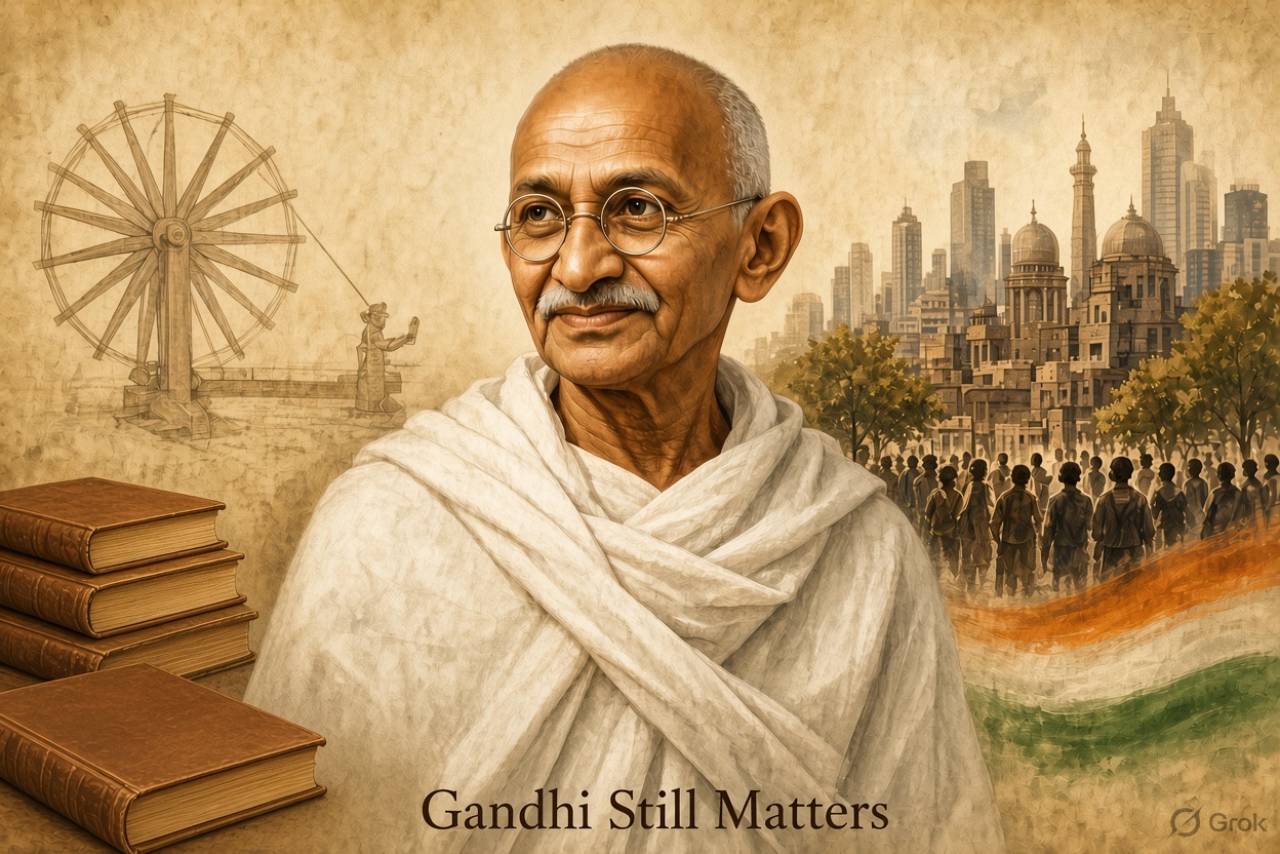
Historian Ramachandra Guha’s new book revisits Gandhi through his disagreements, ideas and influence, asking why the Mahatma continues to remain part of India’s most difficult political and social debates.
Historian Ramachandra Guha has spent years studying Mahatma Gandhi, producing two major biographies that together run to nearly 1,800 pages. Gandhi Before India, published in 2013, and Gandhi: The Years That Changed the World, 1914–1948, published in 2018, trace Gandhi’s life through extensive archival research.
His latest book, Arguments with Gandhi, takes a different route.
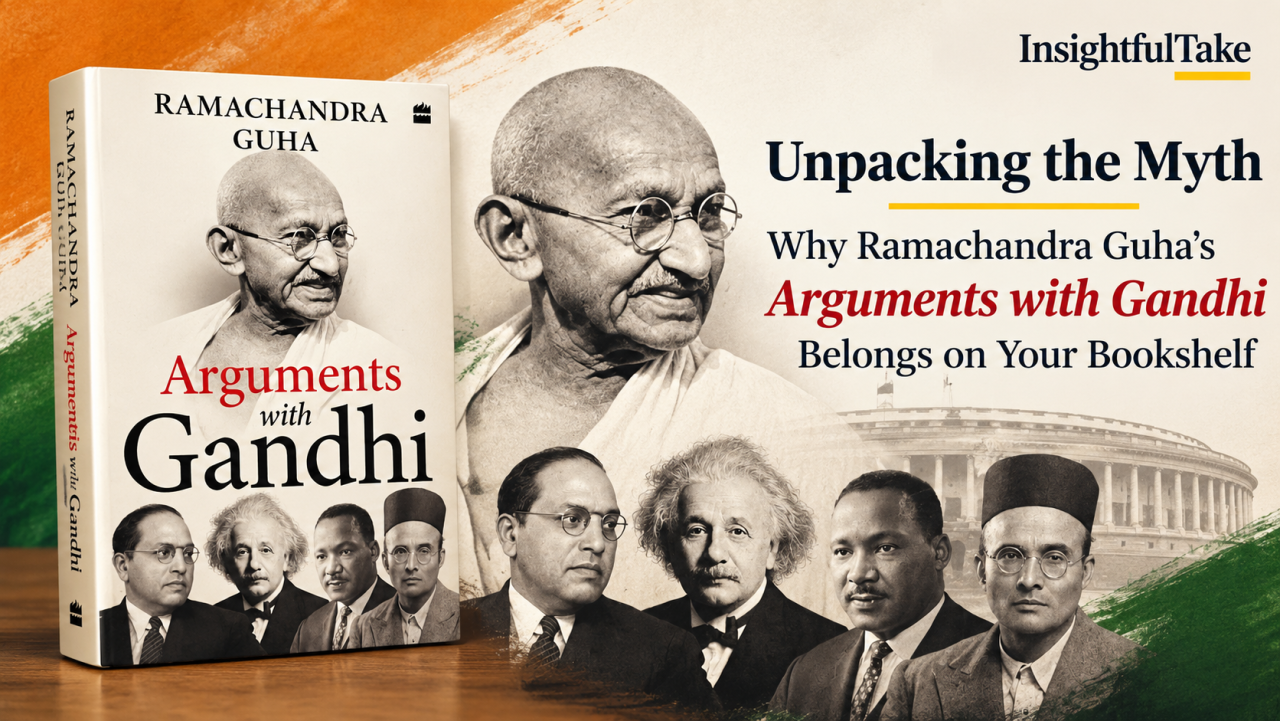
Rather than offering another biography, Guha examines Gandhi through the arguments he had with some of the most influential figures of his time and through the debates his ideas continue to generate.
The book arrives around Gandhi Jayanti 2026, at a time when Gandhi remains both a national icon and a deeply contested political figure.
The question is not whether Gandhi is remembered. He certainly is. The more difficult question is what remains of his ideas and whether they continue to offer useful ways of thinking about politics, society, religion, violence and the environment.
Guha’s answer is that they do.
From Gandhi’s Life to Gandhi’s Arguments
Guha’s earlier biographies reconstructed the many stages of Gandhi’s public life, from his years in South Africa and the development of satyagraha to his return to India, the freedom movement, campaigns against untouchability, efforts at Hindu-Muslim reconciliation and his final months before his assassination in 1948.
Arguments with Gandhi shifts the focus from chronology to debate.
Gandhi’s disagreements with B.R. Ambedkar over caste, with V.D. Savarkar over nationalism and religion, with Bhagat Singh and other revolutionaries over violence, and with Jawaharlal Nehru over economics form an important part of this intellectual landscape.
Guha also examines the influence Gandhi had beyond India. Figures such as Albert Einstein, Martin Luther King Jr. and Nelson Mandela engaged with different aspects of his thought, particularly his ideas about non-violence and political resistance.
That continuing engagement is one reason Gandhi occupies an unusual place in modern political history. Many twentieth-century leaders are primarily remembered for the offices they held, wars they fought or institutions they built. Gandhi is also remembered for a body of ideas that remains open to interpretation, criticism and adaptation.
His views on non-violence, religious pluralism, social inequality, gender, economic development and the environment continue to generate arguments.
Non-Violence as a Political Method
For Gandhi, non-violence was not simply a personal moral principle. He developed it into a method of political action.
Satyagraha, civil disobedience and mass mobilisation became central to his campaigns in South Africa and later in India. Gandhi believed that political resistance could challenge unjust authority without reproducing the violence of the system being opposed.
Research on political movements after the Second World War has also examined whether non-violent campaigns are more likely than violent campaigns to achieve their political objectives and produce democratic outcomes. The evidence has generally found significant advantages for non-violent resistance, although the results vary across countries, movements and historical circumstances.
India has seen several movements that have used elements of peaceful mass mobilisation, including the Chipko movement, the Narmada Bachao Andolan and the protests at Shaheen Bagh against the Citizenship Amendment Act.
These movements differed greatly in their demands and political contexts. They cannot simply be described as extensions of Gandhi's movement. But they demonstrate that peaceful protest remains an important part of India's democratic vocabulary.
Religious Pluralism and the Question of Majoritarianism
Perhaps no aspect of Gandhi’s political thought is more relevant to contemporary debates than his understanding of religious pluralism.
Gandhi repeatedly argued that India could not be defined by the religious identity of its majority. His political vision placed emphasis on equal moral and civic belonging for people of different faiths.
During the communal violence surrounding Partition, Gandhi travelled through areas affected by Hindu-Muslim conflict, including Noakhali. His efforts were directed towards restoring trust and preventing further violence.
This part of Gandhi’s legacy sits uneasily with political currents that define national identity primarily through religious majorities.
Guha has been particularly critical of forms of majoritarian nationalism. He has also pointed to the continuing admiration for Nathuram Godse in some sections of the Hindu right as evidence of the unresolved conflict between Gandhi’s political vision and strands of thought that opposed him during his lifetime.
At the same time, Gandhi’s own record cannot be separated from historical scrutiny. His positions on caste, gender and social reform changed over time, and some of his ideas remain controversial.
That complexity makes the debate more meaningful, not less.
Gandhi, Ambedkar and the Question of Caste
Gandhi’s relationship with B.R. Ambedkar remains one of the most important intellectual conflicts in modern Indian history.
Both opposed untouchability, but they differed sharply over the nature of caste and the political remedies required to address it.
Gandhi initially defended aspects of the traditional varna framework while campaigning against untouchability. His position evolved over time. Ambedkar, meanwhile, increasingly argued that caste itself was the foundation of social oppression and that political and legal safeguards were necessary to dismantle it.
Their disagreements were sometimes deeply personal and political.
Guha’s treatment of Gandhi does not require choosing one historical figure and dismissing the other. Instead, their arguments reveal two different approaches to social reform, equality and political representation.
That debate remains relevant because caste discrimination has not disappeared from Indian society.
Gender and Gandhi’s Contradictions
Gandhi encouraged women to participate in the freedom movement and opposed practices such as child marriage and purdah. Women became important participants in campaigns associated with the national movement.
Yet Gandhi was also a product of his time. His views about women's roles were often conservative, and his personal experiments and attitudes towards sexuality and relationships have attracted considerable criticism from later scholars.
This contradiction is important when assessing Gandhi today.
He need not be treated either as a flawless saint or as a figure whose entire legacy should be discarded. His life contains both progressive interventions and deeply contested beliefs.
Gandhi and the Ecological Question
Gandhi's criticism of uncontrolled industrialisation has acquired new relevance in the age of climate change.
In Hind Swaraj, published in 1909, Gandhi questioned the assumption that industrial civilisation and ever-increasing material consumption represented unquestionable progress.
His preference for decentralised production, local economies and restraint was largely rejected by independent India as the country pursued industrialisation and large-scale economic development under Jawaharlal Nehru.
The environmental consequences of modern development have changed the context of that debate.
Climate change, pollution, resource depletion and ecological degradation have forced governments and societies to reconsider how much consumption the planet can sustain.
Gandhi was not an environmentalist in the contemporary scientific sense. His ideas cannot simply be transferred into modern environmental policy. But his emphasis on limits, restraint and the relationship between human needs and nature continues to offer a useful starting point for discussion.
Gandhi and the BJP-RSS Debate
Gandhi's relationship with the ideological tradition represented by the RSS and later associated with the BJP remains another contested part of his legacy.
During Gandhi's lifetime, sections of Hindu nationalist thought strongly disagreed with his approach to Hindu-Muslim relations, minority rights and non-violence. Gandhi's assassination in January 1948 by Nathuram Godse became one of the defining tragedies of independent India.
The RSS was banned following the assassination, although the organisation denied institutional responsibility for Gandhi's killing and the ban was subsequently lifted.
Decades later, Gandhi occupies an unusual place in Indian political life.
His image appears on currency notes. Gandhi Jayanti is a national holiday. Political leaders across the spectrum invoke his name and legacy, often in connection with cleanliness, public service, rural development or national unity.
At the same time, disagreements remain over how Gandhi's political philosophy relates to contemporary Hindutva politics and the idea of Hindu majoritarianism.
Guha has argued that the Sangh Parivar's emphasis on Hindu primacy conflicts with Gandhi's insistence on equal citizenship across religious communities. Supporters of the broader Hindutva tradition have offered different interpretations of India's civilisational and political identity.
The debate is therefore not simply about whether Gandhi is officially remembered. It is about which parts of his political philosophy are accepted, adapted or rejected.
Why Gandhi Remains Difficult to Retire
Gandhi's continuing relevance does not depend on treating him as infallible.
His record contains contradictions. His views changed. Some of his ideas have been challenged by later generations, while others have acquired new relevance in circumstances Gandhi himself could not have imagined.
That may be precisely why arguments about him continue.
Non-violence remains relevant whenever societies debate political protest and state power. Religious pluralism remains relevant wherever majority and minority identities shape public life. Gandhi's disagreements with Ambedkar remain relevant to discussions of caste and equality. His economic ideas raise questions about consumption and ecological limits.
Even his failures provide material for serious historical inquiry.
Arguments with Gandhi therefore appears less like an attempt to settle the Gandhi question than an invitation to reopen it.
Nearly eight decades after his death, Gandhi remains present not simply because institutions commemorate him, but because his ideas continue to provoke disagreement.
It may be the strongest evidence of his continuing historical relevance. A figure who generates no serious argument can eventually become a monument. Gandhi, by contrast, remains an argument in progress.
Historian Ramachandra Guha has spent years studying Mahatma Gandhi, producing two major biographies that together run to nearly 1,800 pages. Gandhi Before India, published in 2013, and Gandhi: The Years That Changed the World, 1914–1948, published in 2018, trace Gandhi’s life through extensive archival research.
His latest book, Arguments with Gandhi, takes a different route.
Rather than offering another biography, Guha examines Gandhi through the arguments he had with some of the most influential figures of his time and through the debates his ideas continue to generate.
The book arrives around Gandhi Jayanti 2026, at a time when Gandhi remains both a national icon and a deeply contested political figure.
The question is not whether Gandhi is remembered. He certainly is. The more difficult question is what remains of his ideas and whether they continue to offer useful ways of thinking about politics, society, religion, violence and the environment.
Guha’s answer is that they do.
From Gandhi’s Life to Gandhi’s Arguments
Guha’s earlier biographies reconstructed the many stages of Gandhi’s public life, from his years in South Africa and the development of satyagraha to his return to India, the freedom movement, campaigns against untouchability, efforts at Hindu-Muslim reconciliation and his final months before his assassination in 1948.
Arguments with Gandhi shifts the focus from chronology to debate.
Gandhi’s disagreements with B.R. Ambedkar over caste, with V.D. Savarkar over nationalism and religion, with Bhagat Singh and other revolutionaries over violence, and with Jawaharlal Nehru over economics form an important part of this intellectual landscape.
Guha also examines the influence Gandhi had beyond India. Figures such as Albert Einstein, Martin Luther King Jr. and Nelson Mandela engaged with different aspects of his thought, particularly his ideas about non-violence and political resistance.
That continuing engagement is one reason Gandhi occupies an unusual place in modern political history. Many twentieth-century leaders are primarily remembered for the offices they held, wars they fought or institutions they built. Gandhi is also remembered for a body of ideas that remains open to interpretation, criticism and adaptation.
His views on non-violence, religious pluralism, social inequality, gender, economic development and the environment continue to generate arguments.
Non-Violence as a Political Method
For Gandhi, non-violence was not simply a personal moral principle. He developed it into a method of political action.
Satyagraha, civil disobedience and mass mobilisation became central to his campaigns in South Africa and later in India. Gandhi believed that political resistance could challenge unjust authority without reproducing the violence of the system being opposed.
Research on political movements after the Second World War has also examined whether non-violent campaigns are more likely than violent campaigns to achieve their political objectives and produce democratic outcomes. The evidence has generally found significant advantages for non-violent resistance, although the results vary across countries, movements and historical circumstances.
India has seen several movements that have used elements of peaceful mass mobilisation, including the Chipko movement, the Narmada Bachao Andolan and the protests at Shaheen Bagh against the Citizenship Amendment Act.
These movements differed greatly in their demands and political contexts. They cannot simply be described as extensions of Gandhi's movement. But they demonstrate that peaceful protest remains an important part of India's democratic vocabulary.
Religious Pluralism and the Question of Majoritarianism
Perhaps no aspect of Gandhi’s political thought is more relevant to contemporary debates than his understanding of religious pluralism.
Gandhi repeatedly argued that India could not be defined by the religious identity of its majority. His political vision placed emphasis on equal moral and civic belonging for people of different faiths.
During the communal violence surrounding Partition, Gandhi travelled through areas affected by Hindu-Muslim conflict, including Noakhali. His efforts were directed towards restoring trust and preventing further violence.
This part of Gandhi’s legacy sits uneasily with political currents that define national identity primarily through religious majorities.
Guha has been particularly critical of forms of majoritarian nationalism. He has also pointed to the continuing admiration for Nathuram Godse in some sections of the Hindu right as evidence of the unresolved conflict between Gandhi’s political vision and strands of thought that opposed him during his lifetime.
At the same time, Gandhi’s own record cannot be separated from historical scrutiny. His positions on caste, gender and social reform changed over time, and some of his ideas remain controversial.
That complexity makes the debate more meaningful, not less.
Gandhi, Ambedkar and the Question of Caste
Gandhi’s relationship with B.R. Ambedkar remains one of the most important intellectual conflicts in modern Indian history.
Both opposed untouchability, but they differed sharply over the nature of caste and the political remedies required to address it.
Gandhi initially defended aspects of the traditional varna framework while campaigning against untouchability. His position evolved over time. Ambedkar, meanwhile, increasingly argued that caste itself was the foundation of social oppression and that political and legal safeguards were necessary to dismantle it.
Their disagreements were sometimes deeply personal and political.
Guha’s treatment of Gandhi does not require choosing one historical figure and dismissing the other. Instead, their arguments reveal two different approaches to social reform, equality and political representation.
That debate remains relevant because caste discrimination has not disappeared from Indian society.
Gender and Gandhi’s Contradictions
Gandhi encouraged women to participate in the freedom movement and opposed practices such as child marriage and purdah. Women became important participants in campaigns associated with the national movement.
Yet Gandhi was also a product of his time. His views about women's roles were often conservative, and his personal experiments and attitudes towards sexuality and relationships have attracted considerable criticism from later scholars.
This contradiction is important when assessing Gandhi today.
He need not be treated either as a flawless saint or as a figure whose entire legacy should be discarded. His life contains both progressive interventions and deeply contested beliefs.
Gandhi and the Ecological Question
Gandhi's criticism of uncontrolled industrialisation has acquired new relevance in the age of climate change.
In Hind Swaraj, published in 1909, Gandhi questioned the assumption that industrial civilisation and ever-increasing material consumption represented unquestionable progress.
His preference for decentralised production, local economies and restraint was largely rejected by independent India as the country pursued industrialisation and large-scale economic development under Jawaharlal Nehru.
The environmental consequences of modern development have changed the context of that debate.
Climate change, pollution, resource depletion and ecological degradation have forced governments and societies to reconsider how much consumption the planet can sustain.
Gandhi was not an environmentalist in the contemporary scientific sense. His ideas cannot simply be transferred into modern environmental policy. But his emphasis on limits, restraint and the relationship between human needs and nature continues to offer a useful starting point for discussion.
Gandhi and the BJP-RSS Debate
Gandhi's relationship with the ideological tradition represented by the RSS and later associated with the BJP remains another contested part of his legacy.
During Gandhi's lifetime, sections of Hindu nationalist thought strongly disagreed with his approach to Hindu-Muslim relations, minority rights and non-violence. Gandhi's assassination in January 1948 by Nathuram Godse became one of the defining tragedies of independent India.
The RSS was banned following the assassination, although the organisation denied institutional responsibility for Gandhi's killing and the ban was subsequently lifted.
Decades later, Gandhi occupies an unusual place in Indian political life.
His image appears on currency notes. Gandhi Jayanti is a national holiday. Political leaders across the spectrum invoke his name and legacy, often in connection with cleanliness, public service, rural development or national unity.
At the same time, disagreements remain over how Gandhi's political philosophy relates to contemporary Hindutva politics and the idea of Hindu majoritarianism.
Guha has argued that the Sangh Parivar's emphasis on Hindu primacy conflicts with Gandhi's insistence on equal citizenship across religious communities. Supporters of the broader Hindutva tradition have offered different interpretations of India's civilisational and political identity.
The debate is therefore not simply about whether Gandhi is officially remembered. It is about which parts of his political philosophy are accepted, adapted or rejected.
Why Gandhi Remains Difficult to Retire
Gandhi's continuing relevance does not depend on treating him as infallible.
His record contains contradictions. His views changed. Some of his ideas have been challenged by later generations, while others have acquired new relevance in circumstances Gandhi himself could not have imagined.
That may be precisely why arguments about him continue.
Non-violence remains relevant whenever societies debate political protest and state power. Religious pluralism remains relevant wherever majority and minority identities shape public life. Gandhi's disagreements with Ambedkar remain relevant to discussions of caste and equality. His economic ideas raise questions about consumption and ecological limits.
Even his failures provide material for serious historical inquiry.
Arguments with Gandhi therefore appears less like an attempt to settle the Gandhi question than an invitation to reopen it.
Nearly eight decades after his death, Gandhi remains present not simply because institutions commemorate him, but because his ideas continue to provoke disagreement.
It may be the strongest evidence of his continuing historical relevance. A figure who generates no serious argument can eventually become a monument. Gandhi, by contrast, remains an argument in progress.
















Leave a Comment