

Lakhisarai tragedy exposes familiar gaps in crowd management as devotees gathered for Shravan Monday prayers
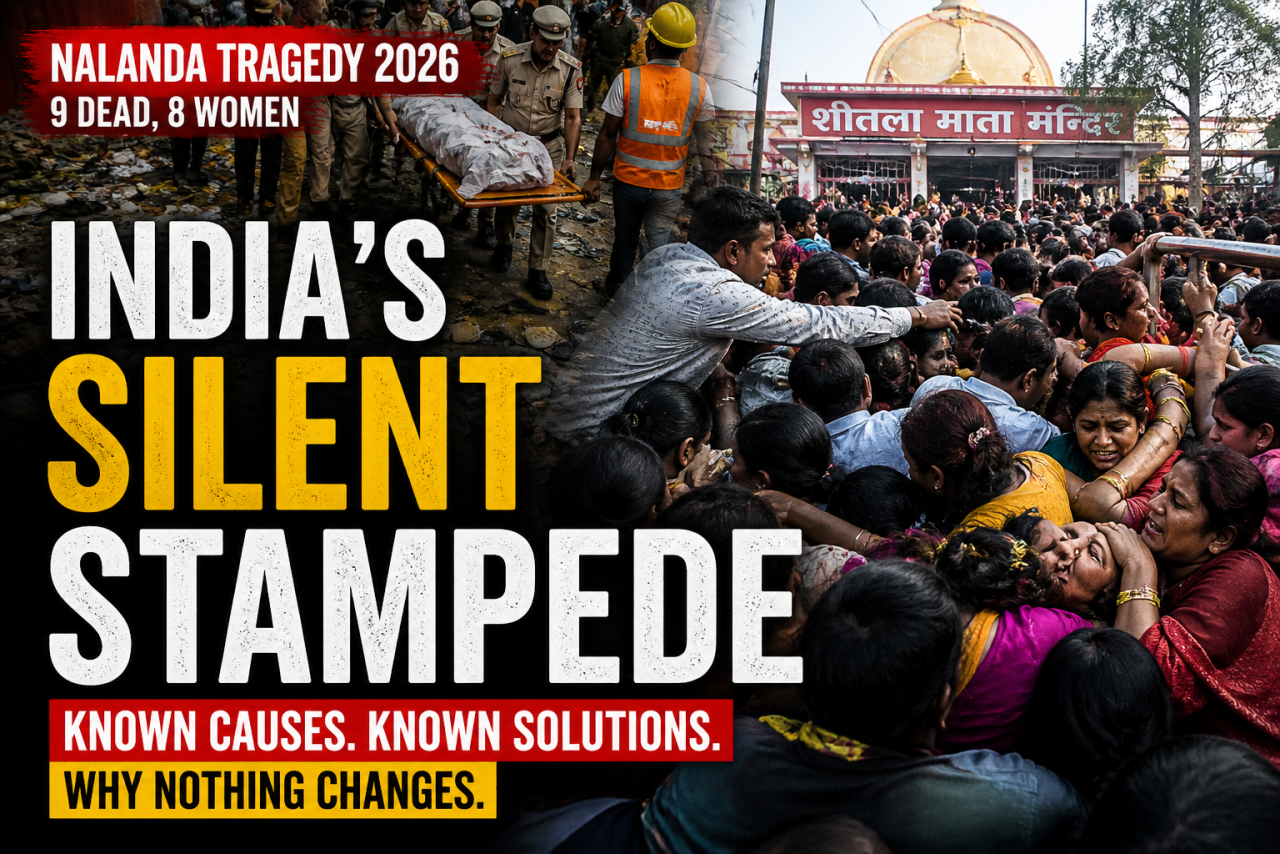
Seven women devotees were killed and around 25 people injured in a stampede near the Ashok Dham temple in Bihar’s Lakhisarai district on Monday morning. The tragedy occurred around 6:40 am on the route between Ashok Dham railway station and the temple, where thousands had gathered for Jalabhishek, the ritual offering of water to Lord Shiva during the holy month of Shravan.
What began with the collapse of an electricity pole quickly turned into a deadly panic after a rumour spread that the fallen pole was carrying live electricity.
How the Stampede Unfolded
According to Lakhisarai District Magistrate Shailendra Kumar, the crowd grew sharply between 6:20 am and 6:40 am, exceeding the numbers anticipated by the local administration.
Devotees were standing in queues along a narrow path bordering agricultural fields when an 11kV electricity pole collapsed near the crowd at around 6:39 am.
Within moments, a rumour spread that the fallen pole was live and that electricity was flowing through the surrounding field. Panic swept through the gathering as devotees began running in different directions.
The sudden movement caused several people to fall, triggering a crush in which victims were trampled underfoot.
Officials later clarified that the cable attached to the pole was insulated and was not carrying live current.
Rescue teams reached the site by around 6:45 am. By 7:20 am, seven deaths had been confirmed, while official accounts put the number of injured between 23 and 25.
The deceased were identified as Hemlata Devi, 55, Lalita Devi, 50, Savita Kumari, 35, all from Lakhisarai’s Halsi area, Manmala Devi, 44, from Barahiya, Rinku Devi, 50, from Munger, Saroj Devi, 65, from Patna, and Savitri Devi, 49, from Lakhisarai.
Compensation Announced
Bihar Chief Minister Samrat Choudhary announced compensation of ₹4 lakh for the next of kin of each victim.
President Droupadi Murmu, Vice President C.P. Radhakrishnan and Prime Minister Narendra Modi expressed condolences to the families of those who died and wished the injured a speedy recovery.
But compensation can address the immediate financial loss. It cannot answer the larger question of why a religious gathering became so vulnerable to a single rumour.
Questions Over Crowd Management
The collapse of the electricity pole may have triggered the panic, but eyewitness accounts have raised questions about whether inadequate crowd management turned the incident into a disaster.
One devotee alleged that barricades intended to divide the crowd into four or five queues broke down under pressure. According to the account, there was also little visible administrative presence to control the sudden surge.
Another eyewitness claimed that the roughly 25-foot cement pole had been installed with a base of only about two and a half feet, raising questions about its stability.
The South Bihar Power Distribution Company’s Managing Director, Saurabh Jorwal, said the pole did have a concrete base. Officials were examining whether the collapse resulted from loosened soil or pressure from the crowd.
The Bihar government has ordered an inquiry by an officer of Additional District Magistrate rank. The probe will examine whether administrative lapses contributed to the deaths.
That investigation will be important not simply to establish what happened, but to determine whether the tragedy could have been prevented.
A Pattern India Has Seen Before
The Lakhisarai stampede is not an isolated incident.
India has repeatedly witnessed deadly crowd disasters at religious gatherings, railway stations and public events. The National Crime Records Bureau recorded 3,074 stampede deaths across India between 2000 and 2022.
The deadliest recent example was the July 2024 Hathras stampede in Uttar Pradesh, where at least 121 people died at a religious gathering. Reports said around 250,000 people attended the event against a permitted capacity of about 80,000.
In January 2025, at least 30 pilgrims died during the Maha Kumbh’s Mauni Amavasya bathing day at the Sangam. Weeks later, on February 15, 2025, 18 people were killed in a crush at New Delhi railway station as passengers rushed to board trains for the Kumbh.
Tirupati recorded six deaths in January 2025 during the distribution of darshan tokens. In March 2023, 36 people died in Indore after a stepwell slab collapsed during a Ram Navami gathering, despite an earlier municipal warning about the structure.
Across these incidents, the circumstances differ, but the underlying vulnerabilities often look remarkably similar.
When Devotion Outruns Preparedness
Large religious gatherings are difficult to manage because organisers are dealing with something that cannot be completely controlled: human behaviour.
A rumour can move faster than an official announcement. A fallen barricade can become a bottleneck. A sudden movement by a few people can trigger thousands to move at once.
That is why crowd management cannot begin after panic starts.
It requires adequate entry and exit routes, strong barricading, continuous monitoring, emergency medical access, trained personnel and clear communication systems capable of killing rumours before they become stampede triggers.
The Lakhisarai tragedy also underlines another uncomfortable reality. A physical hazard does not have to kill people directly to become deadly. The electricity pole apparently did not electrocute anyone. The fear that it might be live was enough to set off the fatal chain of events.
The Questions That Remain
The immediate questions are straightforward.
Was the crowd larger than the administration had planned for? Were the barricades adequate? Was the electricity pole properly installed and maintained? Why did a rumour spread so quickly? Were enough personnel positioned to control the crowd? And could a clearer emergency communication system have prevented the panic?
The government inquiry will have to answer these questions.
But India’s experience with previous stampedes suggests that the real test will come after the inquiry ends.
For Lakhisarai, the tragedy has already produced the familiar aftermath: grieving families, compensation announcements and an official probe.
Seven women devotees were killed and around 25 people injured in a stampede near the Ashok Dham temple in Bihar’s Lakhisarai district on Monday morning. The tragedy occurred around 6:40 am on the route between Ashok Dham railway station and the temple, where thousands had gathered for Jalabhishek, the ritual offering of water to Lord Shiva during the holy month of Shravan.
What began with the collapse of an electricity pole quickly turned into a deadly panic after a rumour spread that the fallen pole was carrying live electricity.
How the Stampede Unfolded
According to Lakhisarai District Magistrate Shailendra Kumar, the crowd grew sharply between 6:20 am and 6:40 am, exceeding the numbers anticipated by the local administration.
Devotees were standing in queues along a narrow path bordering agricultural fields when an 11kV electricity pole collapsed near the crowd at around 6:39 am.
Within moments, a rumour spread that the fallen pole was live and that electricity was flowing through the surrounding field. Panic swept through the gathering as devotees began running in different directions.
The sudden movement caused several people to fall, triggering a crush in which victims were trampled underfoot.
Officials later clarified that the cable attached to the pole was insulated and was not carrying live current.
Rescue teams reached the site by around 6:45 am. By 7:20 am, seven deaths had been confirmed, while official accounts put the number of injured between 23 and 25.
The deceased were identified as Hemlata Devi, 55, Lalita Devi, 50, Savita Kumari, 35, all from Lakhisarai’s Halsi area, Manmala Devi, 44, from Barahiya, Rinku Devi, 50, from Munger, Saroj Devi, 65, from Patna, and Savitri Devi, 49, from Lakhisarai.
Compensation Announced
Bihar Chief Minister Samrat Choudhary announced compensation of ₹4 lakh for the next of kin of each victim.
President Droupadi Murmu, Vice President C.P. Radhakrishnan and Prime Minister Narendra Modi expressed condolences to the families of those who died and wished the injured a speedy recovery.
But compensation can address the immediate financial loss. It cannot answer the larger question of why a religious gathering became so vulnerable to a single rumour.
Questions Over Crowd Management
The collapse of the electricity pole may have triggered the panic, but eyewitness accounts have raised questions about whether inadequate crowd management turned the incident into a disaster.
One devotee alleged that barricades intended to divide the crowd into four or five queues broke down under pressure. According to the account, there was also little visible administrative presence to control the sudden surge.
Another eyewitness claimed that the roughly 25-foot cement pole had been installed with a base of only about two and a half feet, raising questions about its stability.
The South Bihar Power Distribution Company’s Managing Director, Saurabh Jorwal, said the pole did have a concrete base. Officials were examining whether the collapse resulted from loosened soil or pressure from the crowd.
The Bihar government has ordered an inquiry by an officer of Additional District Magistrate rank. The probe will examine whether administrative lapses contributed to the deaths.
That investigation will be important not simply to establish what happened, but to determine whether the tragedy could have been prevented.
A Pattern India Has Seen Before
The Lakhisarai stampede is not an isolated incident.
India has repeatedly witnessed deadly crowd disasters at religious gatherings, railway stations and public events. The National Crime Records Bureau recorded 3,074 stampede deaths across India between 2000 and 2022.
The deadliest recent example was the July 2024 Hathras stampede in Uttar Pradesh, where at least 121 people died at a religious gathering. Reports said around 250,000 people attended the event against a permitted capacity of about 80,000.
In January 2025, at least 30 pilgrims died during the Maha Kumbh’s Mauni Amavasya bathing day at the Sangam. Weeks later, on February 15, 2025, 18 people were killed in a crush at New Delhi railway station as passengers rushed to board trains for the Kumbh.
Tirupati recorded six deaths in January 2025 during the distribution of darshan tokens. In March 2023, 36 people died in Indore after a stepwell slab collapsed during a Ram Navami gathering, despite an earlier municipal warning about the structure.
Across these incidents, the circumstances differ, but the underlying vulnerabilities often look remarkably similar.
When Devotion Outruns Preparedness
Large religious gatherings are difficult to manage because organisers are dealing with something that cannot be completely controlled: human behaviour.
A rumour can move faster than an official announcement. A fallen barricade can become a bottleneck. A sudden movement by a few people can trigger thousands to move at once.
That is why crowd management cannot begin after panic starts.
It requires adequate entry and exit routes, strong barricading, continuous monitoring, emergency medical access, trained personnel and clear communication systems capable of killing rumours before they become stampede triggers.
The Lakhisarai tragedy also underlines another uncomfortable reality. A physical hazard does not have to kill people directly to become deadly. The electricity pole apparently did not electrocute anyone. The fear that it might be live was enough to set off the fatal chain of events.
The Questions That Remain
The immediate questions are straightforward.
Was the crowd larger than the administration had planned for? Were the barricades adequate? Was the electricity pole properly installed and maintained? Why did a rumour spread so quickly? Were enough personnel positioned to control the crowd? And could a clearer emergency communication system have prevented the panic?
The government inquiry will have to answer these questions.
But India’s experience with previous stampedes suggests that the real test will come after the inquiry ends.
For Lakhisarai, the tragedy has already produced the familiar aftermath: grieving families, compensation announcements and an official probe.





















Leave a Comment