
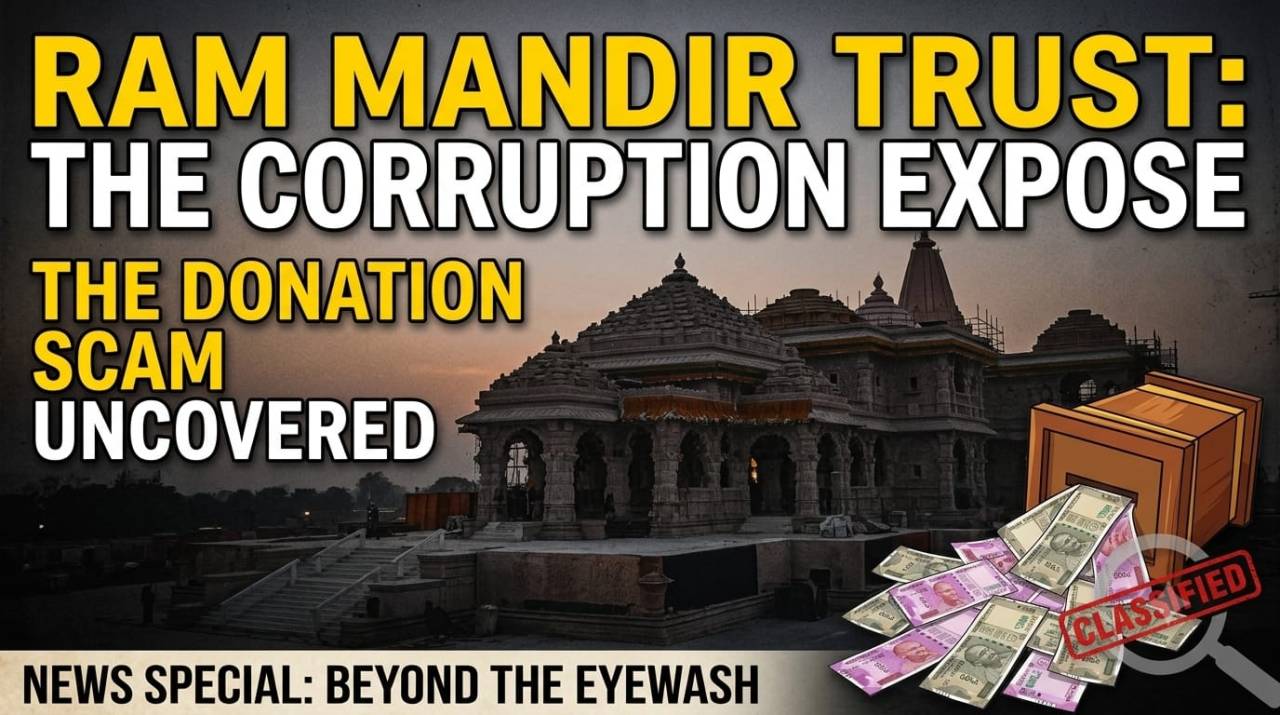
The alleged donation scam at the Ayodhya Ram Temple is more than a financial scandal. It raises urgent questions about transparency, accountability and the governance of India's richest religious institutions.
The recent revelation of a multi-crore donation scam at the Ram Temple in Ayodhya has shaken public confidence and raised troubling questions about the governance of India's most revered religious institutions. What reportedly began with the routine pocketing of currency notes by cash handlers is alleged to have evolved into a large-scale embezzlement estimated at ₹2 to ₹3 crore.
Investigations by a state-appointed Special Investigation Team (SIT) point to a disturbing pattern of institutional negligence. Standard security protocols were allegedly ignored, electronic surveillance records were not preserved as required, and individuals entrusted with handling donations reportedly bypassed established safeguards. Among those under scrutiny is a driver attached to the trust's general secretary, highlighting concerns about weak internal controls rather than isolated individual misconduct.
As demands for accountability grow, the episode exposes a larger structural problem in the management of India's temple trusts. When institutions that receive enormous public donations operate with limited independent oversight, the risk extends beyond financial loss. It begins to erode the public trust on which these institutions ultimately depend.
Inside the Breakdown of Sacred Trust
The findings emerging from the Ayodhya investigation present a classic case of governance failure. A detailed system for receiving, counting, recording and depositing daily offerings had reportedly been designed jointly by the temple trust and the State Bank of India (SBI). On paper, the process appeared robust. In practice, critical safeguards were allegedly ignored.
According to the investigation, cash counting procedures were not consistently followed, monitoring mechanisms failed to function effectively, and CCTV footage that could have strengthened accountability was reportedly not retained for the required duration. Such lapses do not merely represent administrative oversights. They reveal how even well-designed systems become ineffective when implementation is weak and accountability is absent.
The larger lesson is clear. Transparency cannot exist only in policy documents. It must be embedded in everyday operations through independent audits, real-time monitoring, clear reporting standards and strict enforcement of internal controls.
The Ayodhya case should therefore not be viewed as an isolated scandal involving one temple. It is an opportunity to initiate a broader national conversation on how religious institutions entrusted with public money should be governed. Faith deserves reverence, but institutions that manage public donations must also meet the highest standards of financial integrity.
Millions contribute to temples not merely as an act of charity but as an expression of deeply held belief. Protecting those contributions is both a moral responsibility and a public obligation. Transparency is not an attack on faith. It is one of the strongest ways to preserve it.
The recent revelation of a multi-crore donation scam at the Ram Temple in Ayodhya has shaken public confidence and raised troubling questions about the governance of India's most revered religious institutions. What reportedly began with the routine pocketing of currency notes by cash handlers is alleged to have evolved into a large-scale embezzlement estimated at ₹2 to ₹3 crore.
Investigations by a state-appointed Special Investigation Team (SIT) point to a disturbing pattern of institutional negligence. Standard security protocols were allegedly ignored, electronic surveillance records were not preserved as required, and individuals entrusted with handling donations reportedly bypassed established safeguards. Among those under scrutiny is a driver attached to the trust's general secretary, highlighting concerns about weak internal controls rather than isolated individual misconduct.
As demands for accountability grow, the episode exposes a larger structural problem in the management of India's temple trusts. When institutions that receive enormous public donations operate with limited independent oversight, the risk extends beyond financial loss. It begins to erode the public trust on which these institutions ultimately depend.
Inside the Breakdown of Sacred Trust
The findings emerging from the Ayodhya investigation present a classic case of governance failure. A detailed system for receiving, counting, recording and depositing daily offerings had reportedly been designed jointly by the temple trust and the State Bank of India (SBI). On paper, the process appeared robust. In practice, critical safeguards were allegedly ignored.
According to the investigation, cash counting procedures were not consistently followed, monitoring mechanisms failed to function effectively, and CCTV footage that could have strengthened accountability was reportedly not retained for the required duration. Such lapses do not merely represent administrative oversights. They reveal how even well-designed systems become ineffective when implementation is weak and accountability is absent.
The larger lesson is clear. Transparency cannot exist only in policy documents. It must be embedded in everyday operations through independent audits, real-time monitoring, clear reporting standards and strict enforcement of internal controls.
The Ayodhya case should therefore not be viewed as an isolated scandal involving one temple. It is an opportunity to initiate a broader national conversation on how religious institutions entrusted with public money should be governed. Faith deserves reverence, but institutions that manage public donations must also meet the highest standards of financial integrity.
Millions contribute to temples not merely as an act of charity but as an expression of deeply held belief. Protecting those contributions is both a moral responsibility and a public obligation. Transparency is not an attack on faith. It is one of the strongest ways to preserve it.




























Leave a Comment