
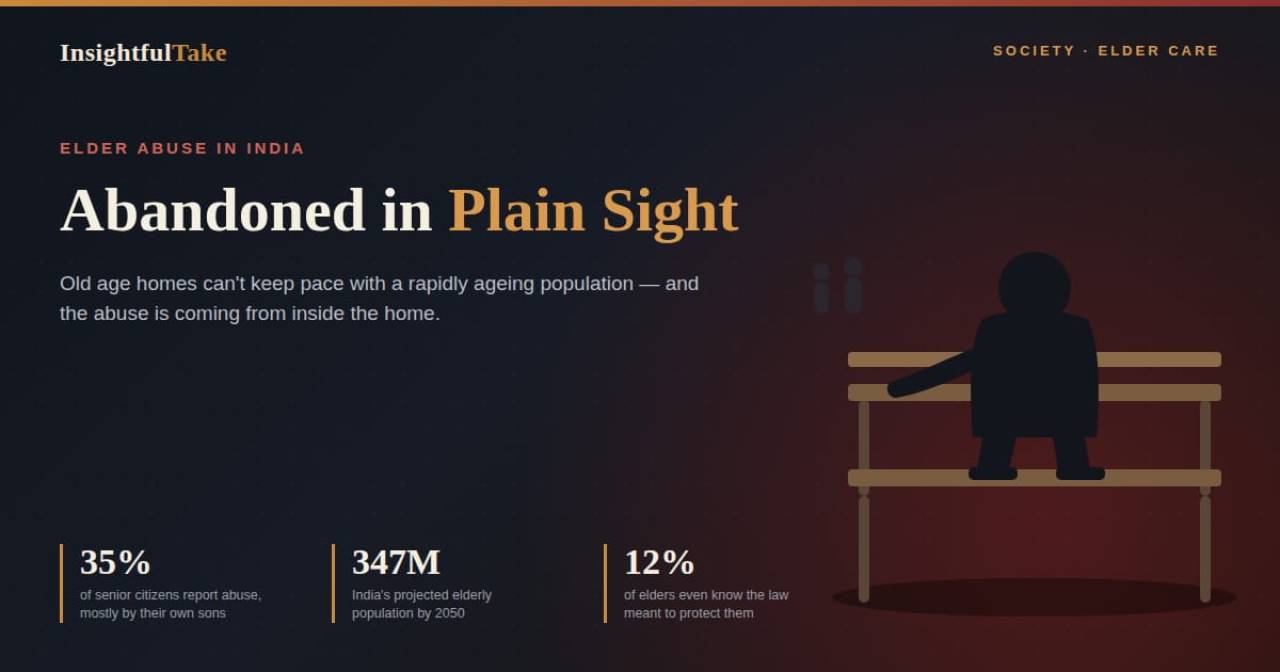
India is ageing rapidly, but its care systems are failing. Rising elder abuse and abandonment expose a growing crisis that families, society and policymakers can no longer ignore.
A 72-year-old woman left on a Delhi park bench by her own son. No money, no address, no way to call home. It sounds like an isolated tragedy. It is not. Cases like this are turning up with growing regularity in parks, railway stations, hospitals and religious sites across Indian cities, showing that the abandonment of the elderly has shifted from a rare exception to a disturbing pattern.
The numbers reinforce what these incidents reveal. The National Crime Records Bureau recorded an 18% rise in elder abuse cases between 2023 and 2024. Complaints to the national elder helpline, 14567, have also continued to increase, although officials and researchers agree these figures represent only a fraction of the actual cases. A nationwide survey by HelpAge India found that 35% of senior citizens have experienced abuse. Most strikingly, sons emerged as the most common perpetrators, even though 82% of India's elderly continue to live with their families. The abuse is not occurring in institutions or on the streets. It is taking place within the home.
A demographic wave with nowhere to land
India's elderly population is expanding rapidly. Citizens aged 60 and above now account for around 11 to 12% of the population. By 2050, that share is projected to exceed 20%, taking the country's elderly population to nearly 347 million. India will become one of the world's fastest-ageing societies, yet its care infrastructure remains far from prepared.
The mismatch between demand and capacity is already evident. Government and NGO estimates suggest there are only around 1,200 to 1,500 registered old age homes across the country, serving an elderly population that already exceeds 100 million and is expected to triple over the next 25 years. A parliamentary reply by the Ministry of Social Justice and Empowerment in December 2025 highlighted the uneven distribution of state-supported senior citizen homes. Odisha leads with 82 such facilities, followed by Andhra Pradesh with 74 and Tamil Nadu with 70, while large parts of northern and northeastern India have very limited institutional support.
Even where homes are available, demand is outstripping supply. Many newer facilities cater to families that can afford commercial retirement living, while abandoned and financially vulnerable seniors struggle to access affordable care.
The law exists. Awareness does not.
India already has legislation designed to address this challenge. The Maintenance and Welfare of Parents and Senior Citizens Act, 2007 requires children and relatives to financially support elderly parents, allows neglected parents to reclaim property transferred to children under certain conditions, and makes abandonment a punishable offence.
Yet the law has had limited impact. Data from the Longitudinal Ageing Study of India shows that only 12% of older persons are aware that such legal protection exists. A law that remains unknown to nearly nine out of ten senior citizens cannot effectively deter neglect or empower victims to seek justice.
Implementation gaps make matters worse. Tribunals established under the Act often face staffing shortages and delays. India also lacks a comprehensive legal definition of elder abuse, with different forms of mistreatment spread across multiple laws, making enforcement inconsistent.
Why this is happening now
The growing crisis reflects broader social and economic changes. Joint families are steadily giving way to nuclear households. Rising living costs, urban migration and employment-related relocation have reduced the ability of many families to care for ageing parents, even when they wish to do so.
Age discrimination further marginalises older people by limiting opportunities for continued economic participation and social engagement. Meanwhile, affordable care facilities remain too few to bridge the widening gap between family support and institutional care.
Older women often face greater vulnerability because of long-standing gender inequalities within households. They are disproportionately exposed to neglect, emotional abuse and financial dependence, underscoring the need for policies that specifically address their circumstances rather than treating all elderly citizens as a single group.
What closing the gap requires
Some promising initiatives are beginning to emerge. Several states have introduced home-based care programmes, pilot projects for independent living communities and community-based day-care centres supported by non-governmental organisations. However, these efforts remain fragmented and fall well short of the scale required.
Three priorities stand out. First, nationwide awareness campaigns must dramatically improve public understanding of the Maintenance and Welfare of Parents and Senior Citizens Act, 2007. Second, maintenance tribunals require greater funding, staffing and faster procedures to ensure legal protections are meaningful. Third, India must significantly expand affordable old age homes, community care services and home-care support, particularly in underserved states beyond the traditional southern strongholds.
Without these reforms, elder abuse and abandonment are likely to rise alongside India's ageing population. The country risks entering an era where demographic change outpaces both public policy and social responsibility, leaving countless senior citizens to spend their final years without the care, dignity and security they deserve.
A 72-year-old woman left on a Delhi park bench by her own son. No money, no address, no way to call home. It sounds like an isolated tragedy. It is not. Cases like this are turning up with growing regularity in parks, railway stations, hospitals and religious sites across Indian cities, showing that the abandonment of the elderly has shifted from a rare exception to a disturbing pattern.
The numbers reinforce what these incidents reveal. The National Crime Records Bureau recorded an 18% rise in elder abuse cases between 2023 and 2024. Complaints to the national elder helpline, 14567, have also continued to increase, although officials and researchers agree these figures represent only a fraction of the actual cases. A nationwide survey by HelpAge India found that 35% of senior citizens have experienced abuse. Most strikingly, sons emerged as the most common perpetrators, even though 82% of India's elderly continue to live with their families. The abuse is not occurring in institutions or on the streets. It is taking place within the home.
A demographic wave with nowhere to land
India's elderly population is expanding rapidly. Citizens aged 60 and above now account for around 11 to 12% of the population. By 2050, that share is projected to exceed 20%, taking the country's elderly population to nearly 347 million. India will become one of the world's fastest-ageing societies, yet its care infrastructure remains far from prepared.
The mismatch between demand and capacity is already evident. Government and NGO estimates suggest there are only around 1,200 to 1,500 registered old age homes across the country, serving an elderly population that already exceeds 100 million and is expected to triple over the next 25 years. A parliamentary reply by the Ministry of Social Justice and Empowerment in December 2025 highlighted the uneven distribution of state-supported senior citizen homes. Odisha leads with 82 such facilities, followed by Andhra Pradesh with 74 and Tamil Nadu with 70, while large parts of northern and northeastern India have very limited institutional support.
Even where homes are available, demand is outstripping supply. Many newer facilities cater to families that can afford commercial retirement living, while abandoned and financially vulnerable seniors struggle to access affordable care.
The law exists. Awareness does not.
India already has legislation designed to address this challenge. The Maintenance and Welfare of Parents and Senior Citizens Act, 2007 requires children and relatives to financially support elderly parents, allows neglected parents to reclaim property transferred to children under certain conditions, and makes abandonment a punishable offence.
Yet the law has had limited impact. Data from the Longitudinal Ageing Study of India shows that only 12% of older persons are aware that such legal protection exists. A law that remains unknown to nearly nine out of ten senior citizens cannot effectively deter neglect or empower victims to seek justice.
Implementation gaps make matters worse. Tribunals established under the Act often face staffing shortages and delays. India also lacks a comprehensive legal definition of elder abuse, with different forms of mistreatment spread across multiple laws, making enforcement inconsistent.
Why this is happening now
The growing crisis reflects broader social and economic changes. Joint families are steadily giving way to nuclear households. Rising living costs, urban migration and employment-related relocation have reduced the ability of many families to care for ageing parents, even when they wish to do so.
Age discrimination further marginalises older people by limiting opportunities for continued economic participation and social engagement. Meanwhile, affordable care facilities remain too few to bridge the widening gap between family support and institutional care.
Older women often face greater vulnerability because of long-standing gender inequalities within households. They are disproportionately exposed to neglect, emotional abuse and financial dependence, underscoring the need for policies that specifically address their circumstances rather than treating all elderly citizens as a single group.
What closing the gap requires
Some promising initiatives are beginning to emerge. Several states have introduced home-based care programmes, pilot projects for independent living communities and community-based day-care centres supported by non-governmental organisations. However, these efforts remain fragmented and fall well short of the scale required.
Three priorities stand out. First, nationwide awareness campaigns must dramatically improve public understanding of the Maintenance and Welfare of Parents and Senior Citizens Act, 2007. Second, maintenance tribunals require greater funding, staffing and faster procedures to ensure legal protections are meaningful. Third, India must significantly expand affordable old age homes, community care services and home-care support, particularly in underserved states beyond the traditional southern strongholds.
Without these reforms, elder abuse and abandonment are likely to rise alongside India's ageing population. The country risks entering an era where demographic change outpaces both public policy and social responsibility, leaving countless senior citizens to spend their final years without the care, dignity and security they deserve.



























Leave a Comment