
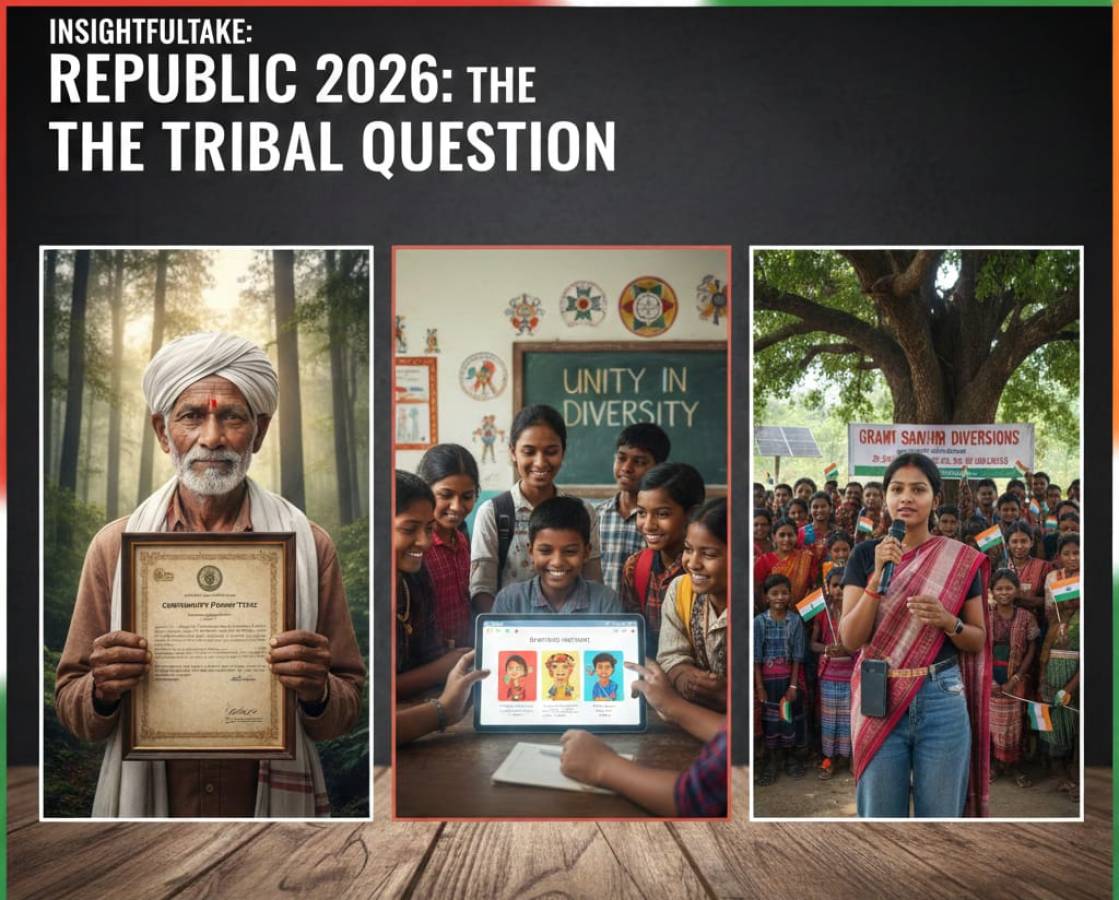
As India celebrates 77 years of the Republic, a harder question remains unanswered: who truly benefited from development?
As India marks 77 years as a Republic, the constitutional ideals of justice, liberty, equality, and fraternity are repeatedly invoked in official speeches and national celebrations. For India’s Adivasi communities, the country’s indigenous peoples, these principles have remained unevenly applied. Independence was not simply a change in political authority for them. It carried the expectation that a way of life sustained for centuries would be safeguarded and that Adivasis would receive a fair and lasting stake in the nation’s progress. More than seven decades later, that expectation remains unfulfilled.
At the time of Independence, more than thirty million Adivasis lived across India’s forests, hills, and mineral-rich regions. Often described as children of the soil, they possessed social and political traditions rooted in collective decision-making long before modern democratic theory reached the subcontinent. Despite this legacy, Adivasis entered the new Republic largely invisible within mainstream political and economic planning.
This marginalisation was shaped by history. Colonial administration treated tribal regions as zones of extraction rather than human development. Railways, mines, and forest policies were designed to serve imperial interests, while education and public services remained limited. Many tribal areas were classified as excluded or partially excluded, distancing them from broader governance. Independent India inherited this structural imbalance and, in many cases, reinforced it in the name of rapid development.
For Adivasi communities, equity has never been a narrow question of income or literacy rates. It is inseparable from land, culture, and political agency.
Land remains the foundation of Adivasi identity and survival. After Independence, large development projects including dams, mining operations, industrial corridors, and power plants were concentrated in mineral-rich tribal belts. Projects such as the Damodar Valley and Hirakud contributed significantly to national growth. The communities displaced by them, however, often received inadequate rehabilitation and little access to the electricity, employment, or wealth generated from their own land.
An equitable Republic cannot rely solely on compensation after displacement. Laws such as the Forest Rights Act and the Panchayats Extension to Scheduled Areas Act recognise the rights of Adivasis over land and local governance. Their uneven implementation has weakened their promise. Equity requires that development projects proceed only with informed consent and ensure direct, long-term benefits for local communities rather than treating displacement as an acceptable cost of progress.
Cultural recognition presents a similar contradiction. Tribal dances, attire, and music are frequently showcased during national celebrations as symbols of India’s diversity. Symbolism, however, does not equal dignity. Too often, Adivasi culture is treated as folklore frozen in time rather than as a living system of knowledge and practice.
True equity demands recognition of tribal knowledge as relevant to the present. Indigenous agricultural methods, forest conservation practices, and medicinal expertise offer sustainable alternatives at a time of climate stress and environmental degradation. When these contributions are dismissed as primitive or romanticised without serious engagement, Adivasis are denied both respect and relevance in the national imagination.
Socio-economic integration has also been shaped by external definitions of progress. Adivasi livelihoods were frequently branded backward because they did not align with industrial or commercial models of land use. Little attention was paid to the growing landlessness among tribal families or to the steady migration of Adivasis to plantations, construction sites, and industrial centres after traditional livelihoods collapsed.
A more equitable approach must begin with education that respects tribal languages and oral traditions while equipping younger generations for participation in the modern economy. Infrastructure such as electricity, healthcare, and digital connectivity must reach remote tribal hamlets so development does not bypass those living at its margins. Political representation must reflect meaningful participation rather than symbolic presence, drawing from the democratic ethos already embedded in many tribal institutions.
After 77 years, the Republic must move beyond inclusion as a gesture and towards partnership as a principle. The outdated idea of civilising or assimilating tribal communities has no place in a constitutional democracy. Equity cannot mean absorption into a single model of development. It must mean shared decision-making and shared outcomes.
A significant portion of India’s mineral wealth lies beneath Adivasi land. If national prosperity is built on these resources, justice demands that its benefits flow back to the communities that have protected and sustained them for generations. Celebrating tribal identity during ceremonial occasions is easy. Ensuring land security, cultural dignity, and political agency is far harder.
The Republic will truly honour its constitutional ideals only when Adivasi citizens can claim, in lived reality and not just in law, that they have received a fair share in the nation they have long sustained.




















Leave a Comment