
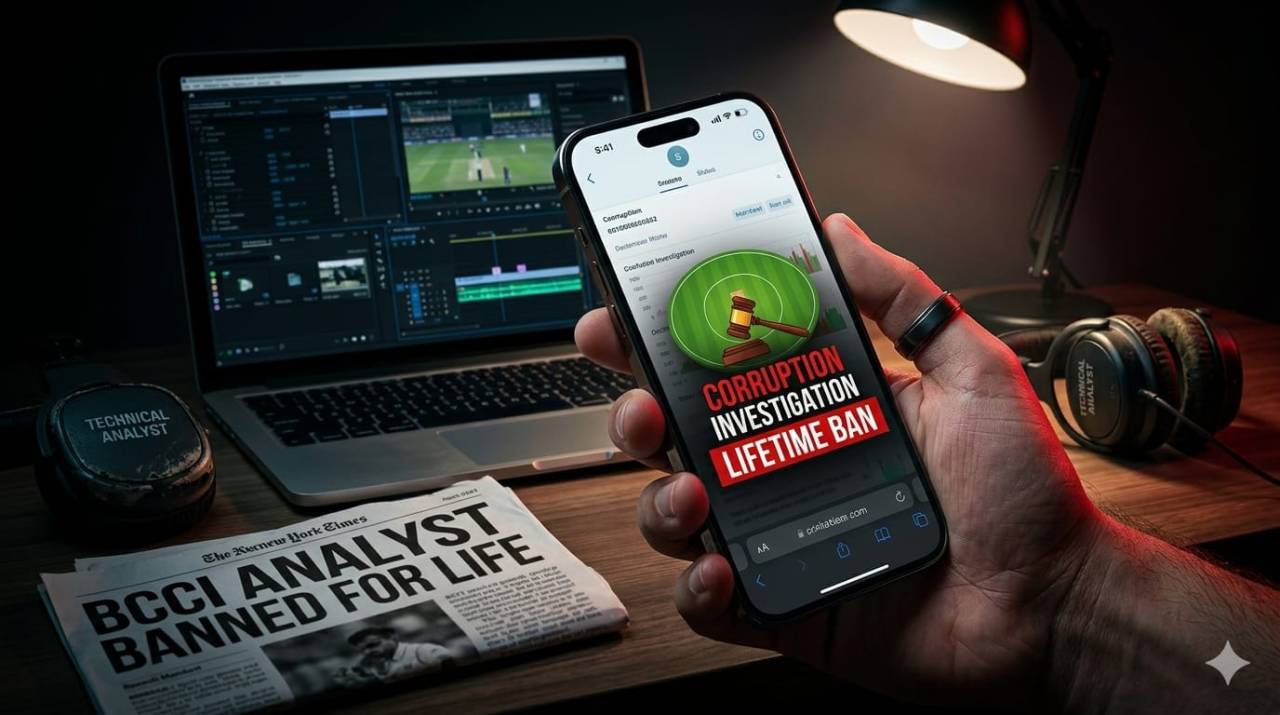
A video analyst with access to the third umpire’s room allegedly tried to manipulate a Ranji Trophy match for ₹5 lakh. The BCCI’s investigation uncovered betting accounts, digital wallets, and a hidden gambling trail—raising serious questions about corruption inside cricket’s technical ranks.
The sanctity of the 22 yards has always been a matter of national pride in India. In a country where cricket is less a sport and more a secular religion, any whisper of “fixing” is treated as heresy. Yet, a recent lifetime ban handed down by the Board of Control for Cricket in India (BCCI) serves as a chilling reminder that the rot of corruption doesn’t just reside in the players’ dugout or the bookies’ den—it has infiltrated the very technical support staff entrusted with the game’s integrity.
The case of Raja Reddy, a video analyst whose career was permanently extinguished by the BCCI Ombudsman, is a cautionary tale of how modern technology and proximity to the game are being weaponized for illicit gain.
A Calculated Betrayal in Indore
The incident dates back to the high-stakes quarter-final of the Ranji Trophy 2024 between Andhra and Madhya Pradesh. Reddy, who held official accreditation and had access to the inner sanctum of the third umpire and match referee’s room, wasn't just analyzing footage. He was allegedly hunting for a payday.
Evidence reveals that Reddy approached Andhra player Girinath Reddy with a proposition that reads like a script from a dark underworld drama: a bribe of ₹5 lakh in exchange for conceding five runs in two specific overs. It was a classic spot-fixing maneuver—subtle enough to escape the casual eye, but significant enough to swing the fortunes of gamblers.
Fortunately, the fortress of Indian cricket held firm. Girinath Reddy didn't just refuse the bribe; he showed the kind of moral steel that the sport desperately needs. He reported the incident to his team manager, triggering a swift investigation by the BCCI’s Anti-Corruption Unit (ACU).
The Digital Paper Trail
Reddy’s defense was a flimsy façade of “curiosity.” He claimed he was merely asking about the playing XI due to “groupism” within the Andhra team. However, the ACU’s forensic dive into his digital life told a much darker story. Despite Reddy deleting his WhatsApp history, investigators unearthed a trail of evidence that was impossible to ignore:
- Betting Accounts: Multiple email IDs on his phone were linked to bet365, a global gambling platform.
- Financial Links: He maintained a Skrill account—a digital wallet often used for international betting transactions—with records showing direct deposits into betting accounts.
- Active Participation: Perhaps most damning was the discovery that his betting profile was reactivated in February 2023, a period during which he was officially bound by the BCCI Anti-Corruption Code.
A Grave Ill to National Pride
BCCI Ombudsman Arun Mishra did not mince words in his order, describing betting by participants as a “grave ill” capable of eroding public confidence in the sport. When an analyst—a person paid to provide objective data—begins to view the game through the lens of the “satta” gambling market, the very spirit of cricket stands compromised.
This is not merely about one individual losing his career. It highlights the vulnerability of the system. Video analysts have access to sensitive information—pitch reports, player fitness updates, tactical plans—often well before the public or even commentators.
If such “insider trading” of cricket intelligence goes unchecked, the game risks becoming a scripted performance rather than a genuine sporting contest.
Final Take: Zero Tolerance
The lifetime ban on Raja Reddy represents both a victory and a warning. Corruption in cricket is evolving. It is shifting from shady stadium corners and whispered deals to encrypted chats and digital wallets.
By acting decisively, the BCCI has sent an unmistakable message: whether you are a star player or a technician behind a laptop in the video room, trading the integrity of the game for personal gain will carry irreversible consequences.
Cricket in India is built on trust—trust from players, administrators, and above all, millions of passionate fans. Protecting that trust now requires vigilance that extends beyond the pitch. As technology becomes more deeply embedded in the sport, safeguarding cricket’s soul will demand that scrutiny of support staff be just as rigorous as the monitoring of players.
Because if the guardians of the game begin to wield digital daggers of insider greed, the wound they inflict could cut far deeper than any match-fixing scandal of the past.
























Leave a Comment