
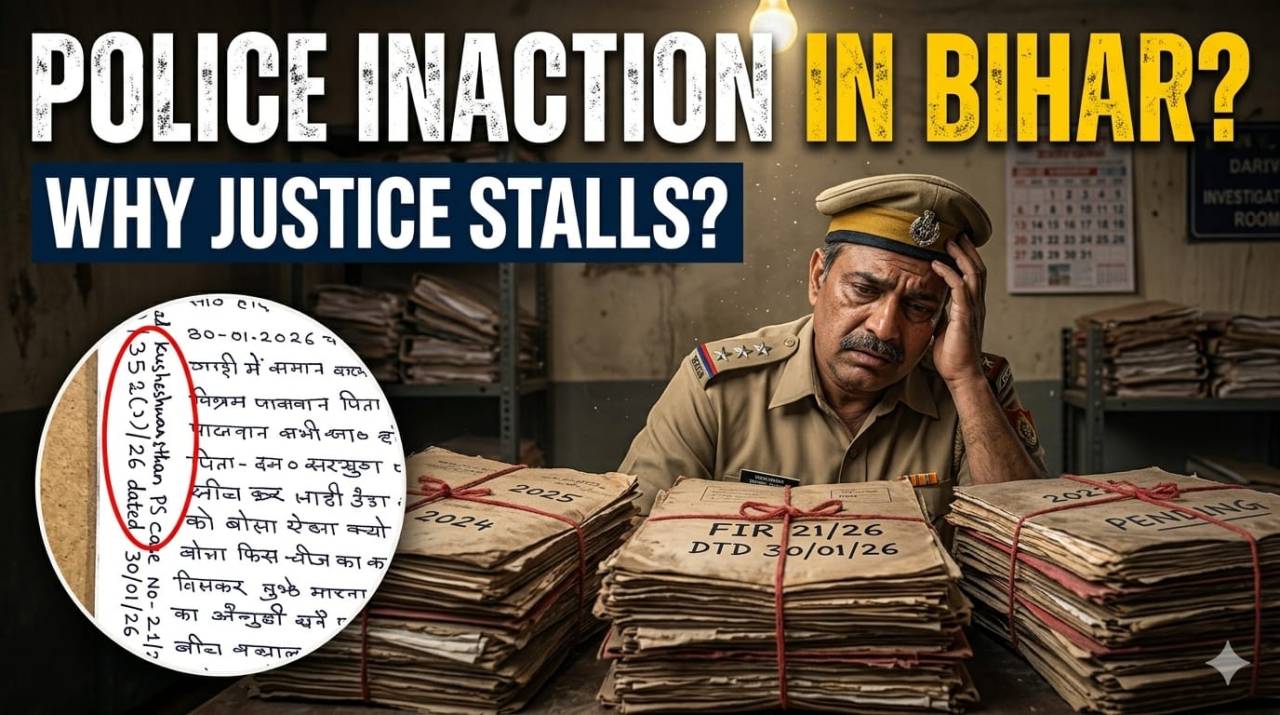
An assault, a registered FIR, and 40 days of silence—Harinagar’s wait for justice is raising uncomfortable questions about rural policing in Bihar.
More than forty days after a violent assault shook Harinagar village in Darbhanga district, the promise of justice appears to be stalled in silence. What began as a shocking episode of violence on January 30, 2026, has now turned into a troubling example of how rural criminal investigations often drift into inertia.
On that afternoon, residents of Harinagar village alleged that a group from the Paswan community, reportedly led by Kailash Paswan, entered the premises of a Brahmin household and physically assaulted members of the family. According to the complaint, Shrinath sustained a head injury during the attack, while gold jewelry and cash were also allegedly snatched. By evening, an FIR—Case No. 21/26—was registered at Kusheshwar Asthan Police Station under several provisions of the Bharatiya Nyaya Sanhita, including Section 303(2) related to theft and Section 352 concerning intentional insult intended to provoke a breach of peace.
However, despite the formal registration of the complaint, the investigation appears to have made little visible progress. As of mid-March, no arrests have been reported, and villagers claim the accused individuals continue to move freely in the area. For the complainant family, the delay has deepened a sense of insecurity. For the broader community, it has revived familiar questions about how quickly justice moves in rural India.
Attempts to obtain an official response from the officers at Kusheshwar Asthan Police Station were unsuccessful at the time of publication.
The stagnation of this case reflects a larger challenge in Bihar’s criminal justice system. According to the National Judicial Data Grid, more than 3.1 million criminal cases remain pending across the state’s courts as of early 2026. A significant share of these cases originate from police investigations that either move slowly or remain incomplete for extended periods.
In districts like Darbhanga, the burden on investigators is often immense. Police officers assigned to investigation duties frequently handle dozens of cases at once. At many rural stations, a single investigating officer may manage between 50 and 100 active files simultaneously. Under such pressure, the quality and speed of investigations inevitably suffer.
Police officials often cite administrative overload as one of the main reasons for delays. Officers who are expected to investigate crimes are regularly reassigned to law-and-order duties, including festival deployments, election security, and VIP movements. These assignments are essential for public order, but they also reduce the time officers can devote to evidence collection and witness examination.
Another structural challenge lies in the limited use of scientific investigation tools in rural policing. While the Bihar government recently flagged off dozens of mobile forensic vehicles to strengthen evidence-based investigations, many remote police stations still rely heavily on eyewitness accounts rather than immediate forensic documentation. In cases involving theft or physical assault, the absence of early forensic collection often weakens the investigative process and prolongs decision-making.
Local observers also point to what is often called the “counter-case culture” in rural disputes. When one party files a complaint, the accused frequently respond by threatening to file a counter-FIR. This creates a legal stalemate where police officers hesitate to act quickly, claiming they must first “verify both sides.” While such caution is meant to prevent wrongful arrests, it can also give alleged offenders time to influence witnesses or escalate tensions within the community.
Behind these operational challenges lies a deeper structural issue: India’s police-to-population ratio. Despite major legal reforms—including the replacement of the Indian Penal Code with the Bharatiya Nyaya Sanhita in 2024—staffing levels in many states remain far below recommended standards. In rural districts especially, the investigative workload continues to outpace available manpower.
For the residents of Harinagar, the consequences are immediate and deeply personal. The complainant, Hemkant Jha, says the family now lives with uncertainty as the legal process drags on. Villagers fear that prolonged silence from authorities could embolden criminal behavior and weaken trust in the justice system.
Legal experts often warn that delayed investigations have ripple effects far beyond a single case. When an FIR with named suspects and reported injuries fails to move forward for weeks, it sends a message that accountability may be negotiable. In rural communities where social tensions can already run high, such perceptions can erode faith in institutional authority.
The responsibility for breaking this cycle ultimately rests with higher administrative oversight. Observers say intervention from district leadership—particularly the office of the Senior Superintendent of Police—could help accelerate the investigation and restore confidence in the process.
For now, Case No. 21/26 stands as a reminder that the law’s silence can sometimes be as powerful as its voice. In Harinagar, the community continues to wait for a sign that the machinery of justice has not stopped moving altogether.





















Leave a Comment