
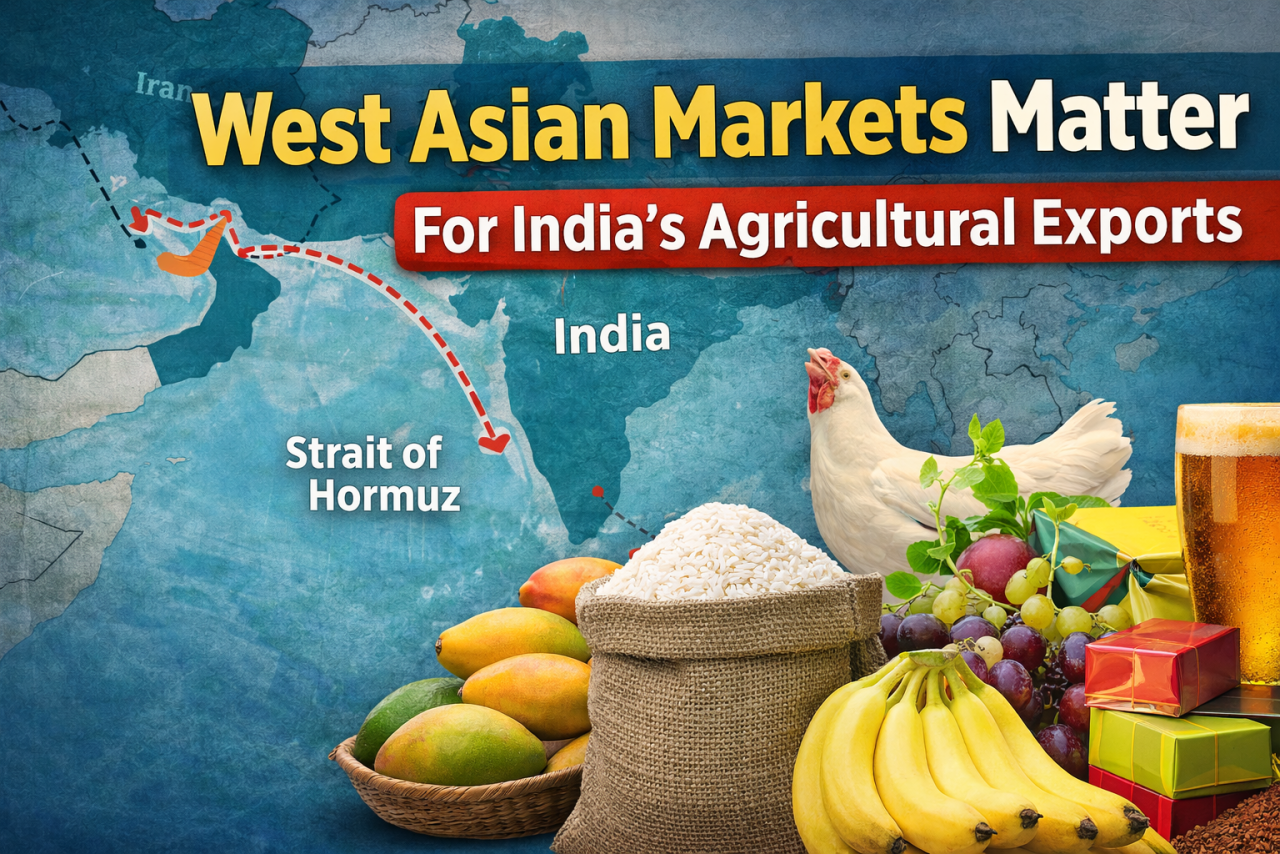
India sends a surprisingly large share of its farm exports to West Asia. From fruits and rice to tea and poultry, several key agricultural products depend heavily on buyers in this region. The numbers reveal why trade routes like the Strait of Hormuz have become crucial for India’s agricultural economy.
Trade routes and distant markets often look like abstract ideas in economic discussions. But for India’s farmers and food exporters, markets in West Asia are deeply important. A close look at export data shows that several Indian agricultural products depend heavily on buyers in West Asian countries. Any disruption in that region, especially around key shipping routes like the Strait of Hormuz, could have real consequences for India’s agricultural trade.
At first glance, West Asian nations may not appear overwhelmingly dominant in India’s export basket. Together, nine countries in the region account for only about 14 percent of India’s total exports. However, when it comes to agricultural goods and natural resources, their importance becomes much clearer. Around 21 percent of India’s agricultural exports and about 18 percent of exports of ores and minerals go to these countries. This means the region plays a much larger role in farm trade than its overall share suggests.
The dependence becomes even more visible when individual products are examined. Fresh fruits stand at the top of the list. Nearly 44.4 percent of India’s fresh fruit exports go to West Asian countries. This means almost half of the fruit that India sends abroad is bought by markets in this region. For fruit growers and exporters, these countries are not just another market; they are the primary destination.
Poultry and dairy products show a similar pattern. Around 42.97 percent of India’s exports of these products go to West Asian buyers. These items require steady demand and reliable transport. The fact that such a large share goes to one region shows how closely linked India’s livestock-based exports are to West Asian consumption.
Cashew exports also depend heavily on this region. About 42.37 percent of India’s cashew exports head toward West Asia. Tea exports follow closely, with 38.3 percent of India’s tea shipments going there. These numbers indicate that traditional export commodities, including tea and processed food items, still find a strong market in West Asian countries.
Another interesting category is alcoholic beverages. About 37.18 percent of India’s exports in this category go to the same group of countries. Rice, one of India’s most important agricultural exports, also shows significant dependence. Around 35.66 percent of Indian rice exports are destined for West Asia. Rice is a staple food in many countries in the region, and India has long been a major supplier.
The trend continues across several other agricultural products. Nearly 29.65 percent of India’s exports of meat and meat preparations go to these markets. Fresh vegetables also have a strong presence, with about 26.93 percent being shipped to the region. Tobacco exports show a share of 25.55 percent, while processed fruits and juices account for about 21.71 percent. Pulses exports to these countries stand at roughly 21.36 percent.
Individually, many of these products may represent less than one percent of India’s total exports. However, when combined, they form a significant portion of the country’s agricultural trade. The pattern clearly shows that West Asian markets absorb a substantial share of many Indian food products.
Geography and logistics help explain this relationship. West Asia is relatively close to India compared to many other export markets. Shipping times are shorter, transport costs are lower, and established trade links have developed over decades. Large Indian communities living in several West Asian countries also contribute to demand for familiar food products such as rice, spices, fruits, and processed items.
However, this dependence also creates vulnerability. Much of the shipping traffic between India and West Asia passes through the Strait of Hormuz, one of the most critical maritime chokepoints in the world. Any disruption in this route due to geopolitical tensions or conflict could slow down shipments or increase costs. That would directly affect exporters and farmers whose products rely on these markets.
This does not mean the relationship is negative. In fact, West Asia has been a stable and growing destination for Indian agricultural goods. The region provides a large consumer base that values Indian food products. At the same time, the data highlights the need for diversification.
India may benefit from expanding agricultural exports to other regions such as Africa, Southeast Asia, and Europe. Doing so would reduce the risks that come from depending too heavily on one region.
For now, the numbers tell a clear story. Even though West Asia accounts for a modest share of India’s overall exports, it remains one of the most crucial markets for Indian agriculture. For farmers, exporters, and policymakers, keeping this trade route stable and open is not just a strategic issue. It is directly tied to the future of India’s farm economy.






















Leave a Comment