
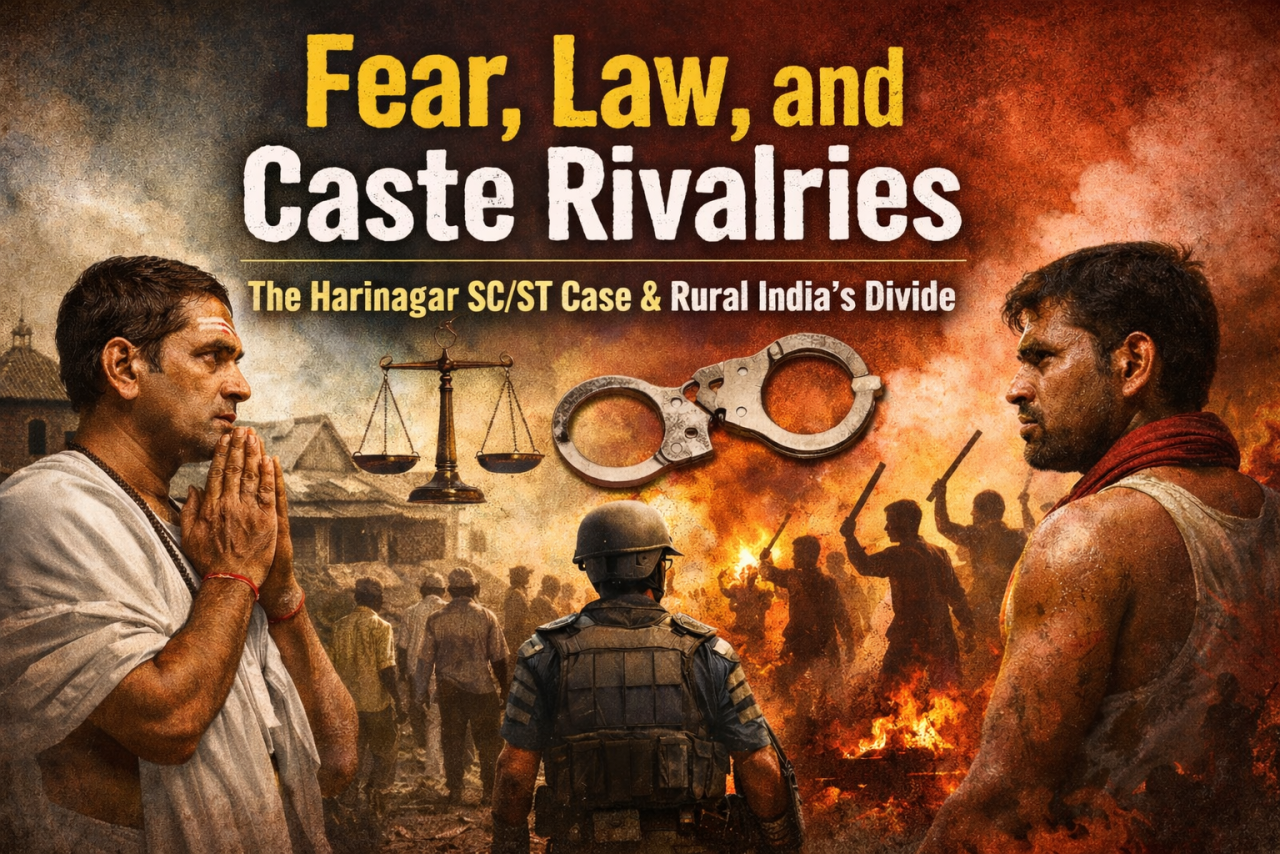
A village dispute in Bihar’s Harinagar has turned into a legal storm, forcing families to flee and raising difficult questions about how the SC/ST Act operates in rural India. As arrests mount and tensions deepen, the case is igniting a wider debate on justice, fear, and the fragile balance of caste relations in India’s villages
A criminal case from a small village in Bihar has triggered a debate that reaches far beyond its geographical boundaries. The developments in Harinagar have once again brought attention to a sensitive question in India’s social and legal landscape: how powerful laws meant to protect the vulnerable interact with the realities of village rivalries, caste identities, and long-standing local disputes.
The controversy surrounding the Harinagar SC/ST case has led to arrests, legal battles, and reports of families leaving their homes temporarily to avoid detention. More importantly, it has ignited discussions among villagers, legal observers, and social commentators about whether strict legal provisions sometimes create fear and uncertainty in rural communities.
The Scheduled Castes and Scheduled Tribes (Prevention of Atrocities) Act was enacted to address one of India’s most painful historical realities: the systematic oppression and humiliation faced by Dalits and tribal communities for centuries. The law introduced strong safeguards, including stringent punishment for caste-based crimes and restrictions on anticipatory bail, in order to ensure that victims could seek justice without intimidation.
Over the years, the Act has played a significant role in bringing attention to crimes that were once ignored or dismissed. For many members of marginalized communities, the law represents dignity, recognition, and protection against discrimination.
Yet the Harinagar episode illustrates how the application of such powerful legal provisions can become complicated when disputes arise within tightly knit village societies.
According to accounts emerging from the village and the chargesheet in the case, the conflict did not begin as a major criminal confrontation. Like many disagreements in rural India, it reportedly grew out of tensions between families. However, once allegations under the SC/ST Act were introduced, the situation quickly escalated into a serious legal matter.
Police action followed, and several individuals were reportedly arrested. The possibility of immediate detention created panic among some of the accused families. As legal proceedings began, reports suggested that a number of villagers left their homes temporarily to avoid arrest while seeking legal remedies.
In small rural communities, such developments often have consequences that extend beyond the individuals directly involved. Agricultural work can be disrupted, families can become divided, and everyday village life may come under strain.
For some Brahmin families in the region, the case has reinforced a growing sense of anxiety about legal vulnerability during disputes. Many villagers express concern that arguments or conflicts unrelated to caste might still lead to charges under stringent laws, making legal defence difficult and expensive.
These concerns have been voiced not only in Harinagar but also in other parts of rural northern India where social structures are undergoing gradual change. As traditional hierarchies shift and political awareness grows across communities, interactions between caste groups sometimes become more tense.
In such an environment, legal provisions that carry severe consequences can easily become entangled with personal rivalries, land disagreements, or local power struggles.
Legal scholars often point out that the strict nature of the SC/ST Act was intentional. Historically, victims of caste-based atrocities faced enormous obstacles in registering complaints. Police reluctance, social pressure, and fear of retaliation often prevented cases from being recorded at all. The law therefore created mechanisms designed to ensure swift and serious action.
However, critics argue that in certain circumstances the absence of early scrutiny or preliminary inquiry may allow the law to be invoked during personal conflicts. When this happens, the resulting arrests and legal proceedings can create long periods of uncertainty for the accused.
The Harinagar case reflects precisely this tension between protection and perception.
Supporters of the accused claim the case arose from a local feud and that the law has intensified the conflict rather than resolving it. They argue that once the SC/ST sections are applied, the legal burden becomes extremely heavy, even before the courts examine the full facts of the matter.
On the other side of the debate, Dalit activists strongly caution against weakening or questioning the law based on individual cases. They emphasize that caste discrimination and social humiliation remain real problems in many villages, and that the SC/ST Act continues to serve as a vital safeguard for vulnerable communities.
From their perspective, focusing too heavily on alleged misuse risks undermining a legal framework that has empowered victims to speak out against injustice.
The reality is that both concerns exist simultaneously within India’s complex social landscape.
Rural society is not static. Economic changes, education, migration, and political mobilization have gradually reshaped village dynamics. Communities that were historically marginalized have gained greater voice and representation, which is an important step toward social equality. At the same time, this transition sometimes produces friction as older social structures evolve.
When such tensions intersect with strict criminal laws, disputes can escalate quickly and take on broader social dimensions.
What cases like Harinagar reveal is the need for careful and transparent legal processes. Strong protection against caste-based atrocities must remain intact, but fair investigation procedures are equally essential to maintain public trust in the justice system.
Thorough fact-finding by police, responsible handling of complaints, and faster judicial review can help ensure that genuine victims receive justice while minimizing the risk of legal escalation in local rivalries.
Ultimately, the courts will decide the outcome of the Harinagar case. But the discussion it has sparked highlights a deeper challenge for India: balancing historical justice with social harmony in rapidly changing rural communities.
The debate is not simply about one village or one law. It is about ensuring that the legal system continues to protect the vulnerable while preserving fairness and confidence among all sections of society.
In that sense, the events in Harinagar serve as a reminder that justice in a diverse country like India must always remain both strong and carefully balanced.





















Leave a Comment