
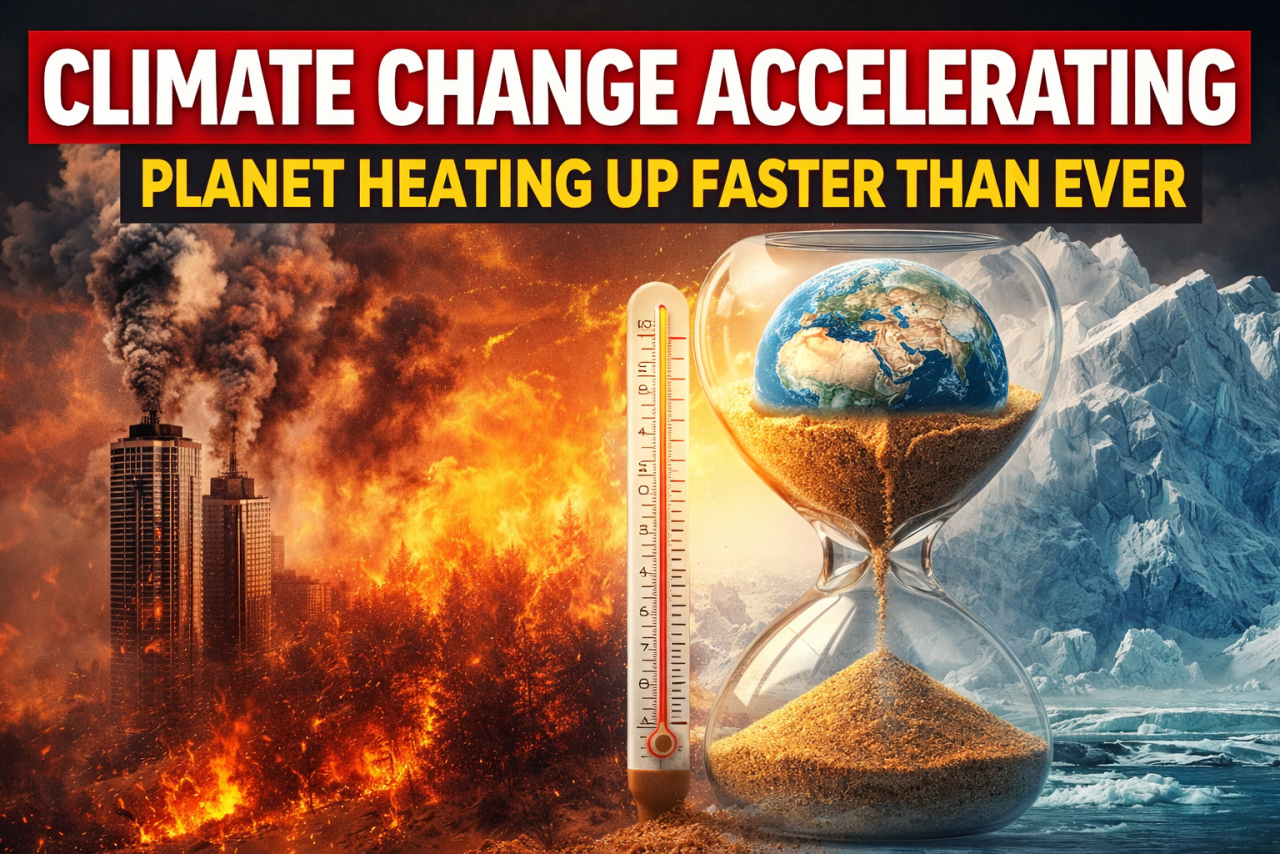
The Earth is warming faster than expected. A new study warns the last decade has seen a sharp acceleration in global temperatures, pushing the world closer to breaching the 1.5°C limit set under the Paris Agreement.
Over the past decade, the pace of global warming has increased more rapidly than scientists previously believed. A new international study suggests that Earth’s temperature is rising at a faster rate than in earlier decades, raising serious concerns about the future of the planet and humanity’s ability to control climate change.
For years, scientists have been tracking the gradual rise in global temperatures caused mainly by human activities such as burning fossil fuels, deforestation, and industrial emissions. However, recent research indicates that the warming trend has not remained steady. Instead, it has accelerated significantly during the past ten years.
Researchers analyzed multiple global temperature datasets collected by leading scientific institutions across the world. These datasets include satellite observations, land-based measurements, and ocean temperature records. After adjusting for natural influences such as volcanic eruptions, solar cycles, and climate events like El Niño, the scientists found clear evidence that the warming trend has become stronger since around 2015.
According to the findings, the average global temperature has been increasing at a faster rate compared to the second half of the twentieth century. In earlier decades, the rise in temperature was slower and appeared almost linear. But the new analysis shows that the trend is now moving upward more sharply, suggesting that climate change is entering a more intense phase.
Scientists say this shift is statistically significant, meaning it is not just a short-term fluctuation or random change. Instead, it represents a genuine acceleration in global warming. This conclusion was reached after researchers compared temperature records from several independent scientific sources, which all showed similar results.
The consequences of this accelerated warming could be far-reaching. One of the most pressing concerns is the global goal of limiting temperature rise to 1.5 degrees Celsius above pre-industrial levels. This target was established under the Paris Agreement, an international pact aimed at preventing the most dangerous impacts of climate change.
Scientists now warn that if the current rate of warming continues, the 1.5°C limit could be crossed as early as the early 2030s. This would happen much sooner than many earlier climate projections had suggested. Crossing this threshold does not mean immediate catastrophe, but it significantly increases the risks of extreme weather, rising sea levels, and long-term damage to ecosystems.
In recent years, many parts of the world have already experienced signs of these changes. Heat waves have become more intense and frequent, droughts have affected agricultural regions, and heavy rainfall events have led to floods in several countries. Such patterns are increasingly linked to the warming climate.
Experts emphasize that natural climate variations still play a role in short-term temperature changes. Phenomena such as El Niño can temporarily push global temperatures higher, while volcanic eruptions can cool the atmosphere for short periods. However, these natural factors alone cannot explain the consistent rise observed in recent decades.
Instead, the dominant driver remains the accumulation of greenhouse gases like carbon dioxide in the atmosphere. These gases trap heat and prevent it from escaping into space, gradually warming the planet. As industrial activity and energy consumption continue to grow worldwide, emissions remain high despite international efforts to reduce them.
Despite the alarming findings, scientists say the future is not entirely predetermined. The trajectory of global warming will largely depend on how quickly countries reduce greenhouse gas emissions. Rapid expansion of renewable energy, improved energy efficiency, and changes in consumption patterns could slow the rate of warming in the coming decades.
Climate researchers stress that immediate and coordinated global action is essential. While the recent acceleration in warming highlights the seriousness of the situation, it also reinforces the urgency of solutions already being discussed around the world.
Ultimately, the message from the scientific community is clear: the window to limit the most dangerous effects of climate change is narrowing. The decisions made by governments, industries, and societies today will determine whether the planet’s warming can still be kept within manageable limits.

















Leave a Comment