
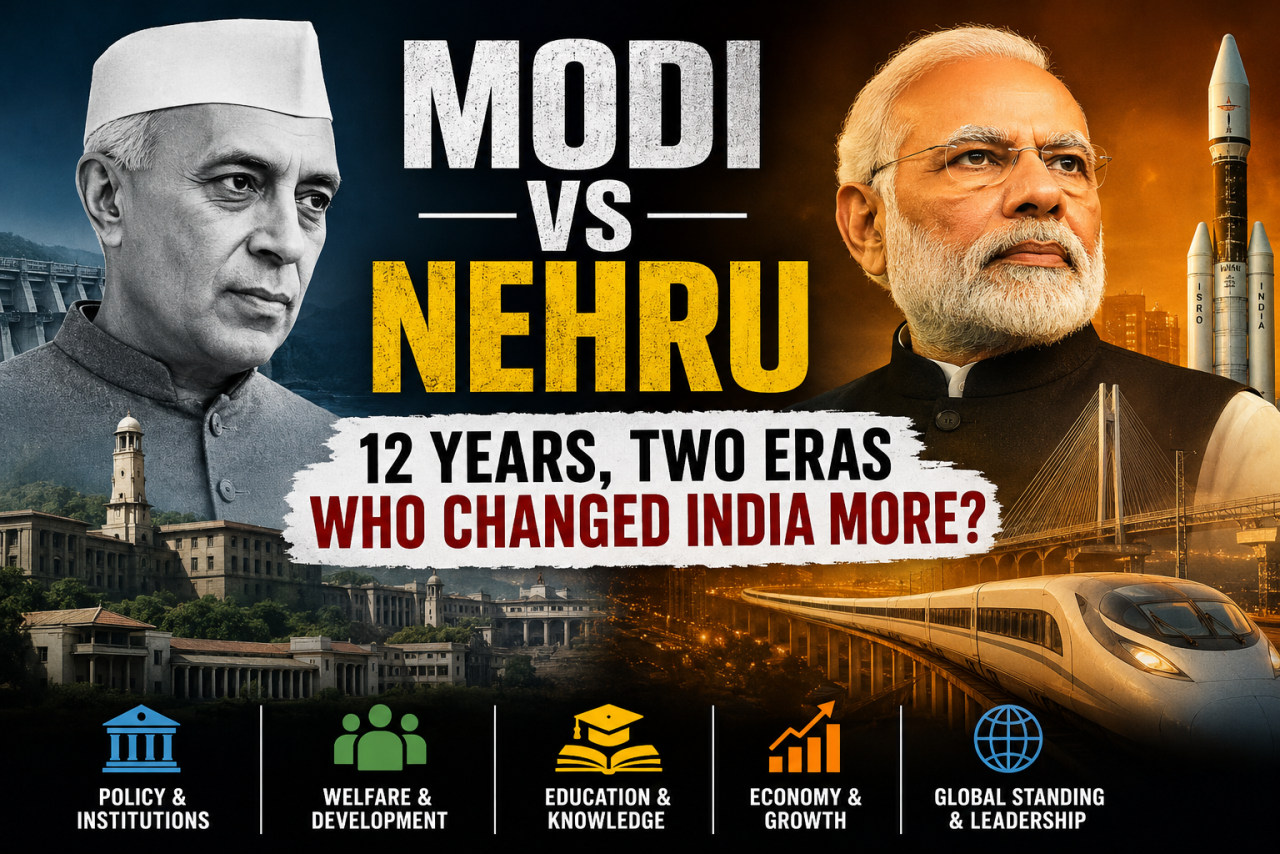
One built the institutions of modern India. The other transformed their delivery. Twelve years each, two visions, one question: whose legacy changed India more?
Two Leaders, Two Eras, One Unfinished Debate
As Prime Minister Narendra Modi completes twelve years at the helm of India's government, comparisons with India's first Prime Minister, Jawaharlal Nehru, have intensified. Supporters of the current government point to rapid infrastructure expansion, welfare delivery, digital governance, and India's growing global profile. Critics respond that the foundations enabling many of these achievements were laid decades earlier under Nehru's leadership.
The debate is often reduced to partisan slogans: one side celebrates the "builder of modern India," while the other hails the "transformer of New India." Yet history is rarely that simple.
A fair comparison requires looking beyond political branding and examining what each leader inherited, what they built, who benefited from their policies, and what challenges remained unresolved.
The question is not merely who governed better. The real question is: what kind of India did each leader seek to create, and how successful were they in doing so?
The Starting Lines Were Not the Same
When Nehru took office in 1947, India was emerging from colonial rule and the trauma of Partition. Literacy rates were abysmal, industrial capacity was limited, poverty was widespread, and democratic institutions existed largely on paper.
The state itself had to be built.
Modi inherited a vastly different nation. India already possessed functioning democratic institutions, a diversified economy, established industries, a growing middle class, and decades of accumulated infrastructure.
The challenge before him was not nation-building but nation-transformation.
Any comparison that ignores these differing starting points risks becoming political theatre rather than historical analysis.
Economy: Architect and Moderniser
Nehru's economic philosophy was rooted in state-led development. The newly independent nation lacked industrial capacity, private capital, and technological expertise. His answer was a strong public sector supported by planning and large-scale industrialisation.
Steel plants, power projects, heavy industries, scientific laboratories, and public institutions emerged during this period. Critics later blamed this model for creating bureaucratic inefficiencies and excessive state control. Yet even many opponents acknowledge that India would have struggled to industrialise without those early investments.
Modi's economic approach has been markedly different.
His government has focused on digitalisation, infrastructure, manufacturing incentives, financial inclusion, and attracting private investment. Initiatives such as GST, UPI, Jan Dhan, Production-Linked Incentive schemes, and Gati Shakti have sought to integrate markets and improve efficiency.
Supporters view this as the modernisation India needed. Critics argue that economic growth has not translated into sufficient employment opportunities and that inequality remains a significant concern.
Viewed historically, Nehru built the framework of the economy; Modi has sought to make that framework faster, more connected, and more globally competitive.
Welfare: Building Capacity Versus Delivering Benefits
The contrast is even sharper in welfare policy.
Nehru's governments focused heavily on creating public institutions—schools, hospitals, research centres, irrigation networks, and community development programmes. Welfare was often conceived through public investment rather than direct transfers.
Modi's welfare model operates through direct delivery. Technology has become the central instrument of governance. Schemes such as PM-KISAN, Ujjwala Yojana, Ayushman Bharat, Jal Jeevan Mission, and PM Awas Yojana have been designed to place benefits directly in the hands of citizens.
The scale of delivery has undeniably expanded.
However, a key debate remains unresolved. Does efficient delivery compensate for weaknesses in public health systems, government schools, and institutional capacity? Or does direct welfare represent a more effective model for a country of India's size?
The answer may shape how future historians evaluate this period.
Education: The Most Significant Divergence
If there is one area where Nehru's influence remains particularly visible, it is education and scientific development.
The IITs, AIIMS, national laboratories, research institutions, and the University Grants Commission emerged from a vision that saw science and higher education as the engines of national progress.
These institutions continue to produce much of India's scientific and technical leadership.
Modi's government has pursued reforms through the National Education Policy 2020, expanded digital learning initiatives, promoted skill development, and encouraged curriculum changes intended to reflect Indian traditions and knowledge systems.
Supporters describe these efforts as overdue reforms. Critics argue that educational debates increasingly reflect ideological battles rather than academic priorities.
While access has expanded, the comparison highlights an important distinction: Nehru focused on building institutions of knowledge; Modi has focused on expanding reach and restructuring delivery.
Infrastructure: Different Centuries, Different Priorities
The infrastructure stories of the two leaders reflect the needs of their respective eras.
For Nehru, dams, steel plants, power generation facilities, and irrigation projects symbolised national development. These projects aimed to create productive capacity in a largely agrarian economy.
For Modi, highways, expressways, airports, freight corridors, digital infrastructure, renewable energy projects, and high-speed connectivity have become the defining markers of progress.
The pace of infrastructure construction during the past decade has been one of the government's strongest political arguments.
Yet infrastructure itself raises a broader question: should success be measured by what is built, or by how effectively those assets improve social and economic outcomes?
Democracy and Institutions: The Hardest Measure
Economic statistics can be counted. Institutional health is harder to quantify.
Nehru's tenure saw the establishment and strengthening of many democratic institutions that continue to shape Indian governance today. Parliament, an independent judiciary, a professional civil service, autonomous universities, and a relatively plural media environment developed during these formative years.
Modi's supporters argue that his government has improved accountability, administrative efficiency, and policy execution. Critics counter that increasing centralisation of political power, pressure on independent institutions, and a shrinking space for dissent deserve greater scrutiny.
This remains perhaps the most contested aspect of the comparison.
History often judges leaders not only by what they achieve, but also by the resilience of the institutions that survive them.
Foreign Policy: From Non-Alignment to Global Assertiveness
Nehru positioned India as a leading voice of the newly independent world through the Non-Aligned Movement. His foreign policy sought strategic autonomy during the Cold War.
Modi's India operates in a dramatically different international environment. The emphasis has shifted toward strategic partnerships, economic diplomacy, and projecting India as a major global power.
Relations with the United States, the Gulf nations, Europe, Russia, and the Global South have all become central pillars of contemporary diplomacy.
If Nehru sought to give India an independent voice, Modi has sought to amplify that voice on a larger stage.
The Verdict History May Deliver
The temptation in modern politics is to declare a winner.
History is rarely interested in such simplicity.
Nehru's greatest achievement was constructing the institutional, industrial, educational, and democratic foundations of an independent republic. Without those foundations, many later successes would have been impossible.
Modi's strongest claim lies in execution: expanding welfare delivery, accelerating infrastructure creation, digitising governance, and projecting India with greater confidence on the world stage.
One governed an India that was being born.
The other governs an India seeking to redefine itself.
The deeper historical question may not be whether Modi surpassed Nehru or whether Nehru remains unmatched. Instead, it may be whether India can successfully combine the institutional foundations of its first generation with the administrative ambition of its current one.
Twelve years into Narendra Modi's tenure, that debate remains open—and it is likely to remain so long after today's political battles have faded into history.
Two Leaders, Two Eras, One Unfinished Debate
As Prime Minister Narendra Modi completes twelve years at the helm of India's government, comparisons with India's first Prime Minister, Jawaharlal Nehru, have intensified. Supporters of the current government point to rapid infrastructure expansion, welfare delivery, digital governance, and India's growing global profile. Critics respond that the foundations enabling many of these achievements were laid decades earlier under Nehru's leadership.
The debate is often reduced to partisan slogans: one side celebrates the "builder of modern India," while the other hails the "transformer of New India." Yet history is rarely that simple.
A fair comparison requires looking beyond political branding and examining what each leader inherited, what they built, who benefited from their policies, and what challenges remained unresolved.
The question is not merely who governed better. The real question is: what kind of India did each leader seek to create, and how successful were they in doing so?
The Starting Lines Were Not the Same
When Nehru took office in 1947, India was emerging from colonial rule and the trauma of Partition. Literacy rates were abysmal, industrial capacity was limited, poverty was widespread, and democratic institutions existed largely on paper.
The state itself had to be built.
Modi inherited a vastly different nation. India already possessed functioning democratic institutions, a diversified economy, established industries, a growing middle class, and decades of accumulated infrastructure.
The challenge before him was not nation-building but nation-transformation.
Any comparison that ignores these differing starting points risks becoming political theatre rather than historical analysis.
Economy: Architect and Moderniser
Nehru's economic philosophy was rooted in state-led development. The newly independent nation lacked industrial capacity, private capital, and technological expertise. His answer was a strong public sector supported by planning and large-scale industrialisation.
Steel plants, power projects, heavy industries, scientific laboratories, and public institutions emerged during this period. Critics later blamed this model for creating bureaucratic inefficiencies and excessive state control. Yet even many opponents acknowledge that India would have struggled to industrialise without those early investments.
Modi's economic approach has been markedly different.
His government has focused on digitalisation, infrastructure, manufacturing incentives, financial inclusion, and attracting private investment. Initiatives such as GST, UPI, Jan Dhan, Production-Linked Incentive schemes, and Gati Shakti have sought to integrate markets and improve efficiency.
Supporters view this as the modernisation India needed. Critics argue that economic growth has not translated into sufficient employment opportunities and that inequality remains a significant concern.
Viewed historically, Nehru built the framework of the economy; Modi has sought to make that framework faster, more connected, and more globally competitive.
Welfare: Building Capacity Versus Delivering Benefits
The contrast is even sharper in welfare policy.
Nehru's governments focused heavily on creating public institutions—schools, hospitals, research centres, irrigation networks, and community development programmes. Welfare was often conceived through public investment rather than direct transfers.
Modi's welfare model operates through direct delivery. Technology has become the central instrument of governance. Schemes such as PM-KISAN, Ujjwala Yojana, Ayushman Bharat, Jal Jeevan Mission, and PM Awas Yojana have been designed to place benefits directly in the hands of citizens.
The scale of delivery has undeniably expanded.
However, a key debate remains unresolved. Does efficient delivery compensate for weaknesses in public health systems, government schools, and institutional capacity? Or does direct welfare represent a more effective model for a country of India's size?
The answer may shape how future historians evaluate this period.
Education: The Most Significant Divergence
If there is one area where Nehru's influence remains particularly visible, it is education and scientific development.
The IITs, AIIMS, national laboratories, research institutions, and the University Grants Commission emerged from a vision that saw science and higher education as the engines of national progress.
These institutions continue to produce much of India's scientific and technical leadership.
Modi's government has pursued reforms through the National Education Policy 2020, expanded digital learning initiatives, promoted skill development, and encouraged curriculum changes intended to reflect Indian traditions and knowledge systems.
Supporters describe these efforts as overdue reforms. Critics argue that educational debates increasingly reflect ideological battles rather than academic priorities.
While access has expanded, the comparison highlights an important distinction: Nehru focused on building institutions of knowledge; Modi has focused on expanding reach and restructuring delivery.
Infrastructure: Different Centuries, Different Priorities
The infrastructure stories of the two leaders reflect the needs of their respective eras.
For Nehru, dams, steel plants, power generation facilities, and irrigation projects symbolised national development. These projects aimed to create productive capacity in a largely agrarian economy.
For Modi, highways, expressways, airports, freight corridors, digital infrastructure, renewable energy projects, and high-speed connectivity have become the defining markers of progress.
The pace of infrastructure construction during the past decade has been one of the government's strongest political arguments.
Yet infrastructure itself raises a broader question: should success be measured by what is built, or by how effectively those assets improve social and economic outcomes?
Democracy and Institutions: The Hardest Measure
Economic statistics can be counted. Institutional health is harder to quantify.
Nehru's tenure saw the establishment and strengthening of many democratic institutions that continue to shape Indian governance today. Parliament, an independent judiciary, a professional civil service, autonomous universities, and a relatively plural media environment developed during these formative years.
Modi's supporters argue that his government has improved accountability, administrative efficiency, and policy execution. Critics counter that increasing centralisation of political power, pressure on independent institutions, and a shrinking space for dissent deserve greater scrutiny.
This remains perhaps the most contested aspect of the comparison.
History often judges leaders not only by what they achieve, but also by the resilience of the institutions that survive them.
Foreign Policy: From Non-Alignment to Global Assertiveness
Nehru positioned India as a leading voice of the newly independent world through the Non-Aligned Movement. His foreign policy sought strategic autonomy during the Cold War.
Modi's India operates in a dramatically different international environment. The emphasis has shifted toward strategic partnerships, economic diplomacy, and projecting India as a major global power.
Relations with the United States, the Gulf nations, Europe, Russia, and the Global South have all become central pillars of contemporary diplomacy.
If Nehru sought to give India an independent voice, Modi has sought to amplify that voice on a larger stage.
The Verdict History May Deliver
The temptation in modern politics is to declare a winner.
History is rarely interested in such simplicity.
Nehru's greatest achievement was constructing the institutional, industrial, educational, and democratic foundations of an independent republic. Without those foundations, many later successes would have been impossible.
Modi's strongest claim lies in execution: expanding welfare delivery, accelerating infrastructure creation, digitising governance, and projecting India with greater confidence on the world stage.
One governed an India that was being born.
The other governs an India seeking to redefine itself.
The deeper historical question may not be whether Modi surpassed Nehru or whether Nehru remains unmatched. Instead, it may be whether India can successfully combine the institutional foundations of its first generation with the administrative ambition of its current one.
Twelve years into Narendra Modi's tenure, that debate remains open—and it is likely to remain so long after today's political battles have faded into history.

















Leave a Comment