
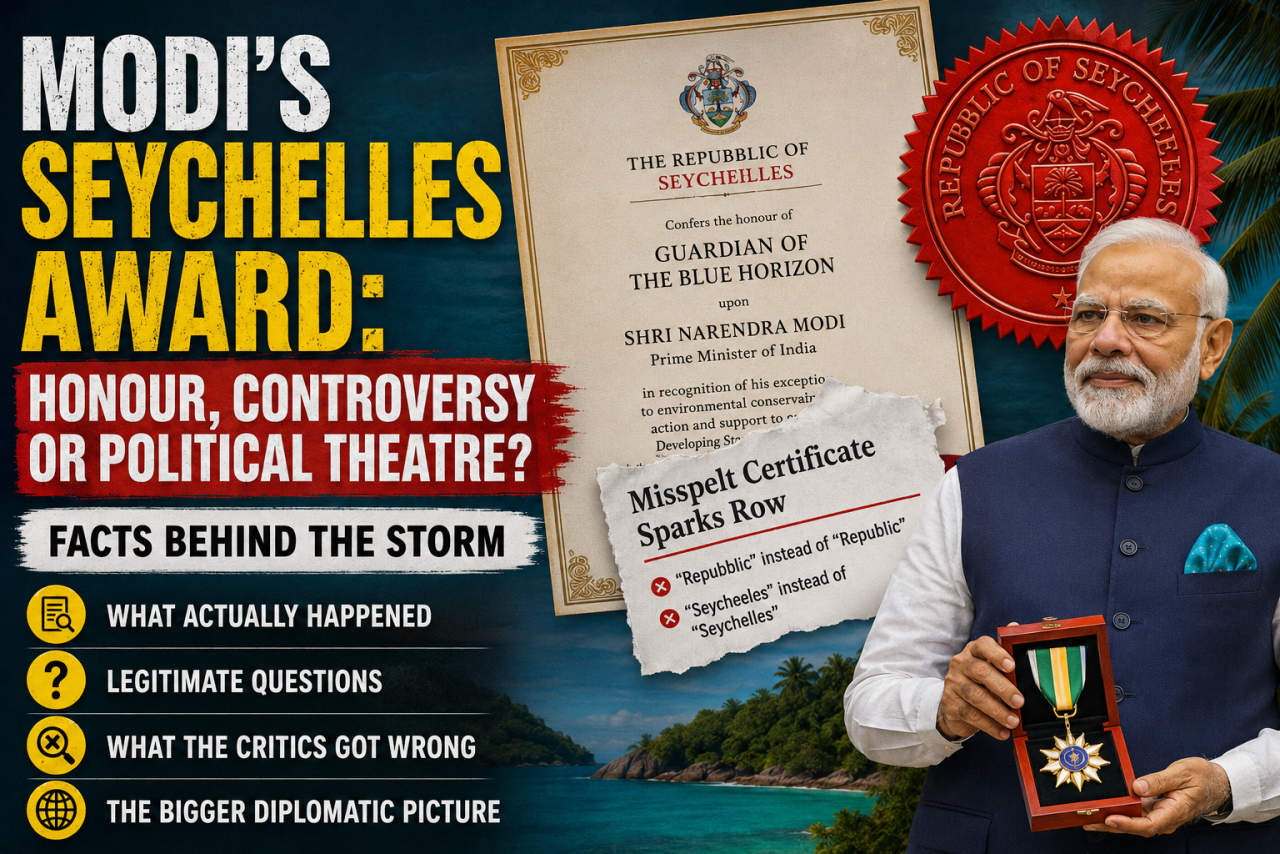
A new award, a misspelt citation, and a political storm. The facts behind Modi's Seychelles honour are far more complex than the viral narrative suggests.
When Prime Minister Narendra Modi received Seychelles' newly instituted 'Guardian of the Blue Horizon' award on June 28, it should have remained a routine diplomatic ceremony. Instead, it spiralled into a political and social media controversy, with supporters rushing to celebrate and critics rushing to discredit the honour.
Both reactions overlooked an important distinction: some criticisms are entirely legitimate, while others go well beyond what the available evidence supports.
A Diplomatic Ceremony That Became a Political Flashpoint
Modi arrived in Seychelles on a three-day state visit coinciding with the island nation's 50th Independence anniversary. During the visit, Seychelles conferred its highest newly established national distinction—the Guardian of the Blue Horizon—on the Prime Minister in recognition of his contributions to environmental conservation, climate action, and support for Small Island Developing States. Modi became the first recipient of the honour.
The political backlash followed almost immediately.
Congress spokesperson Supriya Shrinate pointed out that the award had been instituted just four days before Modi's arrival. Trinamool Congress MP Mahua Moitra described the misspelt citation as evidence of a "tearing hurry." Fact-checker Mohammed Zubair highlighted glaring typographical errors in the citation circulating online, including "Republic" being written as "Repubblic" and "Seychelles" as "Seycheeles."
Those observations triggered a wider narrative that the award itself had been hastily invented to flatter the Indian Prime Minister.
The Criticism That Deserves Serious Attention
The typographical errors are real and embarrassing. Regardless of whether they resulted from hurried drafting, poor proofreading, or administrative negligence, a state citation carrying spelling mistakes—particularly of the host country's own name—reflects poorly on the issuing authorities.
Beyond those errors lies a broader question. Modi has now received 34 international honours from foreign governments, several of them from countries that have also benefited from significant Indian financial or developmental assistance. That does not make the awards illegitimate, but it does justify asking whether such ceremonies have become an increasingly visible instrument of diplomatic symbolism.
Examining that pattern is neither partisan nor cynical. It is part of the media's responsibility to evaluate whether the optics surrounding high-profile awards sometimes overshadow the substantive outcomes of foreign policy engagements.
Where the Narrative Runs Ahead of the Evidence
The claim that Seychelles created the award solely for Modi does not withstand closer examination.
The country has been overhauling its national honours framework for several years. Seychelles enacted a National Awards Act in 2022 to establish a formal civilian honours system. Following a change in government, President Patrick Herminie's administration moved in February 2026 to repeal that legislation. Parliament subsequently passed the National Awards (Repeal) Bill, dissolving the earlier framework and clearing the way for a new honours system under the current administration.
The Guardian of the Blue Horizon emerged from that broader restructuring—not as a one-off decoration created exclusively for a visiting leader. While Modi's visit undoubtedly provided the occasion for the award's first conferment, the origins of the honours framework predate his arrival.
Equally speculative is the claim that the citation was generated using artificial intelligence. The spelling mistakes are unusual for an official document, but typographical errors alone are not evidence of AI-generated content. Government documents are frequently prepared under tight timelines, and without confirmation from Seychelles or India's Ministry of External Affairs regarding the authenticity of the circulating citation, no definitive conclusion can be drawn. It is entirely possible that the widely shared document was a draft or an unofficial version.
Awards Are Symbolic. Diplomacy Shouldn't Be.
Once speculation is separated from verifiable facts, the debate becomes more meaningful.
India announced a $175 million Special Economic Package, extended a ₹1,250 crore line of credit, handed over a Made-in-India fast patrol vessel, six ambulances, and additional equipment to Seychelles. These are tangible commitments with strategic implications in the Indian Ocean region.
The real question, therefore, is not whether Seychelles had the sovereign right to honour Modi—it unquestionably did. Rather, it is whether the growing prominence of ceremonial recognition adds measurable value to India's diplomatic objectives or merely dominates the optics of official visits.
That debate deserves evidence rather than insinuation. It requires assessing strategic outcomes, development partnerships, maritime cooperation, and regional influence—not attributing motives or psychological traits to political leaders.
The controversy surrounding Modi's Seychelles honour is neither as trivial as government supporters suggest nor as scandalous as many critics portray. The spelling errors deserve an explanation. The growing number of foreign honours received by Indian leaders deserves public scrutiny. But scrutiny loses credibility when it is built on assumptions instead of evidence.
Diplomacy should ultimately be judged by national interest, strategic partnerships, and long-term outcomes—not by medals, citations, or social media outrage. Awards may shape headlines for a day, but they rarely define the success of a bilateral relationship. That is where the real assessment belongs.
When Prime Minister Narendra Modi received Seychelles' newly instituted 'Guardian of the Blue Horizon' award on June 28, it should have remained a routine diplomatic ceremony. Instead, it spiralled into a political and social media controversy, with supporters rushing to celebrate and critics rushing to discredit the honour.
Both reactions overlooked an important distinction: some criticisms are entirely legitimate, while others go well beyond what the available evidence supports.
A Diplomatic Ceremony That Became a Political Flashpoint
Modi arrived in Seychelles on a three-day state visit coinciding with the island nation's 50th Independence anniversary. During the visit, Seychelles conferred its highest newly established national distinction—the Guardian of the Blue Horizon—on the Prime Minister in recognition of his contributions to environmental conservation, climate action, and support for Small Island Developing States. Modi became the first recipient of the honour.
The political backlash followed almost immediately.
Congress spokesperson Supriya Shrinate pointed out that the award had been instituted just four days before Modi's arrival. Trinamool Congress MP Mahua Moitra described the misspelt citation as evidence of a "tearing hurry." Fact-checker Mohammed Zubair highlighted glaring typographical errors in the citation circulating online, including "Republic" being written as "Repubblic" and "Seychelles" as "Seycheeles."
Those observations triggered a wider narrative that the award itself had been hastily invented to flatter the Indian Prime Minister.
The Criticism That Deserves Serious Attention
The typographical errors are real and embarrassing. Regardless of whether they resulted from hurried drafting, poor proofreading, or administrative negligence, a state citation carrying spelling mistakes—particularly of the host country's own name—reflects poorly on the issuing authorities.
Beyond those errors lies a broader question. Modi has now received 34 international honours from foreign governments, several of them from countries that have also benefited from significant Indian financial or developmental assistance. That does not make the awards illegitimate, but it does justify asking whether such ceremonies have become an increasingly visible instrument of diplomatic symbolism.
Examining that pattern is neither partisan nor cynical. It is part of the media's responsibility to evaluate whether the optics surrounding high-profile awards sometimes overshadow the substantive outcomes of foreign policy engagements.
Where the Narrative Runs Ahead of the Evidence
The claim that Seychelles created the award solely for Modi does not withstand closer examination.
The country has been overhauling its national honours framework for several years. Seychelles enacted a National Awards Act in 2022 to establish a formal civilian honours system. Following a change in government, President Patrick Herminie's administration moved in February 2026 to repeal that legislation. Parliament subsequently passed the National Awards (Repeal) Bill, dissolving the earlier framework and clearing the way for a new honours system under the current administration.
The Guardian of the Blue Horizon emerged from that broader restructuring—not as a one-off decoration created exclusively for a visiting leader. While Modi's visit undoubtedly provided the occasion for the award's first conferment, the origins of the honours framework predate his arrival.
Equally speculative is the claim that the citation was generated using artificial intelligence. The spelling mistakes are unusual for an official document, but typographical errors alone are not evidence of AI-generated content. Government documents are frequently prepared under tight timelines, and without confirmation from Seychelles or India's Ministry of External Affairs regarding the authenticity of the circulating citation, no definitive conclusion can be drawn. It is entirely possible that the widely shared document was a draft or an unofficial version.
Awards Are Symbolic. Diplomacy Shouldn't Be.
Once speculation is separated from verifiable facts, the debate becomes more meaningful.
India announced a $175 million Special Economic Package, extended a ₹1,250 crore line of credit, handed over a Made-in-India fast patrol vessel, six ambulances, and additional equipment to Seychelles. These are tangible commitments with strategic implications in the Indian Ocean region.
The real question, therefore, is not whether Seychelles had the sovereign right to honour Modi—it unquestionably did. Rather, it is whether the growing prominence of ceremonial recognition adds measurable value to India's diplomatic objectives or merely dominates the optics of official visits.
That debate deserves evidence rather than insinuation. It requires assessing strategic outcomes, development partnerships, maritime cooperation, and regional influence—not attributing motives or psychological traits to political leaders.
The controversy surrounding Modi's Seychelles honour is neither as trivial as government supporters suggest nor as scandalous as many critics portray. The spelling errors deserve an explanation. The growing number of foreign honours received by Indian leaders deserves public scrutiny. But scrutiny loses credibility when it is built on assumptions instead of evidence.
Diplomacy should ultimately be judged by national interest, strategic partnerships, and long-term outcomes—not by medals, citations, or social media outrage. Awards may shape headlines for a day, but they rarely define the success of a bilateral relationship. That is where the real assessment belongs.

















Leave a Comment