
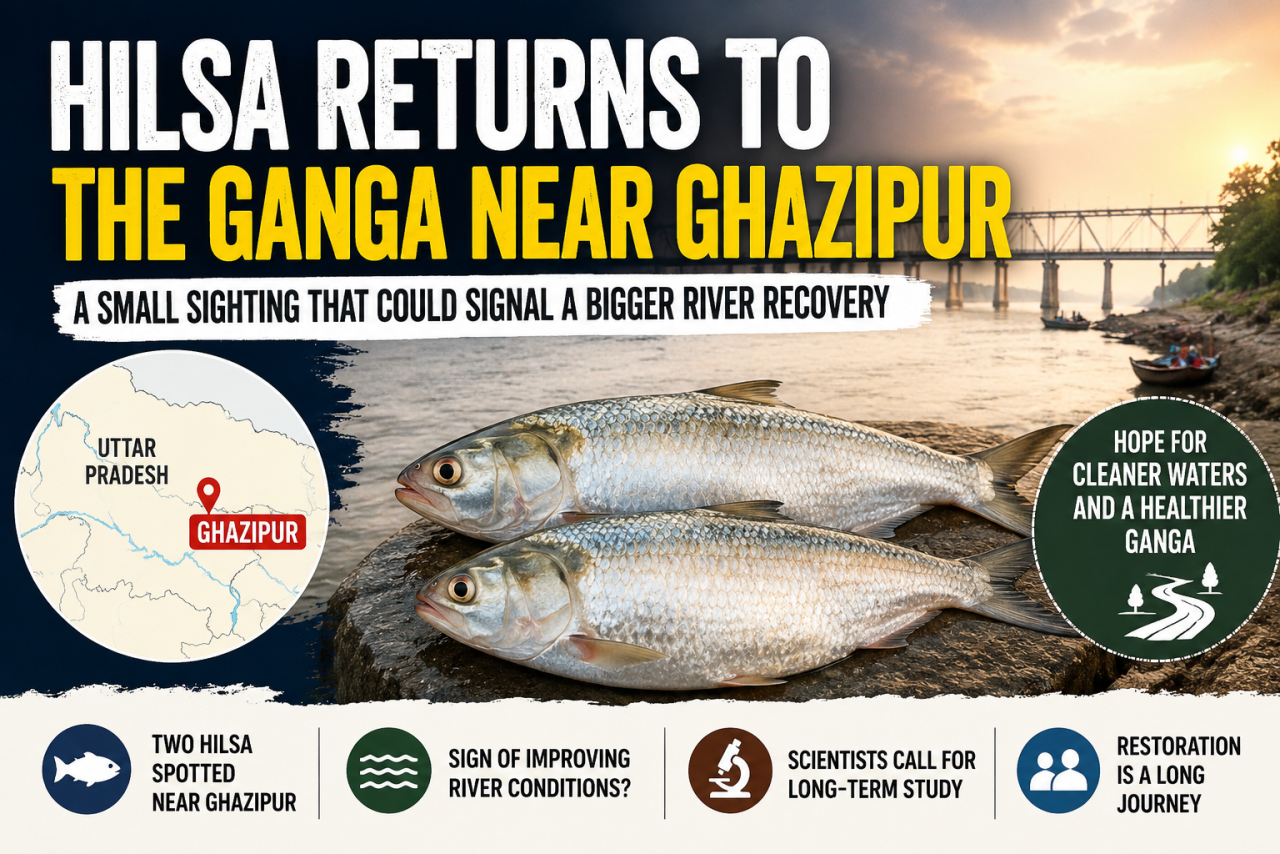
Two hilsa in the Ganga near Ghazipur may be a small discovery, but they could offer a powerful clue about whether one of India’s most important rivers is slowly becoming healthier.
The sighting of two hilsa fish in the Ganga near Ghazipur in Uttar Pradesh may appear to be a small event. But for scientists and people who depend on the river, it could carry a much larger message. After decades of decline, the return of hilsa to this part of the Ganga suggests that some sections of the river may once again be becoming suitable for this important migratory fish.
Scientists this week confirmed the presence of two hilsa near Ghazipur. The finding was confirmed by the National Mission for Clean Ganga and the Central Inland Fisheries Research Institute. Local people also reportedly saw more hilsa in nearby riverine villages, although these reports are still being verified.
Hilsa is not an ordinary river fish. It is a migratory species that moves between the sea and freshwater areas during different stages of its life. Its survival therefore depends on the health of a much larger river system. For hilsa to travel upstream, the river needs sufficient water flow, enough dissolved oxygen, suitable temperatures and a clear route between the sea and freshwater breeding areas.
This makes the Ghazipur sighting important. It may indicate that conditions in at least some parts of the Ganga have improved enough for hilsa to move farther upstream than they have in recent decades.
However, the discovery should not be treated as proof that the Ganga has been completely restored. That would be an easy but misleading conclusion.
The major question is not whether two hilsa have returned. The real question is whether they can complete their natural life cycle.
Scientists say genuine recovery would require evidence of natural migration, spawning, survival and successful reproduction over a sustained period. In other words, the Ganga will have to become a river where hilsa can not only arrive but also breed and produce the next generation.
This distinction offers a fresh way of looking at river restoration. A clean-looking river is not necessarily a healthy river. Water quality measurements are important, but they do not tell the entire story. A living river must also support movement, breeding and biodiversity.
The history of the hilsa makes this challenge clearer. The fish was once known to travel much farther upstream in the Ganga. Historical records indicate that hilsa could reach areas as far upstream as Prayagraj. But its migration patterns changed after the construction of the Farakka Barrage in West Bengal. According to officials, the barrier has affected hilsa movement since the 1970s.
The return of hilsa near Ghazipur therefore raises another important question. If the fish is able to reach this stretch again, does it mean the river is recovering naturally, or has it simply found a temporary passage?
The answer will require long-term scientific observation rather than excitement over a single sighting.
The two hilsa reportedly weighed about 740 grams together. Their number is too small to establish a population. Yet their presence can serve as an ecological signal. Sometimes nature provides an early warning before statistics become visible.
The lesson is simple. River restoration should not be measured only by cleaner water or improved infrastructure. It should also be measured by whether native species can return, migrate freely, reproduce and survive.
The hilsa near Ghazipur may therefore be more than two fish in the Ganga. They could be a small sign of hope, but also a reminder that the real test of river revival has only begun.
The sighting of two hilsa fish in the Ganga near Ghazipur in Uttar Pradesh may appear to be a small event. But for scientists and people who depend on the river, it could carry a much larger message. After decades of decline, the return of hilsa to this part of the Ganga suggests that some sections of the river may once again be becoming suitable for this important migratory fish.
Scientists this week confirmed the presence of two hilsa near Ghazipur. The finding was confirmed by the National Mission for Clean Ganga and the Central Inland Fisheries Research Institute. Local people also reportedly saw more hilsa in nearby riverine villages, although these reports are still being verified.
Hilsa is not an ordinary river fish. It is a migratory species that moves between the sea and freshwater areas during different stages of its life. Its survival therefore depends on the health of a much larger river system. For hilsa to travel upstream, the river needs sufficient water flow, enough dissolved oxygen, suitable temperatures and a clear route between the sea and freshwater breeding areas.
This makes the Ghazipur sighting important. It may indicate that conditions in at least some parts of the Ganga have improved enough for hilsa to move farther upstream than they have in recent decades.
However, the discovery should not be treated as proof that the Ganga has been completely restored. That would be an easy but misleading conclusion.
The major question is not whether two hilsa have returned. The real question is whether they can complete their natural life cycle.
Scientists say genuine recovery would require evidence of natural migration, spawning, survival and successful reproduction over a sustained period. In other words, the Ganga will have to become a river where hilsa can not only arrive but also breed and produce the next generation.
This distinction offers a fresh way of looking at river restoration. A clean-looking river is not necessarily a healthy river. Water quality measurements are important, but they do not tell the entire story. A living river must also support movement, breeding and biodiversity.
The history of the hilsa makes this challenge clearer. The fish was once known to travel much farther upstream in the Ganga. Historical records indicate that hilsa could reach areas as far upstream as Prayagraj. But its migration patterns changed after the construction of the Farakka Barrage in West Bengal. According to officials, the barrier has affected hilsa movement since the 1970s.
The return of hilsa near Ghazipur therefore raises another important question. If the fish is able to reach this stretch again, does it mean the river is recovering naturally, or has it simply found a temporary passage?
The answer will require long-term scientific observation rather than excitement over a single sighting.
The two hilsa reportedly weighed about 740 grams together. Their number is too small to establish a population. Yet their presence can serve as an ecological signal. Sometimes nature provides an early warning before statistics become visible.
The lesson is simple. River restoration should not be measured only by cleaner water or improved infrastructure. It should also be measured by whether native species can return, migrate freely, reproduce and survive.
The hilsa near Ghazipur may therefore be more than two fish in the Ganga. They could be a small sign of hope, but also a reminder that the real test of river revival has only begun.



























Leave a Comment