
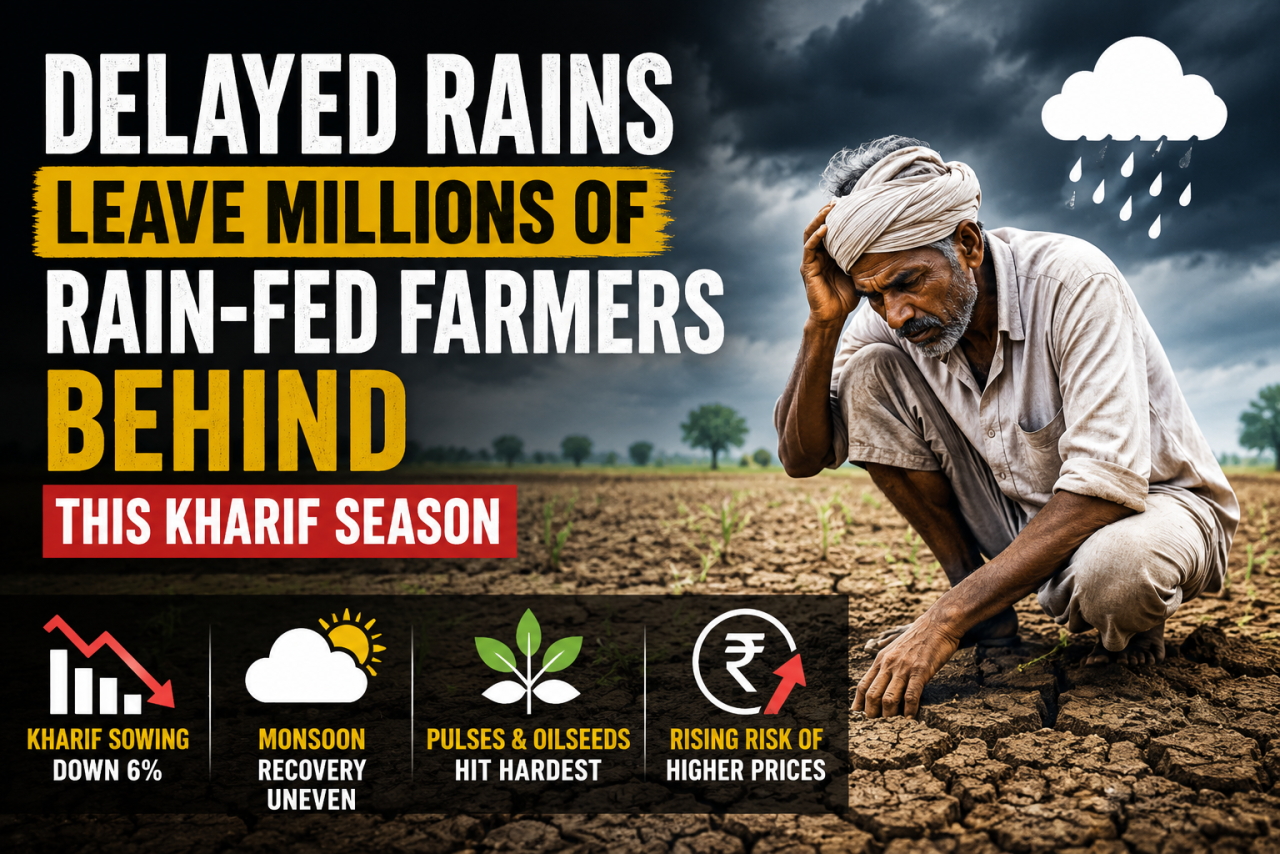
A delayed monsoon has left millions of rain-fed farmers behind, threatening kharif production, rural incomes and the prices of essential food staples across India.
India's kharif sowing season is once again exposing the vulnerability of millions of rain-fed farmers. Although the southwest monsoon has regained momentum after a sluggish start, the recovery has not been uniform, leaving large parts of the country struggling to catch up with delayed sowing.
The impact is most severe for farmers who rely entirely on rainfall rather than irrigation. Unlike irrigated farms, they have little flexibility when the monsoon arrives late, making them the first and hardest hit by changing weather patterns.
Kharif Sowing Falls Behind Last Year's Pace
As of July 17, kharif crops had been sown across approximately 65.8 million hectares, nearly 6 percent lower than the same period last year. While overall acreage may still improve if rainfall remains favourable through the rest of the season, experts say the delay has disproportionately affected rain-fed agriculture.
The biggest setbacks have been reported in pulses, oilseeds, cotton and coarse cereals, crops that depend heavily on timely monsoon rainfall. Without access to canal networks or groundwater irrigation, farmers cultivating these crops have few options when rains are delayed.
Monsoon Recovery Remains Uneven
The southwest monsoon initially weakened across northwest and northeast India, delaying sowing operations in several states. Rainfall has since improved, but the recovery remains uneven across regions.
Weather forecasts indicate an active spell over the next four to five days across much of northern India, including Punjab, Haryana, Uttar Pradesh, Bihar, Jharkhand and West Bengal. Widespread rainfall is also expected across Jammu and Kashmir, Himachal Pradesh and Uttarakhand.
However, rainfall activity is likely to remain subdued across large parts of west-central and peninsular India, leaving many farmers still waiting for adequate precipitation to begin sowing.
Farmers Forced to Change Cropping Plans
Agricultural experts warn that improved rainfall at this stage may not fully compensate for the time already lost. Many crops have a narrow sowing window, and that opportunity is rapidly closing.
Farmers who have missed the ideal planting period for pulses, oilseeds and coarse cereals are increasingly shifting to crops with shorter growing cycles or those considered less risky under uncertain rainfall conditions.
While these alternatives may reduce immediate losses, they often generate lower returns and may not be as well suited to local soil and climatic conditions.
Food Prices Could Feel the Impact
The consequences of delayed sowing extend well beyond the farm.
India already faces supply challenges in pulses and edible oils. Any further decline in acreage under these crops could tighten supplies and place upward pressure on the prices of lentils and cooking oil, both essential items in household kitchens across the country.
For farmers, changing crops also means sacrificing income opportunities from crops that traditionally perform best in their regions.
A Few Crops Defy the Trend
Not all crops have recorded declines this season.
Sugarcane acreage has increased by around 1.5 percent compared with last year. Modest gains have also been reported in sunflower, jute, mesta and kulthi cultivation.
These increases, however, do not offset the broader slowdown because these crops occupy relatively smaller and geographically concentrated areas, making them less representative of the overall kharif landscape.
A Structural Challenge Beyond One Season
Experts argue that the larger issue is no longer a single weak monsoon but the growing unpredictability of rainfall itself.
Every year of delayed or erratic monsoon conditions makes planning more difficult for rain-fed farmers. Unlike irrigated agriculture, which can often withstand a delay of several weeks, rain-fed farming depends on rainfall arriving within a limited and predictable window.
As that window becomes increasingly uncertain, farmers are forced into last-minute decisions that affect productivity, profitability and long-term sustainability.
The Weeks Ahead Will Be Crucial
India's kharif season, which runs from June to September, remains central to the country's production of foodgrains, oilseeds and several commercial crops.
Although national agricultural output may appear stable because irrigated regions help offset losses elsewhere, the reality for rain-fed farmers is far more challenging. Delayed sowing can translate into lower yields, reduced incomes and increased debt for households that have already invested in seeds and other inputs.
The coming weeks will therefore be decisive. If the monsoon maintains its strength across northern and eastern India and extends meaningfully into west-central and peninsular regions, part of the current shortfall may still be recovered. If not, another difficult season could deepen the challenges facing India's millions of rain-fed farmers.
India's kharif sowing season is once again exposing the vulnerability of millions of rain-fed farmers. Although the southwest monsoon has regained momentum after a sluggish start, the recovery has not been uniform, leaving large parts of the country struggling to catch up with delayed sowing.
The impact is most severe for farmers who rely entirely on rainfall rather than irrigation. Unlike irrigated farms, they have little flexibility when the monsoon arrives late, making them the first and hardest hit by changing weather patterns.
Kharif Sowing Falls Behind Last Year's Pace
As of July 17, kharif crops had been sown across approximately 65.8 million hectares, nearly 6 percent lower than the same period last year. While overall acreage may still improve if rainfall remains favourable through the rest of the season, experts say the delay has disproportionately affected rain-fed agriculture.
The biggest setbacks have been reported in pulses, oilseeds, cotton and coarse cereals, crops that depend heavily on timely monsoon rainfall. Without access to canal networks or groundwater irrigation, farmers cultivating these crops have few options when rains are delayed.
Monsoon Recovery Remains Uneven
The southwest monsoon initially weakened across northwest and northeast India, delaying sowing operations in several states. Rainfall has since improved, but the recovery remains uneven across regions.
Weather forecasts indicate an active spell over the next four to five days across much of northern India, including Punjab, Haryana, Uttar Pradesh, Bihar, Jharkhand and West Bengal. Widespread rainfall is also expected across Jammu and Kashmir, Himachal Pradesh and Uttarakhand.
However, rainfall activity is likely to remain subdued across large parts of west-central and peninsular India, leaving many farmers still waiting for adequate precipitation to begin sowing.
Farmers Forced to Change Cropping Plans
Agricultural experts warn that improved rainfall at this stage may not fully compensate for the time already lost. Many crops have a narrow sowing window, and that opportunity is rapidly closing.
Farmers who have missed the ideal planting period for pulses, oilseeds and coarse cereals are increasingly shifting to crops with shorter growing cycles or those considered less risky under uncertain rainfall conditions.
While these alternatives may reduce immediate losses, they often generate lower returns and may not be as well suited to local soil and climatic conditions.
Food Prices Could Feel the Impact
The consequences of delayed sowing extend well beyond the farm.
India already faces supply challenges in pulses and edible oils. Any further decline in acreage under these crops could tighten supplies and place upward pressure on the prices of lentils and cooking oil, both essential items in household kitchens across the country.
For farmers, changing crops also means sacrificing income opportunities from crops that traditionally perform best in their regions.
A Few Crops Defy the Trend
Not all crops have recorded declines this season.
Sugarcane acreage has increased by around 1.5 percent compared with last year. Modest gains have also been reported in sunflower, jute, mesta and kulthi cultivation.
These increases, however, do not offset the broader slowdown because these crops occupy relatively smaller and geographically concentrated areas, making them less representative of the overall kharif landscape.
A Structural Challenge Beyond One Season
Experts argue that the larger issue is no longer a single weak monsoon but the growing unpredictability of rainfall itself.
Every year of delayed or erratic monsoon conditions makes planning more difficult for rain-fed farmers. Unlike irrigated agriculture, which can often withstand a delay of several weeks, rain-fed farming depends on rainfall arriving within a limited and predictable window.
As that window becomes increasingly uncertain, farmers are forced into last-minute decisions that affect productivity, profitability and long-term sustainability.
The Weeks Ahead Will Be Crucial
India's kharif season, which runs from June to September, remains central to the country's production of foodgrains, oilseeds and several commercial crops.
Although national agricultural output may appear stable because irrigated regions help offset losses elsewhere, the reality for rain-fed farmers is far more challenging. Delayed sowing can translate into lower yields, reduced incomes and increased debt for households that have already invested in seeds and other inputs.
The coming weeks will therefore be decisive. If the monsoon maintains its strength across northern and eastern India and extends meaningfully into west-central and peninsular regions, part of the current shortfall may still be recovered. If not, another difficult season could deepen the challenges facing India's millions of rain-fed farmers.


























Leave a Comment