
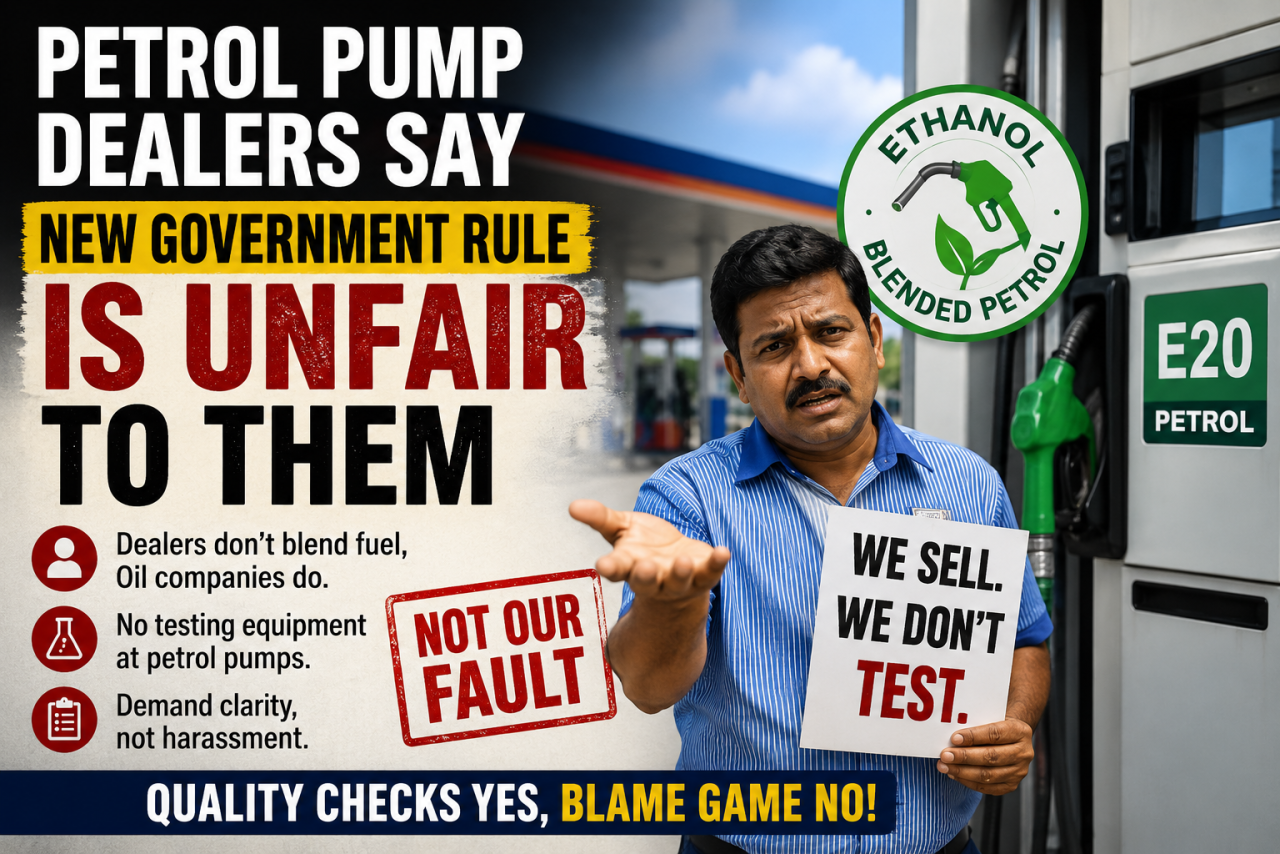
Can petrol pump dealers be held responsible for fuel quality they have no way to test? The new government inspections have sparked a nationwide debate.
Petrol pump dealers across India have expressed concern over a new government directive to strengthen quality checks on ethanol-blended petrol (EBP). While they support efforts to ensure consumers receive good-quality fuel, dealers say the new inspection drive is holding them responsible for a process they neither control nor have the tools to verify.
Government Directs States to Intensify Inspections
On July 8, the Ministry of Petroleum and Natural Gas wrote to the chief secretaries of all states, directing them to ensure coordinated inspections of ethanol-blended petrol sold at retail outlets. The ministry asked state authorities to work with enforcement agencies, district administrations, legal metrology departments and oil marketing companies (OMCs) to check the quality and quantity of ethanol-blended petrol and prevent adulteration.
Following the directive, surprise inspections have reportedly begun in several states, including Delhi, Haryana, Karnataka, Andhra Pradesh and Tamil Nadu. Officials have been collecting fuel samples from petrol pumps to verify compliance with quality standards.
Dealers Say They Are Being Held Accountable for Supply They Do Not Control
Petrol pump dealers argue that they are only retailers and have no role in blending ethanol with petrol. The blending process is carried out at depots operated by state-owned oil marketing companies such as Indian Oil Corporation (IOC), Bharat Petroleum Corporation Limited (BPCL) and Hindustan Petroleum Corporation Limited (HPCL). Dealers receive the fuel after blending, store it in underground tanks and sell it to customers without altering its composition.
Dealer associations say that if the ethanol percentage or fuel quality does not meet prescribed standards, responsibility should primarily lie with the oil companies that blend and supply the fuel rather than with retail outlets.
No Equipment to Verify Ethanol Content
A major concern raised by dealers is the absence of testing equipment at petrol pumps. According to dealer associations, retail outlets can conduct basic checks such as fuel density, but they do not possess laboratory-grade instruments required to determine the exact ethanol content or verify whether the supplied fuel meets government specifications.
As a result, dealers say they cannot independently certify the quality of the fuel they receive from oil company depots, even though they are being questioned during inspections.
Demand for a Uniform SOP
Dealers have also pointed to the lack of a clearly defined Standard Operating Procedure (SOP) for the inspection process. They say officials from multiple departments are conducting inspections, but there is little coordination or clarity on testing methods, documentation or dealer responsibilities.
Some dealer associations have warned that the absence of uniform guidelines could lead to unnecessary harassment during inspections. Several dealers have also expressed concern that they are reluctant to speak publicly on the issue for fear of action from oil marketing companies.
Ethanol Blending Is a National Policy
India has significantly expanded ethanol blending in petrol over the past few years as part of its strategy to reduce dependence on imported crude oil, improve energy security, lower emissions and support the agricultural sector. The government has already achieved nationwide availability of E20 petrol, containing up to 20 percent ethanol.
The recent inspection drive is intended to ensure that ethanol-blended fuel sold to consumers meets prescribed quality standards and to prevent adulteration in the fuel supply chain.
Dealers Want Clarity, Not Exemption
Petrol pump dealers say they are not opposing quality inspections. Instead, they want accountability to reflect how the fuel supply chain operates.
They have urged the government to either place responsibility for ethanol blending and quality verification on the oil marketing companies that prepare the fuel or equip retail outlets with approved testing devices, scientific guidelines and a clearly defined SOP before making dealers accountable for compliance.
As inspections continue across several states, dealer associations say they are awaiting further clarification from both the Ministry of Petroleum and Natural Gas and the state-run oil marketing companies. Until then, they believe they are being asked to guarantee the quality of a product whose composition they have no practical means to verify.
Petrol pump dealers across India have expressed concern over a new government directive to strengthen quality checks on ethanol-blended petrol (EBP). While they support efforts to ensure consumers receive good-quality fuel, dealers say the new inspection drive is holding them responsible for a process they neither control nor have the tools to verify.
Government Directs States to Intensify Inspections
On July 8, the Ministry of Petroleum and Natural Gas wrote to the chief secretaries of all states, directing them to ensure coordinated inspections of ethanol-blended petrol sold at retail outlets. The ministry asked state authorities to work with enforcement agencies, district administrations, legal metrology departments and oil marketing companies (OMCs) to check the quality and quantity of ethanol-blended petrol and prevent adulteration.
Following the directive, surprise inspections have reportedly begun in several states, including Delhi, Haryana, Karnataka, Andhra Pradesh and Tamil Nadu. Officials have been collecting fuel samples from petrol pumps to verify compliance with quality standards.
Dealers Say They Are Being Held Accountable for Supply They Do Not Control
Petrol pump dealers argue that they are only retailers and have no role in blending ethanol with petrol. The blending process is carried out at depots operated by state-owned oil marketing companies such as Indian Oil Corporation (IOC), Bharat Petroleum Corporation Limited (BPCL) and Hindustan Petroleum Corporation Limited (HPCL). Dealers receive the fuel after blending, store it in underground tanks and sell it to customers without altering its composition.
Dealer associations say that if the ethanol percentage or fuel quality does not meet prescribed standards, responsibility should primarily lie with the oil companies that blend and supply the fuel rather than with retail outlets.
No Equipment to Verify Ethanol Content
A major concern raised by dealers is the absence of testing equipment at petrol pumps. According to dealer associations, retail outlets can conduct basic checks such as fuel density, but they do not possess laboratory-grade instruments required to determine the exact ethanol content or verify whether the supplied fuel meets government specifications.
As a result, dealers say they cannot independently certify the quality of the fuel they receive from oil company depots, even though they are being questioned during inspections.
Demand for a Uniform SOP
Dealers have also pointed to the lack of a clearly defined Standard Operating Procedure (SOP) for the inspection process. They say officials from multiple departments are conducting inspections, but there is little coordination or clarity on testing methods, documentation or dealer responsibilities.
Some dealer associations have warned that the absence of uniform guidelines could lead to unnecessary harassment during inspections. Several dealers have also expressed concern that they are reluctant to speak publicly on the issue for fear of action from oil marketing companies.
Ethanol Blending Is a National Policy
India has significantly expanded ethanol blending in petrol over the past few years as part of its strategy to reduce dependence on imported crude oil, improve energy security, lower emissions and support the agricultural sector. The government has already achieved nationwide availability of E20 petrol, containing up to 20 percent ethanol.
The recent inspection drive is intended to ensure that ethanol-blended fuel sold to consumers meets prescribed quality standards and to prevent adulteration in the fuel supply chain.
Dealers Want Clarity, Not Exemption
Petrol pump dealers say they are not opposing quality inspections. Instead, they want accountability to reflect how the fuel supply chain operates.
They have urged the government to either place responsibility for ethanol blending and quality verification on the oil marketing companies that prepare the fuel or equip retail outlets with approved testing devices, scientific guidelines and a clearly defined SOP before making dealers accountable for compliance.
As inspections continue across several states, dealer associations say they are awaiting further clarification from both the Ministry of Petroleum and Natural Gas and the state-run oil marketing companies. Until then, they believe they are being asked to guarantee the quality of a product whose composition they have no practical means to verify.





















Leave a Comment