
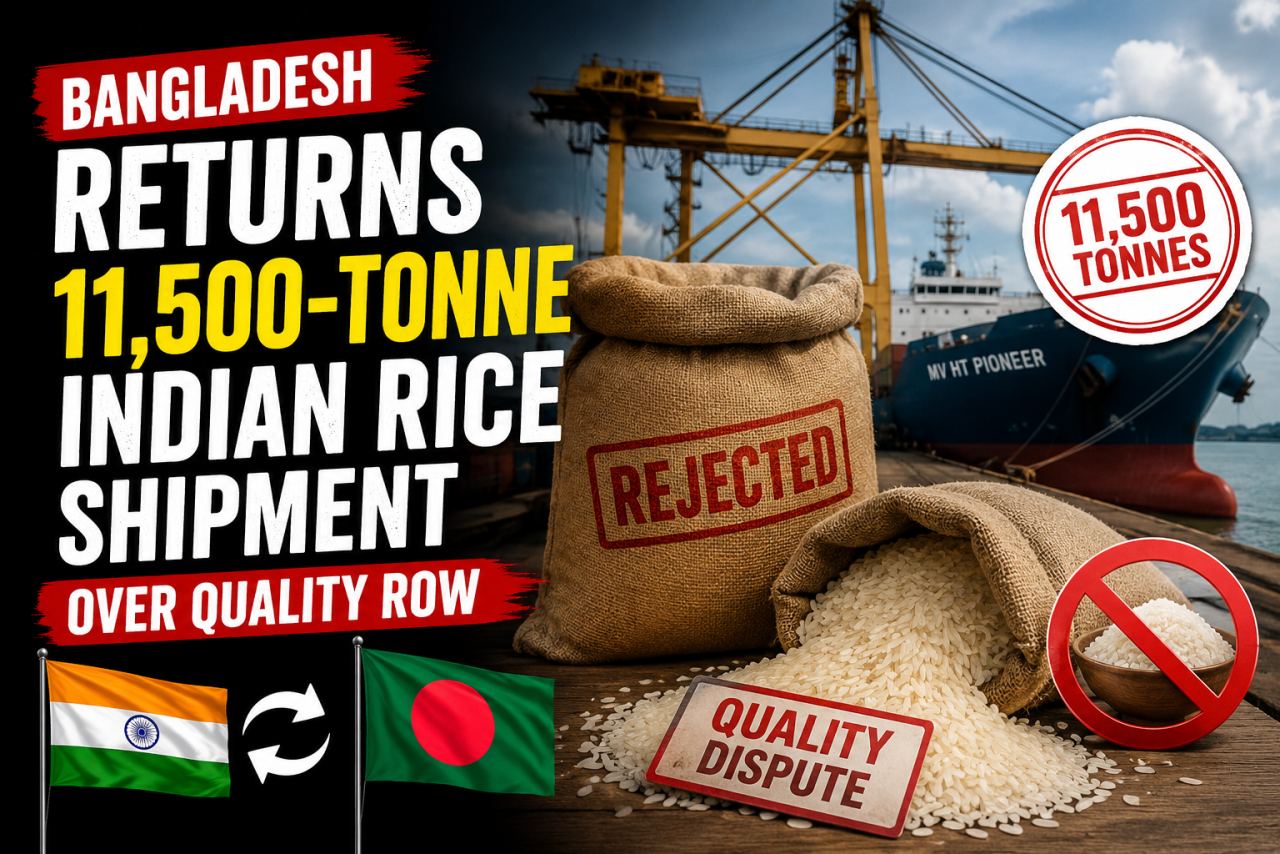
Bangladesh has sent back an 11,500-tonne shipment of Indian rice that had already passed quality checks, raising questions over inspection standards, food security and the future of India-Bangladesh rice trade.
A government-to-government rice supply agreement between India and Bangladesh has hit an unexpected hurdle after Dhaka rejected an 11,500-tonne shipment of Indian rice over alleged quality concerns, despite the cargo having initially passed official inspection for human consumption.
The consignment, carried by the MV HT Pioneer, arrived at Chittagong Port on July 21 with 11,500 tonnes of non-basmati parboiled rice under a bilateral food supply arrangement. Laboratory tests conducted on July 22 certified the shipment as fit for consumption, allowing unloading to begin.
About 3,500 tonnes were unloaded over July 23 and 24 and dispatched to government storage depots in Tejgaon, Halishahar, Dewanhat, and the Joydebpur Local Supply Depot.
Quality Concerns Trigger Sudden Reversal
The situation changed dramatically on July 25, when officials at the Tejgaon and Halishahar depots reported that the rice appeared to be of inferior quality and unsuitable for human consumption.
The matter was escalated to Bangladesh's Food Secretary and the Director General of the Food Department. Local media soon reported the controversy.
The shipping agent, however, disputed the findings, arguing that the rice was merely "slightly reddish" in colour and not substandard. With the disagreement unresolved, Bangladeshi authorities halted further unloading. The remaining around 8,000 tonnes stayed onboard and the entire shipment is now being returned to India.
Questions Over Inspection Process
Indian trade circles have questioned how a shipment that cleared mandatory quality testing could be declared unfit just four days later.
Officials note that India has exported rice to Bangladesh for years without comparable disputes. The abrupt reversal has raised concerns over the consistency of inspection procedures, although no official explanation has clarified what changed between the initial clearance and the subsequent rejection.
Some observers have speculated whether the episode reflects changing political dynamics following the Bangladesh Nationalist Party's return to power under Prime Minister Tarique Rahman in February 2026. However, Bangladeshi authorities have not linked the decision to politics, and no evidence has emerged to support such claims.
Bangladesh Still Needs Indian Rice
The dispute comes at a time when Bangladesh remains heavily dependent on rice imports.
Unseasonal pre-monsoon rainfall and flash floods damaged significant portions of the country's Boro rice crop, particularly in the low-lying haor regions of northeastern Bangladesh. Since the Boro harvest accounts for more than half of the country's annual rice production, the losses have forced Dhaka to plan imports of nearly 900,000 tonnes of rice during the current financial year.
Ironically, while the disputed shipment was under review, Bangladesh also requested India to permit additional rice exports to help bridge its domestic supply gap. This suggests that despite the current disagreement, India's role as Bangladesh's largest rice supplier remains unchanged.
Bilateral Rice Trade Continues to Grow
Trade data reflects the importance of the relationship.
India exported approximately 1.36 million tonnes of non-basmati rice worth around 545 million US dollars to Bangladesh during the 2025–26 financial year, a sharp increase from 0.809 million tonnes valued at 359 million US dollars in the previous year.
Indian rice also remains more competitively priced than supplies from Pakistan, Vietnam and Thailand, making it difficult for Bangladesh to quickly replace Indian imports.
Industry participants therefore expect the dispute to be resolved through either compensation, replacement cargo or a mutually agreed settlement rather than a prolonged disruption in bilateral trade.
Diplomatic Impact Likely to Remain Limited
Although the incident has created an uncomfortable moment in India-Bangladesh trade relations, it is unlikely to derail broader diplomatic engagement.
Since Prime Minister Tarique Rahman's government assumed office, both New Delhi and Dhaka have signalled interest in maintaining stable ties. Prime Minister Narendra Modi has extended an invitation to Bangladesh's leadership, while India's High Commissioner has held direct discussions with the new administration.
The return of a single rice shipment, even one involving 11,500 tonnes, is therefore unlikely to alter the broader trajectory of bilateral relations.
Instead, the episode highlights the need for clearer inspection standards, transparent quality verification and stronger dispute-resolution mechanisms as food trade between the two neighbours continues to expand.
A government-to-government rice supply agreement between India and Bangladesh has hit an unexpected hurdle after Dhaka rejected an 11,500-tonne shipment of Indian rice over alleged quality concerns, despite the cargo having initially passed official inspection for human consumption.
The consignment, carried by the MV HT Pioneer, arrived at Chittagong Port on July 21 with 11,500 tonnes of non-basmati parboiled rice under a bilateral food supply arrangement. Laboratory tests conducted on July 22 certified the shipment as fit for consumption, allowing unloading to begin.
About 3,500 tonnes were unloaded over July 23 and 24 and dispatched to government storage depots in Tejgaon, Halishahar, Dewanhat, and the Joydebpur Local Supply Depot.
Quality Concerns Trigger Sudden Reversal
The situation changed dramatically on July 25, when officials at the Tejgaon and Halishahar depots reported that the rice appeared to be of inferior quality and unsuitable for human consumption.
The matter was escalated to Bangladesh's Food Secretary and the Director General of the Food Department. Local media soon reported the controversy.
The shipping agent, however, disputed the findings, arguing that the rice was merely "slightly reddish" in colour and not substandard. With the disagreement unresolved, Bangladeshi authorities halted further unloading. The remaining around 8,000 tonnes stayed onboard and the entire shipment is now being returned to India.
Questions Over Inspection Process
Indian trade circles have questioned how a shipment that cleared mandatory quality testing could be declared unfit just four days later.
Officials note that India has exported rice to Bangladesh for years without comparable disputes. The abrupt reversal has raised concerns over the consistency of inspection procedures, although no official explanation has clarified what changed between the initial clearance and the subsequent rejection.
Some observers have speculated whether the episode reflects changing political dynamics following the Bangladesh Nationalist Party's return to power under Prime Minister Tarique Rahman in February 2026. However, Bangladeshi authorities have not linked the decision to politics, and no evidence has emerged to support such claims.
Bangladesh Still Needs Indian Rice
The dispute comes at a time when Bangladesh remains heavily dependent on rice imports.
Unseasonal pre-monsoon rainfall and flash floods damaged significant portions of the country's Boro rice crop, particularly in the low-lying haor regions of northeastern Bangladesh. Since the Boro harvest accounts for more than half of the country's annual rice production, the losses have forced Dhaka to plan imports of nearly 900,000 tonnes of rice during the current financial year.
Ironically, while the disputed shipment was under review, Bangladesh also requested India to permit additional rice exports to help bridge its domestic supply gap. This suggests that despite the current disagreement, India's role as Bangladesh's largest rice supplier remains unchanged.
Bilateral Rice Trade Continues to Grow
Trade data reflects the importance of the relationship.
India exported approximately 1.36 million tonnes of non-basmati rice worth around 545 million US dollars to Bangladesh during the 2025–26 financial year, a sharp increase from 0.809 million tonnes valued at 359 million US dollars in the previous year.
Indian rice also remains more competitively priced than supplies from Pakistan, Vietnam and Thailand, making it difficult for Bangladesh to quickly replace Indian imports.
Industry participants therefore expect the dispute to be resolved through either compensation, replacement cargo or a mutually agreed settlement rather than a prolonged disruption in bilateral trade.
Diplomatic Impact Likely to Remain Limited
Although the incident has created an uncomfortable moment in India-Bangladesh trade relations, it is unlikely to derail broader diplomatic engagement.
Since Prime Minister Tarique Rahman's government assumed office, both New Delhi and Dhaka have signalled interest in maintaining stable ties. Prime Minister Narendra Modi has extended an invitation to Bangladesh's leadership, while India's High Commissioner has held direct discussions with the new administration.
The return of a single rice shipment, even one involving 11,500 tonnes, is therefore unlikely to alter the broader trajectory of bilateral relations.
Instead, the episode highlights the need for clearer inspection standards, transparent quality verification and stronger dispute-resolution mechanisms as food trade between the two neighbours continues to expand.















Leave a Comment