
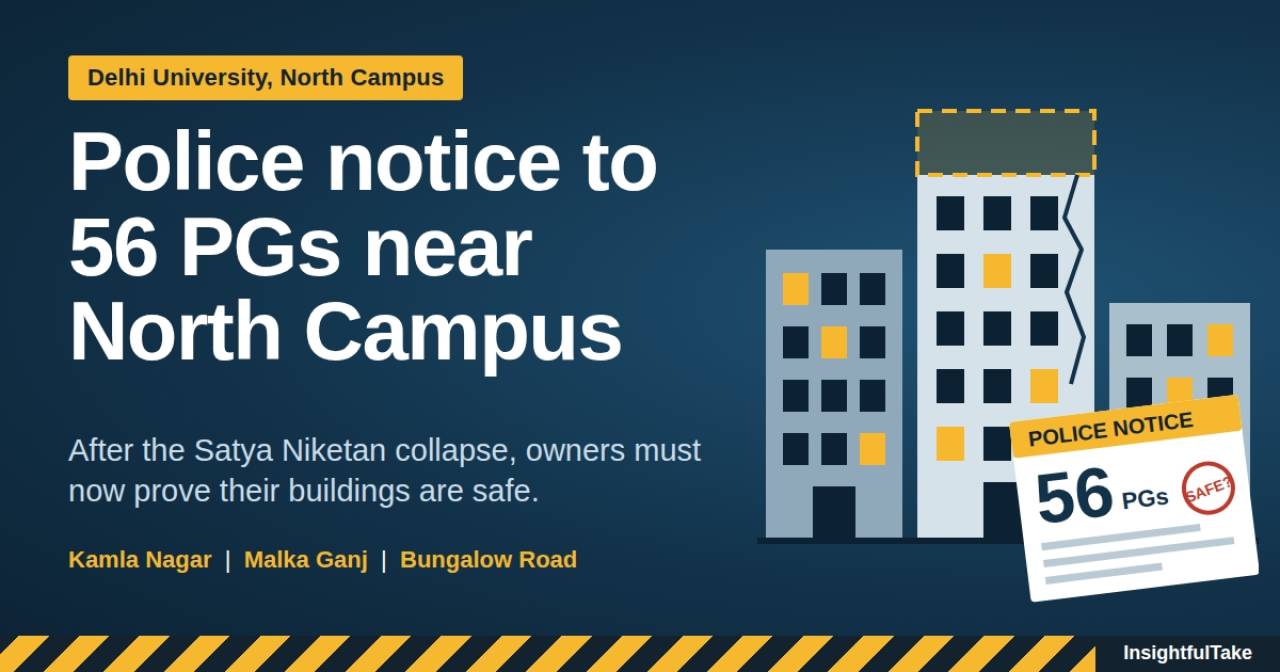
After seven deaths in the Satya Niketan PG collapse, Delhi Police are checking 56 North Campus PGs for fire safety, structural stability, legal approvals and overcrowding.
Notices sent to PGs in Kamla Nagar, Malka Ganj and Bungalow Road demand ownership papers, fire clearances and safety records, and an officer admits most owners may not have them.
Think of a student who arrives in Delhi with two bags, an admission letter and a tight budget. Finding a PG near Delhi University's North Campus feels like a win. The room is close to college, the rent is manageable, and the owner seems friendly. What most students never ask is the question that matters most: is this building actually safe to live in?
After the collapse in Satya Niketan, that question can no longer be ignored.
The Tragedy That Changed the Conversation
A five-storey PG building in Satya Niketan came down, and seven people lost their lives. Five of them were DU students. Families who had sent their children to Delhi to build a future were left mourning, and many other students began looking nervously at their own buildings.
The collapse raised an uncomfortable point. Buildings like this can run as student homes for years without anyone checking whether they are legal, strong or fit for the number of people inside.
What the Police Have Now Done
Delhi Police have started checking. They have sent notices to at least 56 PGs in Kamla Nagar, Malka Ganj and Bungalow Road. These are the neighbourhoods where hundreds of North Campus students live, and the notices were issued by the Roop Nagar police station, which covers them.
Officers say this is part of a wider survey to find illegal construction, overcrowding and serious safety gaps. It is not a single raid but a systematic check of how student housing really works.
What Owners Have Been Asked to Show
The notices are detailed. In simple terms, every PG owner is being asked to answer these questions on paper:
Do you own this building, and was it approved?
Owners must produce ownership deeds, sanctioned building plans and clearances from civic bodies such as the MCD, the DDA and the Delhi Fire Service, along with occupancy or completion certificates where applicable.
Is it safe from fire and collapse?
Police want a valid fire safety certificate or NOC, and the latest structural safety certificate.
Was anything built without permission?
Owners must declare any extra floor, basement, room or terrace, and show the permission for it.
How many people live here, and who looks after them?
PGs must give floor-wise and room-wise occupancy figures and verified records of their workers.
Are women safe?
Where women live, owners must give details of female caretakers. If there is no female warden, they must state in writing who is responsible for safety, help and emergency response during each shift.
Who enters the building?
Owners must share details of CCTV cameras and security guards, plus a copy of the visitor register for the last 15 days.
Why Extra Floors and Rooms Are Such a Worry
A building is planned to carry a fixed load. When owners add floors, rooms or terrace structures without approval, that load rises, and so does the risk.
Squeezing more students into the same space adds to it, because crowded rooms and narrow staircases become dangerous in a fire or emergency. Police have said they want to find exactly this kind of unchecked expansion.
The Warning, and a Worrying Reality Check
The notices come with a clear warning. If owners fail to provide the documents, the matter can be referred to civic agencies, which could lead to sealing.
One police officer familiar with the survey painted a grim picture. He said many PG operators in the area lack the required paperwork, estimating that about 95% either don't have the documents or don't meet safety norms. He added that police will look at each case separately before deciding what action to take.
If that figure is even close to reality, the problem is far bigger than a few careless owners. It suggests that unsafe student housing has been quietly accepted for a long time.
A Difficult Balance
There is no easy answer here. Safety must come first, because no room is worth a life. But sealing a building also means students lose their homes in the middle of an academic session, often with little time to find another place.
Owners who genuinely want to comply may need time to get certificates. The fairest path is one where dangerous buildings are dealt with firmly, while the honest and fixable cases get a chance to set things right.
What Students and Parents Can Do Right Now
You don't have to wait for the police to check. Before paying a deposit, or even if you already live in a PG, you can:
- Ask whether the building has a fire NOC, and look for extinguishers and clear exits.
- Check that the staircase is wide enough and not blocked by storage.
- Ask how many people share each room.
- Notice whether there are CCTV cameras and a proper visitor register.
- If it is a girls' PG, ask who the female warden or caretaker is.
A landlord who hesitates to answer these basic questions is giving you an answer already.
Final Take
The Satya Niketan collapse cost seven lives, and this survey is the system's attempt to stop it from happening again. Whether it leads to real change depends on what comes next: honest paperwork, strict follow-up, and owners who understand that a PG is a home for other people's children, not just a source of rent.
Notices sent to PGs in Kamla Nagar, Malka Ganj and Bungalow Road demand ownership papers, fire clearances and safety records, and an officer admits most owners may not have them.
Think of a student who arrives in Delhi with two bags, an admission letter and a tight budget. Finding a PG near Delhi University's North Campus feels like a win. The room is close to college, the rent is manageable, and the owner seems friendly. What most students never ask is the question that matters most: is this building actually safe to live in?
After the collapse in Satya Niketan, that question can no longer be ignored.
The Tragedy That Changed the Conversation
A five-storey PG building in Satya Niketan came down, and seven people lost their lives. Five of them were DU students. Families who had sent their children to Delhi to build a future were left mourning, and many other students began looking nervously at their own buildings.
The collapse raised an uncomfortable point. Buildings like this can run as student homes for years without anyone checking whether they are legal, strong or fit for the number of people inside.
What the Police Have Now Done
Delhi Police have started checking. They have sent notices to at least 56 PGs in Kamla Nagar, Malka Ganj and Bungalow Road. These are the neighbourhoods where hundreds of North Campus students live, and the notices were issued by the Roop Nagar police station, which covers them.
Officers say this is part of a wider survey to find illegal construction, overcrowding and serious safety gaps. It is not a single raid but a systematic check of how student housing really works.
What Owners Have Been Asked to Show
The notices are detailed. In simple terms, every PG owner is being asked to answer these questions on paper:
Do you own this building, and was it approved?
Owners must produce ownership deeds, sanctioned building plans and clearances from civic bodies such as the MCD, the DDA and the Delhi Fire Service, along with occupancy or completion certificates where applicable.
Is it safe from fire and collapse?
Police want a valid fire safety certificate or NOC, and the latest structural safety certificate.
Was anything built without permission?
Owners must declare any extra floor, basement, room or terrace, and show the permission for it.
How many people live here, and who looks after them?
PGs must give floor-wise and room-wise occupancy figures and verified records of their workers.
Are women safe?
Where women live, owners must give details of female caretakers. If there is no female warden, they must state in writing who is responsible for safety, help and emergency response during each shift.
Who enters the building?
Owners must share details of CCTV cameras and security guards, plus a copy of the visitor register for the last 15 days.
Why Extra Floors and Rooms Are Such a Worry
A building is planned to carry a fixed load. When owners add floors, rooms or terrace structures without approval, that load rises, and so does the risk.
Squeezing more students into the same space adds to it, because crowded rooms and narrow staircases become dangerous in a fire or emergency. Police have said they want to find exactly this kind of unchecked expansion.
The Warning, and a Worrying Reality Check
The notices come with a clear warning. If owners fail to provide the documents, the matter can be referred to civic agencies, which could lead to sealing.
One police officer familiar with the survey painted a grim picture. He said many PG operators in the area lack the required paperwork, estimating that about 95% either don't have the documents or don't meet safety norms. He added that police will look at each case separately before deciding what action to take.
If that figure is even close to reality, the problem is far bigger than a few careless owners. It suggests that unsafe student housing has been quietly accepted for a long time.
A Difficult Balance
There is no easy answer here. Safety must come first, because no room is worth a life. But sealing a building also means students lose their homes in the middle of an academic session, often with little time to find another place.
Owners who genuinely want to comply may need time to get certificates. The fairest path is one where dangerous buildings are dealt with firmly, while the honest and fixable cases get a chance to set things right.
What Students and Parents Can Do Right Now
You don't have to wait for the police to check. Before paying a deposit, or even if you already live in a PG, you can:
- Ask whether the building has a fire NOC, and look for extinguishers and clear exits.
- Check that the staircase is wide enough and not blocked by storage.
- Ask how many people share each room.
- Notice whether there are CCTV cameras and a proper visitor register.
- If it is a girls' PG, ask who the female warden or caretaker is.
A landlord who hesitates to answer these basic questions is giving you an answer already.
Final Take
The Satya Niketan collapse cost seven lives, and this survey is the system's attempt to stop it from happening again. Whether it leads to real change depends on what comes next: honest paperwork, strict follow-up, and owners who understand that a PG is a home for other people's children, not just a source of rent.




















Leave a Comment