
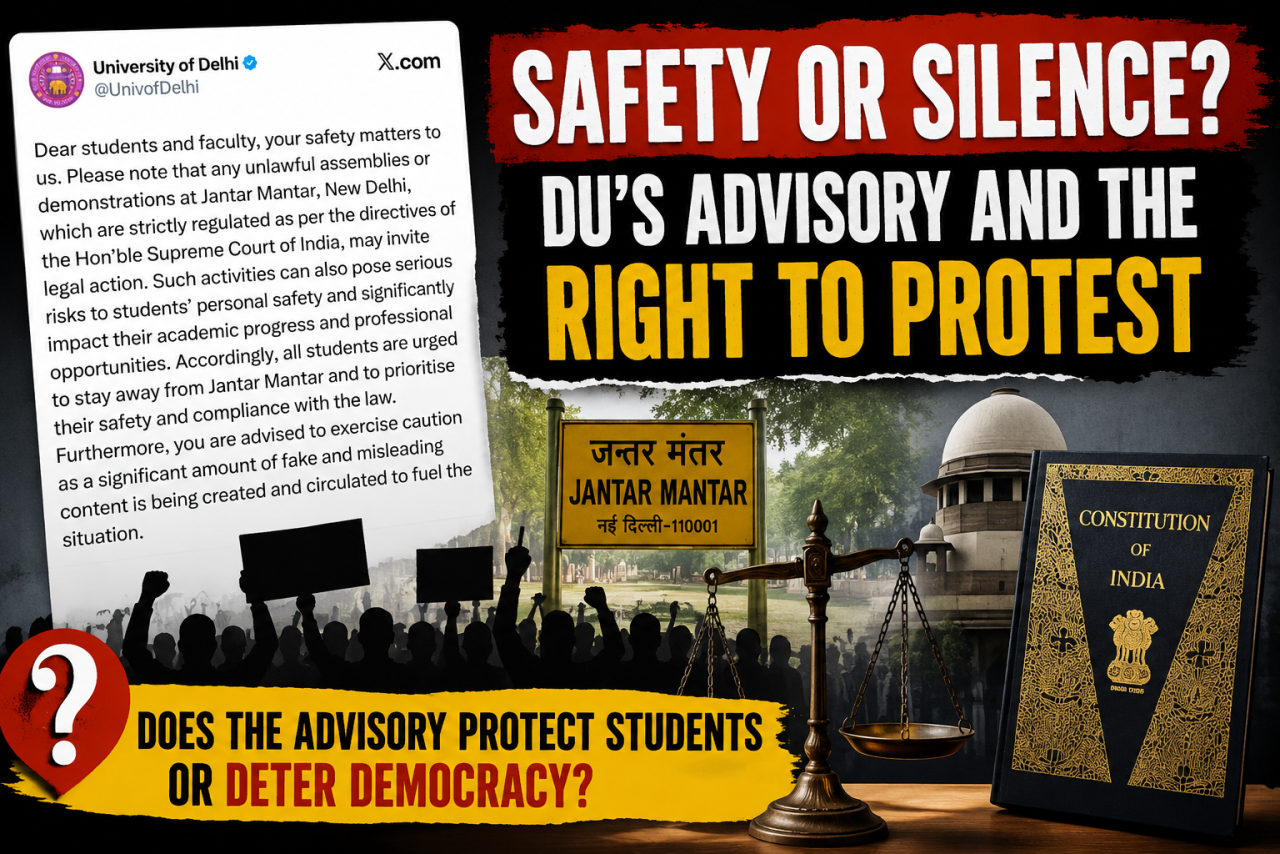
When a university asks students to stay away from protests, is it protecting them—or unintentionally weakening the democratic spirit that the Constitution seeks to uphold?
The University of Delhi's recent advisory urging students and faculty to stay away from Jantar Mantar has triggered an important constitutional debate. Presented as a measure to ensure safety and legal compliance, the notification warns against participating in "unlawful assemblies or demonstrations" and suggests that such participation could invite legal action, affect academic progress, and even harm future professional opportunities. It also cautions against misinformation circulating on social media.
At first glance, the advisory appears administrative and well-intentioned. Universities certainly have a responsibility to protect their students. However, when viewed through the lens of India's Constitution and democratic traditions, the language and tone of the notification raise concerns that deserve careful scrutiny.
India is not merely a nation governed by laws. It is a constitutional democracy where citizens enjoy fundamental rights. Article 19(1)(a) guarantees the freedom of speech and expression. Article 19(1)(b) protects the right to assemble peacefully and without arms. These are not privileges granted by governments or universities. They are constitutional guarantees that lie at the heart of Indian democracy.
The notification repeatedly stresses the risks associated with demonstrations but makes little distinction between peaceful, lawful protest and unlawful assembly. That distinction is crucial. Peaceful protest has historically been one of the most powerful instruments of democratic participation. From India's freedom movement to contemporary campaigns for social justice, students have often stood at the forefront of constitutional change.
By framing public demonstrations primarily as threats to safety and career prospects, the advisory risks creating a chilling effect. Students may begin to fear that exercising their constitutional rights could have long-term academic or professional consequences. Such messaging may discourage civic participation even where protests remain peaceful and lawful.
Universities occupy a unique place in democratic societies. They are not merely institutions for granting degrees. They are spaces where ideas are debated, authority is questioned, and future citizens learn the responsibilities that accompany constitutional freedoms. A university that appears to prioritise obedience over engagement risks undermining its own educational mission.
Another aspect that deserves attention is the reference to potential legal consequences. The advisory cites Supreme Court directives regulating activities at Jantar Mantar. Courts have indeed recognised that public demonstrations may be subject to reasonable restrictions in the interest of public order. However, reasonable restrictions cannot become blanket discouragements against democratic participation. The Constitution itself allows restrictions only within carefully defined limits and requires that any limitation on fundamental rights satisfy standards of legality, necessity, and proportionality.
The notification also warns that participation in demonstrations could significantly impact students' academic progress and professional opportunities. This statement is particularly troubling because it may be interpreted as an indirect warning rather than objective guidance. Unless supported by specific legal or institutional rules, such assertions risk appearing more coercive than informative.
Equally significant is the advisory's reference to fake and misleading content being circulated online. The spread of misinformation is undoubtedly a genuine concern in today's digital age. Universities should encourage students to verify facts through credible sources. However, caution against misinformation should not become a substitute for open discussion. Critical thinking develops not through fear but through dialogue, evidence, and reasoned debate.
Supporters of the advisory may argue that the university is merely attempting to prevent students from becoming entangled in volatile situations. Student safety is undeniably important, and institutions have a duty of care. Yet safety and constitutional liberty need not be presented as opposing values. A more balanced advisory could have encouraged students to participate only in peaceful, lawful gatherings, remain informed about legal requirements, avoid misinformation, and prioritise personal security. Such an approach would respect both institutional responsibility and constitutional freedoms.
The timing and wording of the notification also invite broader questions about the relationship between educational institutions and democratic dissent. Around the world, universities have historically nurtured social movements, encouraged debate, and produced leaders who challenged injustice. India's own history bears testimony to the role of students in shaping public discourse. Advisories that appear to discourage civic engagement risk narrowing that democratic space.
Ultimately, the issue extends beyond a single university notification. It concerns the values that public institutions choose to uphold. The Constitution does not ask citizens to remain silent in the face of public issues. It encourages responsible participation within the framework of law. Universities should prepare students to become informed, courageous, and constitutionally aware citizens rather than merely compliant graduates.
Delhi University's advisory may have been drafted with safety in mind. However, safety should never come at the cost of democratic confidence. In a constitutional republic, institutions best serve the nation not by discouraging peaceful civic participation but by educating citizens about their rights, responsibilities, and the rule of law. That balance is not just desirable. It is essential to the health of Indian democracy.
The University of Delhi's recent advisory urging students and faculty to stay away from Jantar Mantar has triggered an important constitutional debate. Presented as a measure to ensure safety and legal compliance, the notification warns against participating in "unlawful assemblies or demonstrations" and suggests that such participation could invite legal action, affect academic progress, and even harm future professional opportunities. It also cautions against misinformation circulating on social media.
At first glance, the advisory appears administrative and well-intentioned. Universities certainly have a responsibility to protect their students. However, when viewed through the lens of India's Constitution and democratic traditions, the language and tone of the notification raise concerns that deserve careful scrutiny.
India is not merely a nation governed by laws. It is a constitutional democracy where citizens enjoy fundamental rights. Article 19(1)(a) guarantees the freedom of speech and expression. Article 19(1)(b) protects the right to assemble peacefully and without arms. These are not privileges granted by governments or universities. They are constitutional guarantees that lie at the heart of Indian democracy.
The notification repeatedly stresses the risks associated with demonstrations but makes little distinction between peaceful, lawful protest and unlawful assembly. That distinction is crucial. Peaceful protest has historically been one of the most powerful instruments of democratic participation. From India's freedom movement to contemporary campaigns for social justice, students have often stood at the forefront of constitutional change.
By framing public demonstrations primarily as threats to safety and career prospects, the advisory risks creating a chilling effect. Students may begin to fear that exercising their constitutional rights could have long-term academic or professional consequences. Such messaging may discourage civic participation even where protests remain peaceful and lawful.
Universities occupy a unique place in democratic societies. They are not merely institutions for granting degrees. They are spaces where ideas are debated, authority is questioned, and future citizens learn the responsibilities that accompany constitutional freedoms. A university that appears to prioritise obedience over engagement risks undermining its own educational mission.
Another aspect that deserves attention is the reference to potential legal consequences. The advisory cites Supreme Court directives regulating activities at Jantar Mantar. Courts have indeed recognised that public demonstrations may be subject to reasonable restrictions in the interest of public order. However, reasonable restrictions cannot become blanket discouragements against democratic participation. The Constitution itself allows restrictions only within carefully defined limits and requires that any limitation on fundamental rights satisfy standards of legality, necessity, and proportionality.
The notification also warns that participation in demonstrations could significantly impact students' academic progress and professional opportunities. This statement is particularly troubling because it may be interpreted as an indirect warning rather than objective guidance. Unless supported by specific legal or institutional rules, such assertions risk appearing more coercive than informative.
Equally significant is the advisory's reference to fake and misleading content being circulated online. The spread of misinformation is undoubtedly a genuine concern in today's digital age. Universities should encourage students to verify facts through credible sources. However, caution against misinformation should not become a substitute for open discussion. Critical thinking develops not through fear but through dialogue, evidence, and reasoned debate.
Supporters of the advisory may argue that the university is merely attempting to prevent students from becoming entangled in volatile situations. Student safety is undeniably important, and institutions have a duty of care. Yet safety and constitutional liberty need not be presented as opposing values. A more balanced advisory could have encouraged students to participate only in peaceful, lawful gatherings, remain informed about legal requirements, avoid misinformation, and prioritise personal security. Such an approach would respect both institutional responsibility and constitutional freedoms.
The timing and wording of the notification also invite broader questions about the relationship between educational institutions and democratic dissent. Around the world, universities have historically nurtured social movements, encouraged debate, and produced leaders who challenged injustice. India's own history bears testimony to the role of students in shaping public discourse. Advisories that appear to discourage civic engagement risk narrowing that democratic space.
Ultimately, the issue extends beyond a single university notification. It concerns the values that public institutions choose to uphold. The Constitution does not ask citizens to remain silent in the face of public issues. It encourages responsible participation within the framework of law. Universities should prepare students to become informed, courageous, and constitutionally aware citizens rather than merely compliant graduates.
Delhi University's advisory may have been drafted with safety in mind. However, safety should never come at the cost of democratic confidence. In a constitutional republic, institutions best serve the nation not by discouraging peaceful civic participation but by educating citizens about their rights, responsibilities, and the rule of law. That balance is not just desirable. It is essential to the health of Indian democracy.























Leave a Comment