
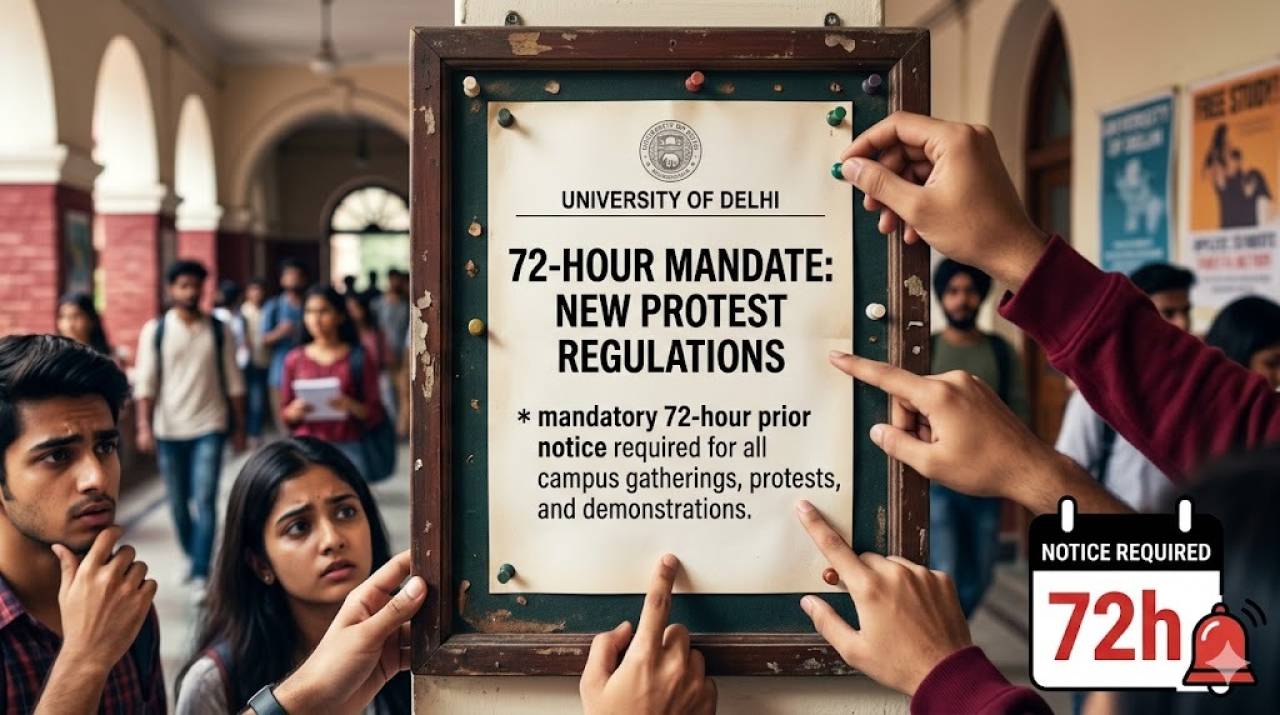
At Delhi University, speaking up now comes with a deadline. Students must give 72 hours’ notice before protesting—but can dissent really wait?
The University of Delhi has long been regarded as a cornerstone of democratic expression and student-led advocacy in India. From systemic policy critiques to grassroots social movements, the campus has historically served as a laboratory for civic engagement. However, a recent administrative directive from the Proctor’s office has introduced a significant shift in the operational framework of campus life: the formal requirement of a 72-hour prior notice for any protest, demonstration, or collective gathering.
Understanding the Administrative Framework
The new mandate stipulates that any group intending to organize a demonstration must submit a written application to the university administration at least three days in advance. This application is required to be exhaustive, detailing the specific objective of the gathering, the projected number of attendees, and the primary points of contact for the organizers.
According to university officials, the primary objective of this regulation is the maintenance of "academic discipline" and the "safety and security" of the university community. By implementing a structured notification system, the administration aims to:
- Prevent Academic Disruption: Ensuring that protests do not impede the delivery of lectures or the conduct of examinations.
- Ensure Campus Safety: Coordinating security personnel to prevent the infiltration of "external elements" who are not affiliated with the university.
- Logistical Management: Managing the use of public spaces within the campus to avoid overlapping events.
The Implications for Student Autonomy
While the administration frames this policy as a matter of procedural efficiency, it raises critical questions regarding the nature of spontaneous democratic expression. In an academic environment, student grievances—ranging from sudden fee hikes to immediate social justice concerns—often require a timely and visceral response. The imposition of a 72-hour "cooling-off" period may effectively dampen the momentum of such movements.
Furthermore, the requirement to provide names and identification of organizers days in advance has sparked a debate regarding privacy and the potential for administrative overreach. Critics argue that this level of scrutiny could lead to "pre-emptive deterrence," where students might hesitate to voice dissent due to fears of future academic or disciplinary repercussions.
Strategic Compliance for Student Bodies
For the student community, navigating this new landscape requires a balance between activism and administrative literacy. To ensure that student voices remain audible without facing technical disqualification or suspension, several strategic considerations are now essential:
- Proactive Planning: Student unions and societies must now incorporate administrative lead times into their campaign strategies. An event that fails to meet the 72-hour window is now legally vulnerable to being shut down by security.
- Documentation and Accountability: Organizers should maintain rigorous records of their correspondence with the Proctor’s office to ensure that legitimate requests for assembly are not unreasonably denied or delayed.
- Engagement with Student Representation: There is an immediate need for dialogue between the Delhi University Students' Union (DUSU) and the administration to clarify the "grey areas" of this policy—specifically, what constitutes a "gathering" and how the university defines "disruption."
Final Take
The 72-hour notice rule marks a definitive turn toward a more regulated campus environment at Delhi University. While the administration emphasizes order and safety, the student body must remain vigilant in ensuring that "order" does not become a synonym for "silence." For DU students, this isn’t just campus politics anymore. It’s about making sure the university remains a place where people can speak freely and question things openly.


























Leave a Comment