
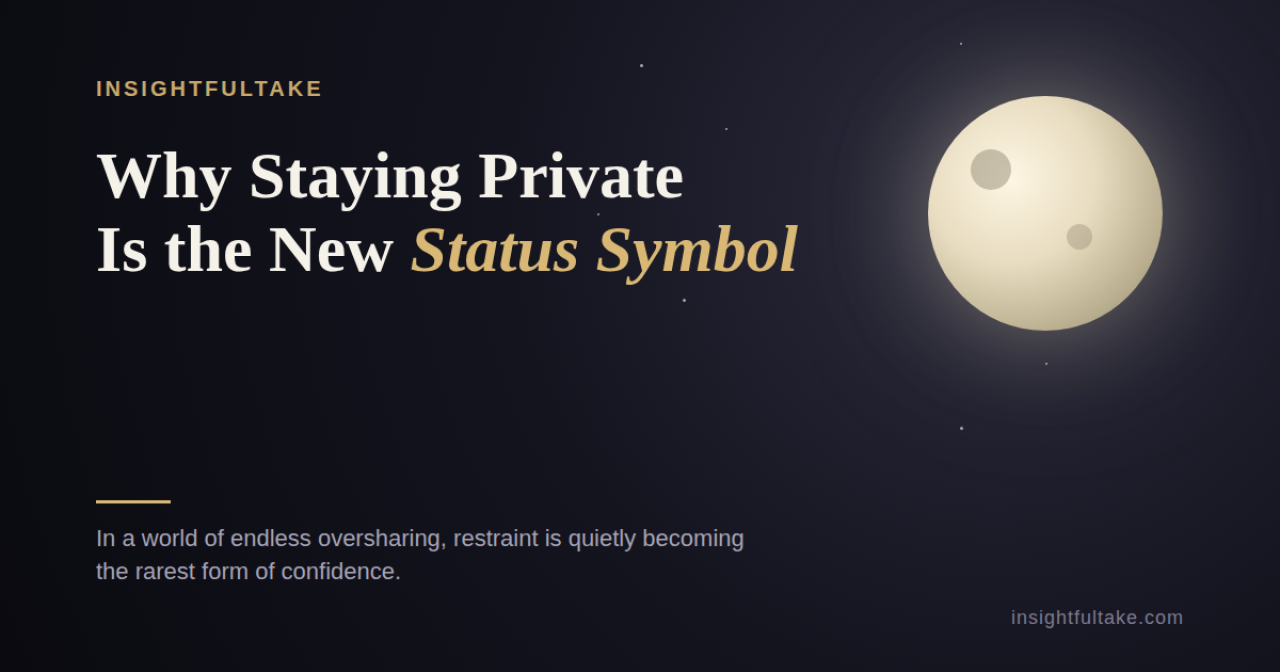
Everyone wants to be seen. But in a world where everyone shares everything, choosing what to keep private may be the ultimate status symbol.
Ask yourself something simple: what did you keep to yourself today? Not what you ate, not what you earned, what did you choose not to tell anyone? If the honest answer is nothing, you have given away the one thing that made you interesting.
There was a time when people built their reputation on what they showed. The rich showed their wealth. The successful showed their achievements. The happy showed their happiness. Showing was the currency of respect. But somewhere in the last decade, that currency got debased. Everyone shows everything now, and the result is that showing has stopped meaning much at all.
Think about how much of daily life gets performed for an audience today: the breakfast, the gym session, the vacation, the breakup, the promotion, the grief. Every emotion gets a caption. Every milestone gets a post. We have convinced ourselves this is connection, but a lot of it is just noise dressed up as identity. The person who tells you everything about their life within minutes of meeting you has, in that very act, told you they have nothing left to protect. And things that are handed over too easily rarely get valued, not by the person receiving them, and eventually, not even by the person giving them.
Aura was never built on volume. It was built on depth. Think of someone you've met who said very little, revealed almost nothing about themselves, and yet left a stronger impression than a dozen people who wouldn't stop talking. That's not an accident. Silence creates curiosity, and curiosity is a form of respect you cannot force, you can only earn it by making people wonder. The mind is drawn to what is withheld, not to what is handed over freely. This isn't a new psychological trick invented by marketers. It's just how attention has always worked.
Right now, keeping things private is starting to feel like a small act of rebellion. Not posting is treated as odd. Not explaining yourself is treated as suspicious. Carrying a personal problem without turning it into content for hundreds of people to react to is treated as almost antisocial. But consider this plainly: someone who is constantly explaining themselves to the internet has essentially handed the internet the keys to their inner life. And a life that's always on display starts to feel a little cheap, no matter how good it actually is.
This isn't an argument for disappearing from the world or distrusting your friends. Privacy is not the same as isolation, one is a boundary, the other is a wound, and confusing the two does real damage. What's being asked here is something much simpler and, honestly, much harder: restraint. Restraint in what you share. Restraint in the urge to explain every decision. Restraint in the compulsion to prove your life is going well by constantly announcing it. Let some of your joy stay wordless. Let some of your success arrive quietly, known only to the few people who actually matter, while everyone else is left to guess.
There's a reason the moon holds more fascination than the sun. The sun overwhelms you with total exposure, there's nothing left to imagine. The moon shows you only a slice of itself each night, and that's exactly why people keep looking up at it. Be more moon, less floodlight. Keep a part of yourself in the dark, not out of shame, but because mystery is a form of respect you owe your own life.
Young people today are told, in a hundred small ways, that visibility equals value, that if something isn't documented, it didn't really happen, that a life needs to be constantly curated to count. Push back on that quietly. You don't even need to announce your pushback; that would defeat the point. Just start small. Keep one meal a day off your phone. Keep one relationship free of public performance. Keep one goal secret until you've actually achieved it. You'll notice something shift, a kind of strength returning to you that you didn't realise you'd been giving away.
Privacy, at the end of the day, isn't about hiding. It's about dignity. And dignity, unlike attention, doesn't disappear the moment the likes stop coming in. Protect your privacy the way you'd protect anything valuable, not because it's fragile, but because it's rare, and rare things were never meant to be shown to everyone.
Ask yourself something simple: what did you keep to yourself today? Not what you ate, not what you earned, what did you choose not to tell anyone? If the honest answer is nothing, you have given away the one thing that made you interesting.
There was a time when people built their reputation on what they showed. The rich showed their wealth. The successful showed their achievements. The happy showed their happiness. Showing was the currency of respect. But somewhere in the last decade, that currency got debased. Everyone shows everything now, and the result is that showing has stopped meaning much at all.
Think about how much of daily life gets performed for an audience today: the breakfast, the gym session, the vacation, the breakup, the promotion, the grief. Every emotion gets a caption. Every milestone gets a post. We have convinced ourselves this is connection, but a lot of it is just noise dressed up as identity. The person who tells you everything about their life within minutes of meeting you has, in that very act, told you they have nothing left to protect. And things that are handed over too easily rarely get valued, not by the person receiving them, and eventually, not even by the person giving them.
Aura was never built on volume. It was built on depth. Think of someone you've met who said very little, revealed almost nothing about themselves, and yet left a stronger impression than a dozen people who wouldn't stop talking. That's not an accident. Silence creates curiosity, and curiosity is a form of respect you cannot force, you can only earn it by making people wonder. The mind is drawn to what is withheld, not to what is handed over freely. This isn't a new psychological trick invented by marketers. It's just how attention has always worked.
Right now, keeping things private is starting to feel like a small act of rebellion. Not posting is treated as odd. Not explaining yourself is treated as suspicious. Carrying a personal problem without turning it into content for hundreds of people to react to is treated as almost antisocial. But consider this plainly: someone who is constantly explaining themselves to the internet has essentially handed the internet the keys to their inner life. And a life that's always on display starts to feel a little cheap, no matter how good it actually is.
This isn't an argument for disappearing from the world or distrusting your friends. Privacy is not the same as isolation, one is a boundary, the other is a wound, and confusing the two does real damage. What's being asked here is something much simpler and, honestly, much harder: restraint. Restraint in what you share. Restraint in the urge to explain every decision. Restraint in the compulsion to prove your life is going well by constantly announcing it. Let some of your joy stay wordless. Let some of your success arrive quietly, known only to the few people who actually matter, while everyone else is left to guess.
There's a reason the moon holds more fascination than the sun. The sun overwhelms you with total exposure, there's nothing left to imagine. The moon shows you only a slice of itself each night, and that's exactly why people keep looking up at it. Be more moon, less floodlight. Keep a part of yourself in the dark, not out of shame, but because mystery is a form of respect you owe your own life.
Young people today are told, in a hundred small ways, that visibility equals value, that if something isn't documented, it didn't really happen, that a life needs to be constantly curated to count. Push back on that quietly. You don't even need to announce your pushback; that would defeat the point. Just start small. Keep one meal a day off your phone. Keep one relationship free of public performance. Keep one goal secret until you've actually achieved it. You'll notice something shift, a kind of strength returning to you that you didn't realise you'd been giving away.
Privacy, at the end of the day, isn't about hiding. It's about dignity. And dignity, unlike attention, doesn't disappear the moment the likes stop coming in. Protect your privacy the way you'd protect anything valuable, not because it's fragile, but because it's rare, and rare things were never meant to be shown to everyone.









Leave a Comment