
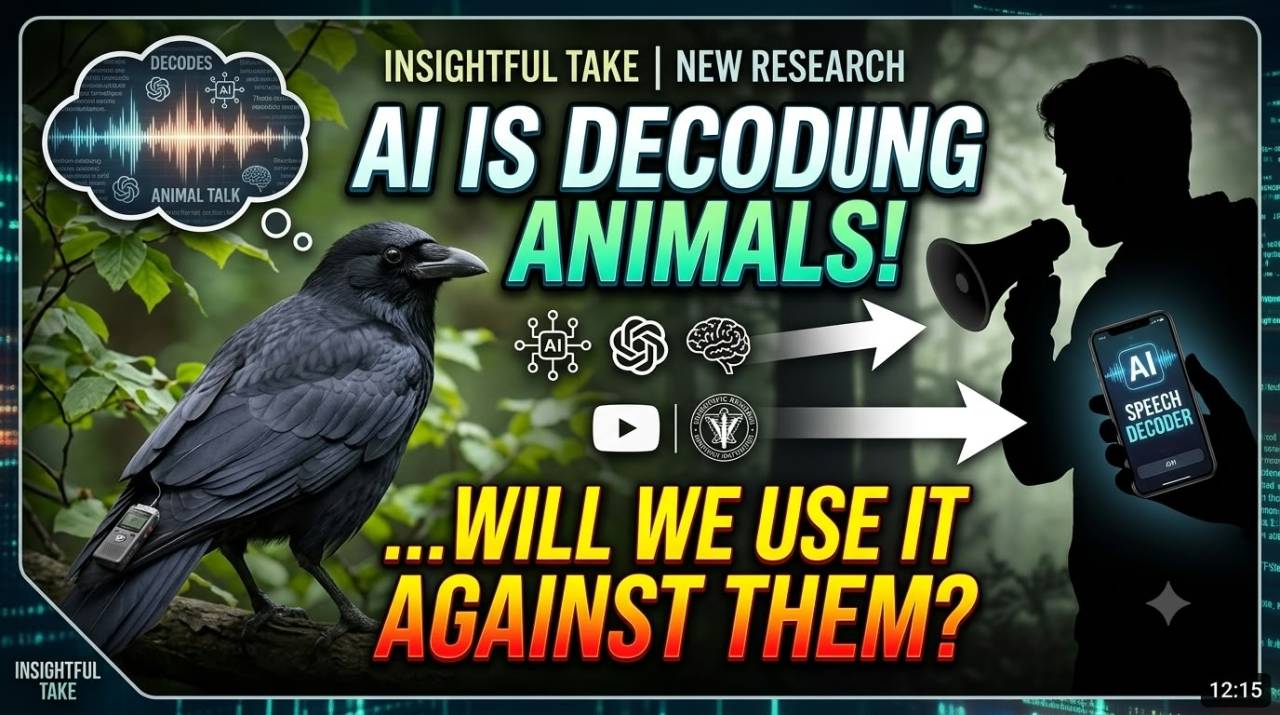
AI could finally help humans understand what animals are saying. The bigger question is whether that knowledge will protect wildlife or give humans another way to control it.
For centuries, humans have tried to understand the sounds, calls and gestures animals use to communicate. Artificial Intelligence is now giving scientists new ways to study those signals at a scale that was previously impossible.
But the same technology that could help us understand wildlife could also give humans a new way to manipulate it.
That is where the ethical problem begins.
Teaching Machines to Listen to Animals
Biologists Vittorio Baglione and Daniela Canestrari of Spain’s University of León have spent more than three decades studying carrion crows.
In 2018, the researchers attached tiny microphones to the tail feathers of 43 birds. The experiment produced thousands of hours of recordings, creating far more material than researchers could realistically analyse by listening to it manually.
They eventually worked with the Earth Species Project, using machine learning to process the recordings. The resulting catalogue contained more than 150,000 crow calls.
The technology has already helped researchers connect particular calls with specific situations.
In one example, when a buzzard attacked a crow’s nest, the affected bird produced a distinctive distress call. Other crows responded and came to its aid.
For scientists, this offers a glimpse into a communication system that humans have barely begun to understand.
But understanding the signal also creates the possibility of reproducing it.
When Listening Becomes Manipulation
The ability to identify and recreate animal calls raises an uncomfortable question. What happens when the technology moves from observing animals to influencing them?
Baglione has pointed to a simple but disturbing possibility. A hunter could potentially broadcast a simulated "safe signal" to make crows believe that an area is harmless and draw them into danger.
The concern is not limited to hunting.
In a 2025 report, César Rodríguez-Garavito, director of the More-Than-Human Life programme at New York University, outlined several ways decoded animal communication could be misused. These could include attracting wildlife towards large groups of people, using animals for military purposes such as sea-mine detection, or helping hunters and poachers lure animals more effectively.
Humans have used sound to exploit animals before. Whalers have used sonar, while poachers have used recorded calls to attract birds.
AI could make such techniques much more precise.
The Problem With Playing Back Animal Calls
There is another difficulty. Scientists often use audio playback to test whether they have correctly interpreted an animal's call. A recorded or artificially generated sound is played to an animal, and researchers observe its reaction.
The method is useful, but it is not risk-free.
If researchers misunderstand a call, playing it repeatedly could confuse animals, cause stress or interfere with relationships within a group. A signal that appears harmless to a human observer could have an entirely different meaning for the animal receiving it.
There is also a larger problem. Once researchers learn how to influence an animal's behaviour, the distinction between studying communication and controlling behaviour becomes increasingly thin.
Understanding Is Not the Same as Controlling
Philosopher Kristin Andrews has raised an important point in discussions about animal communication. Decoding an animal's sounds does not necessarily mean that we understand its mind.
A machine may be able to recognise patterns in thousands of calls. That does not automatically tell us what an animal experiences, intends or understands.
For Andrews, genuine communication should involve a two-way relationship rather than simply becoming another method of controlling animals. She has argued that two-way audio experiments should be approached with particular caution and, ideally, be limited to species that actively seek interaction with humans.
That distinction matters.
There is a difference between listening to wildlife and learning how to make wildlife do what we want.
The Bigger Question
AI could become one of the most powerful tools ever developed for studying animal communication. It may help scientists identify patterns that humans have missed for generations and offer new insights into how animals cooperate, warn one another and respond to danger.
But greater knowledge also brings greater responsibility.
If machines can learn an animal's language, humans will eventually have to decide what they are allowed to do with that knowledge.
The danger is not that AI will suddenly "speak" to animals.
The danger is that humans may learn enough to make animals respond to us without understanding the consequences.
Wildlife needs protection not only from guns, traps and habitat destruction, but potentially from technologies that can manipulate behaviour itself.
The challenge, therefore, is not simply to teach machines how to listen.
It is to make sure humans know when they should stop talking.
For centuries, humans have tried to understand the sounds, calls and gestures animals use to communicate. Artificial Intelligence is now giving scientists new ways to study those signals at a scale that was previously impossible.
But the same technology that could help us understand wildlife could also give humans a new way to manipulate it.
That is where the ethical problem begins.
Teaching Machines to Listen to Animals
Biologists Vittorio Baglione and Daniela Canestrari of Spain’s University of León have spent more than three decades studying carrion crows.
In 2018, the researchers attached tiny microphones to the tail feathers of 43 birds. The experiment produced thousands of hours of recordings, creating far more material than researchers could realistically analyse by listening to it manually.
They eventually worked with the Earth Species Project, using machine learning to process the recordings. The resulting catalogue contained more than 150,000 crow calls.
The technology has already helped researchers connect particular calls with specific situations.
In one example, when a buzzard attacked a crow’s nest, the affected bird produced a distinctive distress call. Other crows responded and came to its aid.
For scientists, this offers a glimpse into a communication system that humans have barely begun to understand.
But understanding the signal also creates the possibility of reproducing it.
When Listening Becomes Manipulation
The ability to identify and recreate animal calls raises an uncomfortable question. What happens when the technology moves from observing animals to influencing them?
Baglione has pointed to a simple but disturbing possibility. A hunter could potentially broadcast a simulated "safe signal" to make crows believe that an area is harmless and draw them into danger.
The concern is not limited to hunting.
In a 2025 report, César Rodríguez-Garavito, director of the More-Than-Human Life programme at New York University, outlined several ways decoded animal communication could be misused. These could include attracting wildlife towards large groups of people, using animals for military purposes such as sea-mine detection, or helping hunters and poachers lure animals more effectively.
Humans have used sound to exploit animals before. Whalers have used sonar, while poachers have used recorded calls to attract birds.
AI could make such techniques much more precise.
The Problem With Playing Back Animal Calls
There is another difficulty. Scientists often use audio playback to test whether they have correctly interpreted an animal's call. A recorded or artificially generated sound is played to an animal, and researchers observe its reaction.
The method is useful, but it is not risk-free.
If researchers misunderstand a call, playing it repeatedly could confuse animals, cause stress or interfere with relationships within a group. A signal that appears harmless to a human observer could have an entirely different meaning for the animal receiving it.
There is also a larger problem. Once researchers learn how to influence an animal's behaviour, the distinction between studying communication and controlling behaviour becomes increasingly thin.
Understanding Is Not the Same as Controlling
Philosopher Kristin Andrews has raised an important point in discussions about animal communication. Decoding an animal's sounds does not necessarily mean that we understand its mind.
A machine may be able to recognise patterns in thousands of calls. That does not automatically tell us what an animal experiences, intends or understands.
For Andrews, genuine communication should involve a two-way relationship rather than simply becoming another method of controlling animals. She has argued that two-way audio experiments should be approached with particular caution and, ideally, be limited to species that actively seek interaction with humans.
That distinction matters.
There is a difference between listening to wildlife and learning how to make wildlife do what we want.
The Bigger Question
AI could become one of the most powerful tools ever developed for studying animal communication. It may help scientists identify patterns that humans have missed for generations and offer new insights into how animals cooperate, warn one another and respond to danger.
But greater knowledge also brings greater responsibility.
If machines can learn an animal's language, humans will eventually have to decide what they are allowed to do with that knowledge.
The danger is not that AI will suddenly "speak" to animals.
The danger is that humans may learn enough to make animals respond to us without understanding the consequences.
Wildlife needs protection not only from guns, traps and habitat destruction, but potentially from technologies that can manipulate behaviour itself.
The challenge, therefore, is not simply to teach machines how to listen.
It is to make sure humans know when they should stop talking.






















Leave a Comment