
Noida’s land compensation hike gives farmers a bigger payout, but the real test is whether the promise of fairer land acquisition survives the 15-year journey to New Noida.
A long-running demand from farmers affected by Noida’s expanding development plans has finally brought results, with the Noida Authority approving a sharp increase in land compensation rates for developed plots.
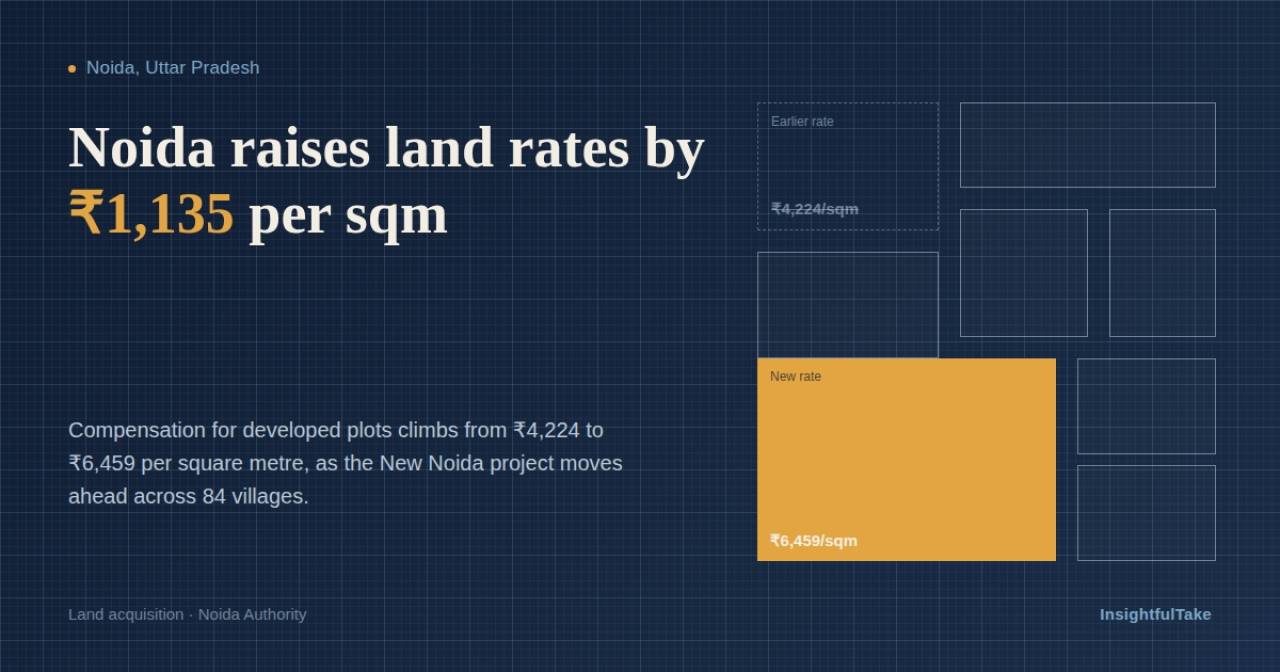
The Authority has raised the rate by ₹1,135 per square metre, taking compensation from ₹4,224 to ₹6,459 per square metre. That represents an increase of roughly 53 per cent.
The decision, cleared at a recent board meeting, is aimed largely at farmers whose agricultural land is being acquired for the upcoming New Noida project and who have spent months seeking better compensation.
Krishan Karunesh, chief executive officer of the Noida Authority, confirmed that the revised rate was approved in response to the demand for higher compensation.
The changes go beyond the basic land rate. The Authority has also agreed to increase the abadi land component by five per cent and provide affected farmers with five per cent of the developed plot in the final layout. Such benefit-sharing arrangements have increasingly become part of land acquisition negotiations in Uttar Pradesh.
Why Has Noida Raised the Rate?
The revision is closely linked to the ambitious New Noida project, formally notified as the Dadri-Noida-Ghaziabad Investment Region, or DNGIR.
The proposed investment region covers 84 villages spread across 209.11 square kilometres. Of these, 63 villages are in Bulandshahr district and 21 are in Gautam Buddh Nagar.
The project is being positioned as a major extension of the industrial and residential corridor that has already transformed Noida and Greater Noida.
But large-scale development requires large-scale land acquisition, making farmer cooperation critical to the project's progress.
To manage the acquisition and development process, DNGIR has been divided into four phases extending over more than 15 years.
Phase 1 is scheduled for completion by 2027 and covers approximately 3,798 hectares. Phase 2 will run until 2032 and cover around 5,908 hectares. Phase 3 is expected to continue until 2037 across about 8,230 hectares, while the final phase is scheduled for completion by 2041.
Officials have indicated that compensation rates for different phases will be revised periodically. The latest increase is being described as the first such revision for Phase 1 land.
The Impact Goes Beyond Noida
Noida is not alone in revising its land compensation rates.
The Greater Noida Authority has also increased its developed plot rate, raising it from ₹4,125 to ₹6,415 per square metre. The scale of the increase is broadly similar to Noida's revision.
The Yamuna Expressway Industrial Development Authority is also expected to align its rate with Noida's figure, although a formal notification is still awaited.
There is, however, an important distinction.
Noida officials have clarified that the latest revision applies only to land within Noida Authority's jurisdiction. It does not automatically extend to land being acquired under DNGIR or by other regional development authorities.
That distinction matters because farmers in different parts of the proposed investment region may come under different administrative authorities, with separate notifications and acquisition procedures governing their land.
What Does the Decision Mean for Farmers?
For farmers who have watched agricultural land around Noida and Greater Noida being converted into commercial, residential and industrial developments, the decision represents a significant improvement, but not necessarily the end of the dispute.
The higher compensation rate addresses one of the central complaints over land acquisition. The additional five per cent abadi component and the promise of five per cent of the developed plot also give farmers a greater share in the value created from their land.
Yet the larger DNGIR project is expected to unfold over many years.
With the final phase extending until 2041, many families may still face negotiations over land that is not scheduled for acquisition for years.
The bigger question now is whether the latest revision will become a broader template for land acquisition across Uttar Pradesh.
If other development authorities follow a similar approach, the decision could mark a shift towards more predictable and higher compensation for farmers whose land is being absorbed into rapidly expanding urban and industrial corridors.
If not, farmers in different phases and jurisdictions may once again have to negotiate separately for what they believe is a fair share of the value generated from their land.
For New Noida, therefore, the rate hike is more than a change in numbers. It is also an attempt to build the trust and cooperation that a project of this scale will need to move forward.
A long-running demand from farmers affected by Noida’s expanding development plans has finally brought results, with the Noida Authority approving a sharp increase in land compensation rates for developed plots.
The Authority has raised the rate by ₹1,135 per square metre, taking compensation from ₹4,224 to ₹6,459 per square metre. That represents an increase of roughly 53 per cent.
The decision, cleared at a recent board meeting, is aimed largely at farmers whose agricultural land is being acquired for the upcoming New Noida project and who have spent months seeking better compensation.
Krishan Karunesh, chief executive officer of the Noida Authority, confirmed that the revised rate was approved in response to the demand for higher compensation.
The changes go beyond the basic land rate. The Authority has also agreed to increase the abadi land component by five per cent and provide affected farmers with five per cent of the developed plot in the final layout. Such benefit-sharing arrangements have increasingly become part of land acquisition negotiations in Uttar Pradesh.
Why Has Noida Raised the Rate?
The revision is closely linked to the ambitious New Noida project, formally notified as the Dadri-Noida-Ghaziabad Investment Region, or DNGIR.
The proposed investment region covers 84 villages spread across 209.11 square kilometres. Of these, 63 villages are in Bulandshahr district and 21 are in Gautam Buddh Nagar.
The project is being positioned as a major extension of the industrial and residential corridor that has already transformed Noida and Greater Noida.
But large-scale development requires large-scale land acquisition, making farmer cooperation critical to the project's progress.
To manage the acquisition and development process, DNGIR has been divided into four phases extending over more than 15 years.
Phase 1 is scheduled for completion by 2027 and covers approximately 3,798 hectares. Phase 2 will run until 2032 and cover around 5,908 hectares. Phase 3 is expected to continue until 2037 across about 8,230 hectares, while the final phase is scheduled for completion by 2041.
Officials have indicated that compensation rates for different phases will be revised periodically. The latest increase is being described as the first such revision for Phase 1 land.
The Impact Goes Beyond Noida
Noida is not alone in revising its land compensation rates.
The Greater Noida Authority has also increased its developed plot rate, raising it from ₹4,125 to ₹6,415 per square metre. The scale of the increase is broadly similar to Noida's revision.
The Yamuna Expressway Industrial Development Authority is also expected to align its rate with Noida's figure, although a formal notification is still awaited.
There is, however, an important distinction.
Noida officials have clarified that the latest revision applies only to land within Noida Authority's jurisdiction. It does not automatically extend to land being acquired under DNGIR or by other regional development authorities.
That distinction matters because farmers in different parts of the proposed investment region may come under different administrative authorities, with separate notifications and acquisition procedures governing their land.
What Does the Decision Mean for Farmers?
For farmers who have watched agricultural land around Noida and Greater Noida being converted into commercial, residential and industrial developments, the decision represents a significant improvement, but not necessarily the end of the dispute.
The higher compensation rate addresses one of the central complaints over land acquisition. The additional five per cent abadi component and the promise of five per cent of the developed plot also give farmers a greater share in the value created from their land.
Yet the larger DNGIR project is expected to unfold over many years.
With the final phase extending until 2041, many families may still face negotiations over land that is not scheduled for acquisition for years.
The bigger question now is whether the latest revision will become a broader template for land acquisition across Uttar Pradesh.
If other development authorities follow a similar approach, the decision could mark a shift towards more predictable and higher compensation for farmers whose land is being absorbed into rapidly expanding urban and industrial corridors.
If not, farmers in different phases and jurisdictions may once again have to negotiate separately for what they believe is a fair share of the value generated from their land.
For New Noida, therefore, the rate hike is more than a change in numbers. It is also an attempt to build the trust and cooperation that a project of this scale will need to move forward.























Leave a Comment