
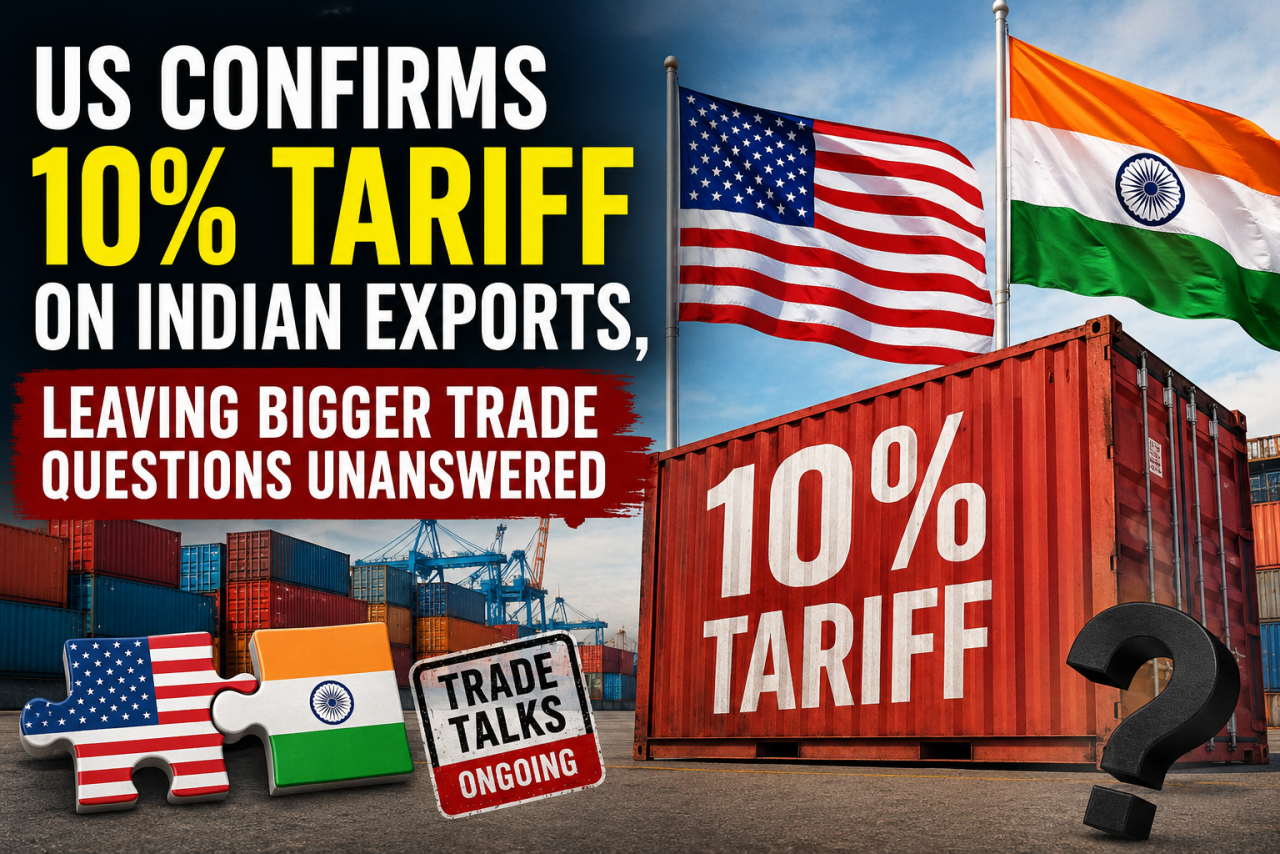
India has avoided a higher US tariff for now, but with trade talks unfinished and new duties under discussion, uncertainty remains the biggest challenge for exporters.
India has avoided a sharper trade setback after the United States confirmed a 10% tariff on most Indian exports under a new legal framework. While the decision spares exporters from a higher levy, it offers only temporary relief in a trade relationship that remains deeply uncertain. The bigger question is no longer what the tariff is today, but how long it will stay that way.
The 10% rate matters largely because of what India avoided. Earlier this year, the Office of the US Trade Representative (USTR) had proposed a higher 12.5% tariff on Indian goods. By remaining in the lower bracket, India now stands on a more level playing field with countries such as China and Vietnam, while around 36 other economies face the steeper rate.
The tariff has been imposed under Section 301 of the US Trade Act of 1974 and applies in addition to the existing Most-Favoured-Nation (MFN) tariff. This means Indian exporters continue to face a higher overall duty burden when selling goods in the American market.
One of the key reasons India secured the lower rate appears to be a recent policy change at home. On July 13, India amended its Foreign Trade Policy to prohibit the import of goods produced wholly or partly through forced or bonded labour. The move addressed a concern raised in the USTR's earlier review, which had noted the absence of such a prohibition in India's trade regulations.
By introducing the rule, India joined a group of countries that qualified for the lower tariff bracket. US Trade Representative Jamieson Greer described the change as a positive step for both fair trade and labour rights, while stressing that countries benefiting from the lower rate would also be expected to enforce these standards effectively.
The current tariff framework has its roots in President Donald Trump's "Liberation Day" tariffs, a sweeping package of import duties that was struck down earlier this year after the US Supreme Court ruled that the administration had exceeded its statutory authority in imposing them. The ruling delayed, rather than ended, Washington's broader tariff strategy.
The US administration has since introduced a revised legal mechanism, allowing tariffs ranging from 10% to 12.5% on imports from around 60 countries. India has secured the lower rate for now, but that should not be mistaken for long-term certainty.
Fresh signs of future trade tensions are already emerging. This week, the US proposed tariffs of up to 200% on imported generic medicines after a two-year transition period. India, one of the world's largest suppliers of affordable generic drugs to the United States, could face significant disruption if the proposal eventually becomes policy. Even if it serves primarily as a negotiating tool today, it signals that tariffs will remain central to future trade discussions.
The broader issue remains the unfinished bilateral trade agreement between India and the United States. The current 10% tariff is widely seen as an interim arrangement because only one of the ongoing Section 301 investigations concerning India has concluded. Until negotiations produce a comprehensive agreement, tariff rates and market access conditions could continue to change with little warning.
For India, the response cannot be limited to waiting for the next announcement from Washington. Exporters need to diversify beyond the US market while competing on quality and value rather than relying on aggressive price cuts. The government must continue engaging with the United States, India's largest export destination, while firmly challenging trade concerns that do not reflect the country's regulatory framework. At the same time, India should pursue calibrated import substitution that strengthens domestic competitiveness instead of merely shielding inefficient industries. A more resilient manufacturing base would reduce excessive dependence on any single export market.
The latest tariff decision offers short-term relief, but it does not resolve the underlying uncertainty. Until a comprehensive trade agreement is signed, the 10% tariff should be viewed less as a settlement than as a pause. For Indian exporters, the greatest challenge is no longer the tariff itself, but the unpredictability of what comes next.
India has avoided a sharper trade setback after the United States confirmed a 10% tariff on most Indian exports under a new legal framework. While the decision spares exporters from a higher levy, it offers only temporary relief in a trade relationship that remains deeply uncertain. The bigger question is no longer what the tariff is today, but how long it will stay that way.
The 10% rate matters largely because of what India avoided. Earlier this year, the Office of the US Trade Representative (USTR) had proposed a higher 12.5% tariff on Indian goods. By remaining in the lower bracket, India now stands on a more level playing field with countries such as China and Vietnam, while around 36 other economies face the steeper rate.
The tariff has been imposed under Section 301 of the US Trade Act of 1974 and applies in addition to the existing Most-Favoured-Nation (MFN) tariff. This means Indian exporters continue to face a higher overall duty burden when selling goods in the American market.
One of the key reasons India secured the lower rate appears to be a recent policy change at home. On July 13, India amended its Foreign Trade Policy to prohibit the import of goods produced wholly or partly through forced or bonded labour. The move addressed a concern raised in the USTR's earlier review, which had noted the absence of such a prohibition in India's trade regulations.
By introducing the rule, India joined a group of countries that qualified for the lower tariff bracket. US Trade Representative Jamieson Greer described the change as a positive step for both fair trade and labour rights, while stressing that countries benefiting from the lower rate would also be expected to enforce these standards effectively.
The current tariff framework has its roots in President Donald Trump's "Liberation Day" tariffs, a sweeping package of import duties that was struck down earlier this year after the US Supreme Court ruled that the administration had exceeded its statutory authority in imposing them. The ruling delayed, rather than ended, Washington's broader tariff strategy.
The US administration has since introduced a revised legal mechanism, allowing tariffs ranging from 10% to 12.5% on imports from around 60 countries. India has secured the lower rate for now, but that should not be mistaken for long-term certainty.
Fresh signs of future trade tensions are already emerging. This week, the US proposed tariffs of up to 200% on imported generic medicines after a two-year transition period. India, one of the world's largest suppliers of affordable generic drugs to the United States, could face significant disruption if the proposal eventually becomes policy. Even if it serves primarily as a negotiating tool today, it signals that tariffs will remain central to future trade discussions.
The broader issue remains the unfinished bilateral trade agreement between India and the United States. The current 10% tariff is widely seen as an interim arrangement because only one of the ongoing Section 301 investigations concerning India has concluded. Until negotiations produce a comprehensive agreement, tariff rates and market access conditions could continue to change with little warning.
For India, the response cannot be limited to waiting for the next announcement from Washington. Exporters need to diversify beyond the US market while competing on quality and value rather than relying on aggressive price cuts. The government must continue engaging with the United States, India's largest export destination, while firmly challenging trade concerns that do not reflect the country's regulatory framework. At the same time, India should pursue calibrated import substitution that strengthens domestic competitiveness instead of merely shielding inefficient industries. A more resilient manufacturing base would reduce excessive dependence on any single export market.
The latest tariff decision offers short-term relief, but it does not resolve the underlying uncertainty. Until a comprehensive trade agreement is signed, the 10% tariff should be viewed less as a settlement than as a pause. For Indian exporters, the greatest challenge is no longer the tariff itself, but the unpredictability of what comes next.




















Leave a Comment