
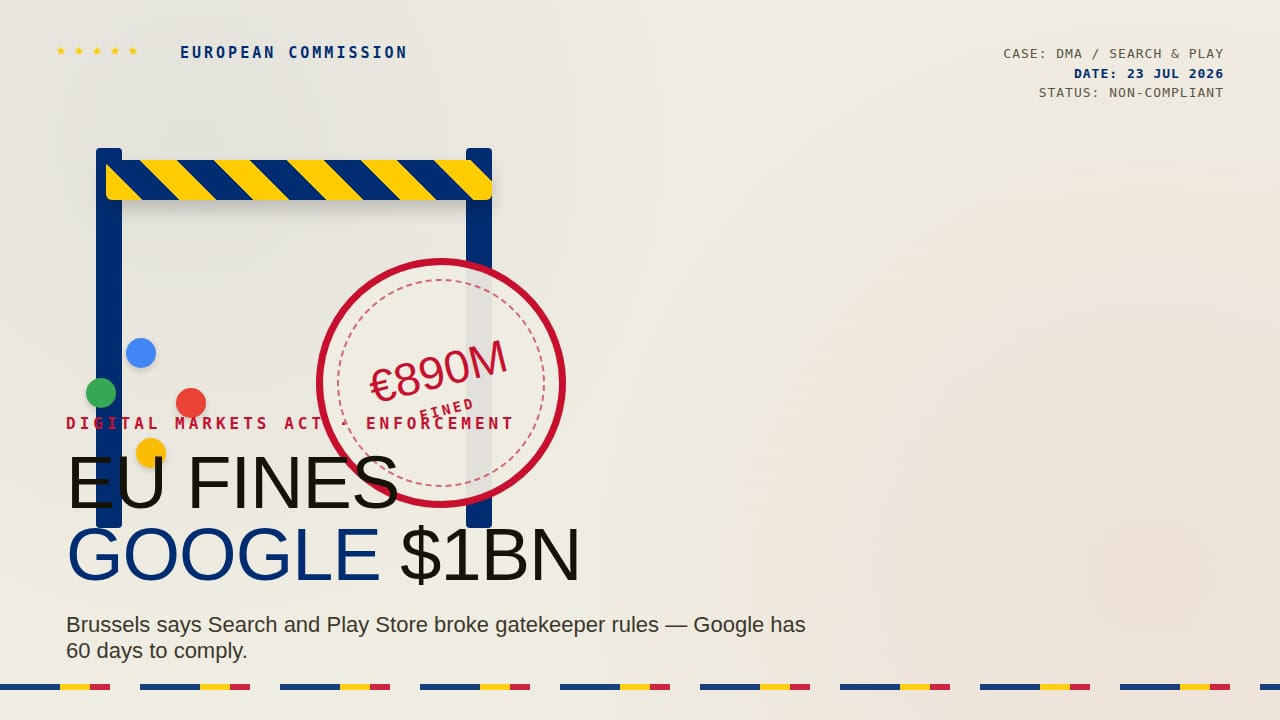
Google's biggest challenge in Europe isn't over. The EU has imposed another massive fine, accusing the tech giant of giving its own services an unfair advantage and limiting competition.
The European Union has fined Google €890 million, nearly $1 billion, for violating the bloc's digital competition rules. Announced on July 23, 2026, the penalty is one of the biggest enforcement actions taken so far under the Digital Markets Act (DMA), the landmark law designed to curb the dominance of major technology companies.
Why Google Was Fined
The European Commission, the EU's executive body, investigated two separate practices by Google and imposed penalties that together total €890 million.
The first case focused on Google Search. Regulators found that Google's own services, including Google Shopping, Google Hotels, and Google Flights, were given more prominent placement in search results than competing services. According to the Commission, this gave Google's products an unfair advantage, even when rival platforms offered better or more relevant results.
Teresa Ribera, the European Commission's Executive Vice President for a Clean, Just and Competitive Transition, said companies should succeed because their products are better, not because they own the platform on which those products appear.
The second case involved the Google Play Store for Android devices. The Commission concluded that Google prevented app developers from informing customers about cheaper purchasing options outside the Play Store, such as buying directly through the developer's website or another app marketplace. This practice, known as "anti-steering," was found to limit both consumer choice and competition.
What Happens Next
Google has been given 60 days to bring its services into compliance with the Digital Markets Act. If it fails to do so, the company could face additional daily penalties calculated on the basis of its average daily global earnings.
Google has defended its position, arguing that some of the required changes could reduce the usefulness of features such as travel information displayed in Search and weaken certain security protections in the Play Store. However, reports indicate that similar regulatory changes introduced in other markets have not led to the problems the company has warned about.
A Long History of EU Antitrust Cases
This is far from Google's first clash with European regulators.
In 2017, the company was fined around €2.4 billion for giving preferential treatment to its shopping comparison service. A year later, it received a record €4.3 billion fine for abusing Android's market dominance to strengthen the position of Google Search and other Google apps. Although that penalty was later reduced slightly, the EU's highest court upheld the decision just weeks before this latest ruling, in July 2026.
In 2025, Google was also fined nearly €3 billion over alleged anti-competitive practices in its digital advertising business.
With the latest penalty included, Google has now accumulated more than €10 billion in EU antitrust fines, making it one of the most heavily penalised technology companies in the history of European competition law.
The Bigger Picture
The ruling reflects the European Union's broader effort to rein in the market power of the world's largest technology companies. Alongside Google, companies such as Meta and Apple have also faced investigations and significant penalties under the EU's evolving digital regulations.
The decision also comes at a time of growing tension between the European Union and the United States over technology regulation and trade policy. While some American officials have criticised the EU's increasingly aggressive approach toward US technology firms, European regulators maintain that strong competition rules are essential to protect consumers, encourage innovation, and create a level playing field for smaller businesses.
Whether Google chooses to accept the ruling or challenge it in court remains uncertain. For now, however, the company faces a strict deadline to change how two of its most important products operate within the European Union.
The European Union has fined Google €890 million, nearly $1 billion, for violating the bloc's digital competition rules. Announced on July 23, 2026, the penalty is one of the biggest enforcement actions taken so far under the Digital Markets Act (DMA), the landmark law designed to curb the dominance of major technology companies.
Why Google Was Fined
The European Commission, the EU's executive body, investigated two separate practices by Google and imposed penalties that together total €890 million.
The first case focused on Google Search. Regulators found that Google's own services, including Google Shopping, Google Hotels, and Google Flights, were given more prominent placement in search results than competing services. According to the Commission, this gave Google's products an unfair advantage, even when rival platforms offered better or more relevant results.
Teresa Ribera, the European Commission's Executive Vice President for a Clean, Just and Competitive Transition, said companies should succeed because their products are better, not because they own the platform on which those products appear.
The second case involved the Google Play Store for Android devices. The Commission concluded that Google prevented app developers from informing customers about cheaper purchasing options outside the Play Store, such as buying directly through the developer's website or another app marketplace. This practice, known as "anti-steering," was found to limit both consumer choice and competition.
What Happens Next
Google has been given 60 days to bring its services into compliance with the Digital Markets Act. If it fails to do so, the company could face additional daily penalties calculated on the basis of its average daily global earnings.
Google has defended its position, arguing that some of the required changes could reduce the usefulness of features such as travel information displayed in Search and weaken certain security protections in the Play Store. However, reports indicate that similar regulatory changes introduced in other markets have not led to the problems the company has warned about.
A Long History of EU Antitrust Cases
This is far from Google's first clash with European regulators.
In 2017, the company was fined around €2.4 billion for giving preferential treatment to its shopping comparison service. A year later, it received a record €4.3 billion fine for abusing Android's market dominance to strengthen the position of Google Search and other Google apps. Although that penalty was later reduced slightly, the EU's highest court upheld the decision just weeks before this latest ruling, in July 2026.
In 2025, Google was also fined nearly €3 billion over alleged anti-competitive practices in its digital advertising business.
With the latest penalty included, Google has now accumulated more than €10 billion in EU antitrust fines, making it one of the most heavily penalised technology companies in the history of European competition law.
The Bigger Picture
The ruling reflects the European Union's broader effort to rein in the market power of the world's largest technology companies. Alongside Google, companies such as Meta and Apple have also faced investigations and significant penalties under the EU's evolving digital regulations.
The decision also comes at a time of growing tension between the European Union and the United States over technology regulation and trade policy. While some American officials have criticised the EU's increasingly aggressive approach toward US technology firms, European regulators maintain that strong competition rules are essential to protect consumers, encourage innovation, and create a level playing field for smaller businesses.
Whether Google chooses to accept the ruling or challenge it in court remains uncertain. For now, however, the company faces a strict deadline to change how two of its most important products operate within the European Union.




























Leave a Comment