
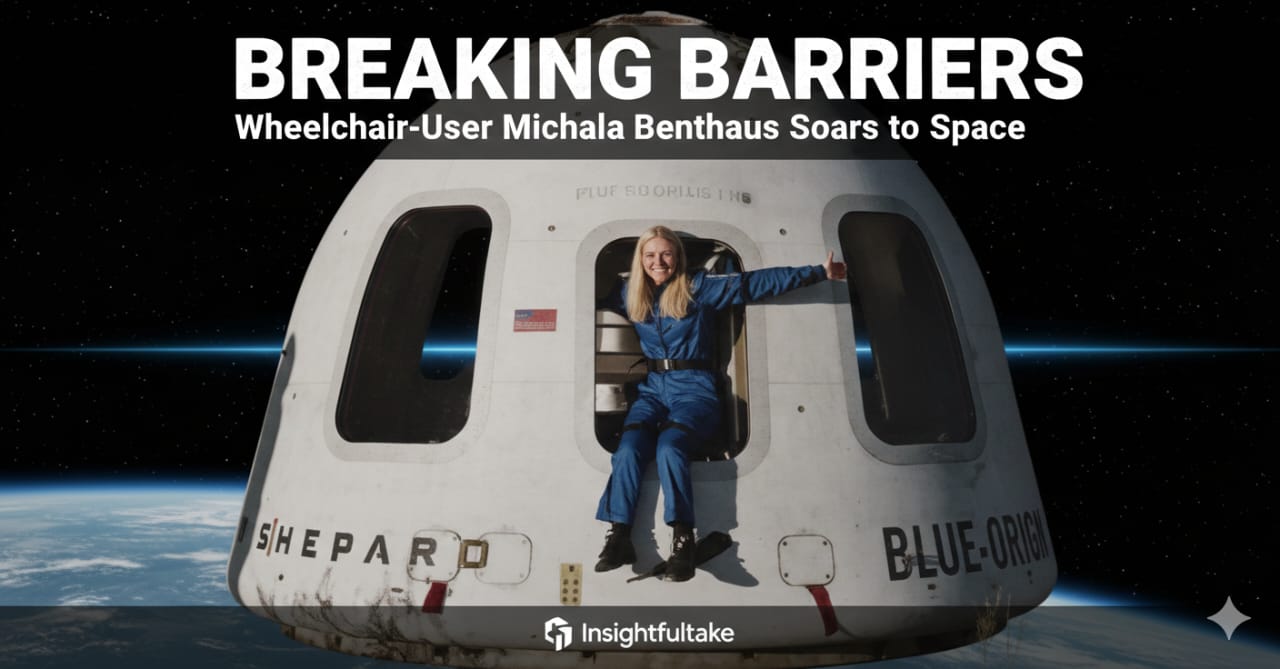
In a landmark moment for inclusive science and global space exploration, the Karman line—the internationally recognized boundary of space—was crossed by a pioneer who represents millions on Earth. Michaela Benthaus, a German aerospace and mechatronics engineer, became the first person who uses a wheelchair to journey into the cosmos. Launched via Blue Origin’s New Shepard suborbital mission, this flight marks a paradigm shift in how we perceive physical ability in the demanding environment of space.
A Historic Journey Beyond the Karman Line
On a Saturday morning at 8:15 am local time, the New Shepard rocket ignited its engines at its Texas launch site. For the passengers on board, including Benthaus, the mission was more than a ten-minute suborbital hop; it was a testament to the evolving nature of the aerospace industry. The fully automated rocket ascended vertically, propelling the crew capsule to altitudes where the Earth's curvature becomes visible against the blackness of the vacuum.
The flight reached its apogee past the Karman line, allowing the crew to experience several minutes of microgravity. This weightless environment—where the downward pull of gravity is balanced by the centrifugal force of orbital motion or the free-fall state of a suborbital trajectory—offered a unique perspective on accessibility. After the brief stay in space, the capsule detached and descended gracefully under a system of parachutes, landing safely in the West Texas desert.
The Science of Inclusion
Michaela Benthaus is not just a passenger; she is a professional engineer at the European Space Agency (ESA). Her journey is deeply personal yet professionally significant. Having suffered a spinal cord injury following a mountain biking accident, Benthaus has been a vocal advocate for accessibility. "After my accident, I really, really figured out how inaccessible our world still is for people with disabilities," she shared in a poignant video released by the company.
Her flight addresses a critical question in space medicine and engineering: Can space be the ultimate equalizer? In the microgravity environment, the physical constraints imposed by Earth's gravity are temporarily lifted. For individuals with mobility impairments, the ability to move in three dimensions without the resistance of weight provides a glimpse into a future where "disability" is a relative term, defined more by environmental design than by biological limits.
The Evolution of Space Tourism
This mission was the 16th crewed flight for Blue Origin, a venture led by Jeff Bezos. While the company maintains a level of confidentiality regarding its ticket prices, the industry is seeing a surge in commercial interest. Competitors like Virgin Galactic reportedly charge upwards of $600,000 for similar suborbital experiences.
However, the inclusion of individuals like Benthaus suggests that the industry is moving beyond mere "tourism" toward "purposeful exploration." By successfully integrating a wheelchair user into a standard mission profile, Blue Origin has demonstrated that the engineering of modern spacecraft is becoming robust enough to accommodate a wider spectrum of human diversity.
A Global Inspiration
The impact of this flight resonated across the scientific community. Jared Isaacman, a prominent figure in commercial spaceflight, congratulated Benthaus on social media, noting that she has "inspired millions to look up and imagine what is possible."
From an educational perspective, this event aligns with the principles of modern physics and human geography. It challenges us to rethink the "limits of growth" and the social structures we build. If we can engineer a rocket to take a wheelchair user to space, it poses a reflective question to society: why do we still find it difficult to make our terrestrial cities fully accessible?
Final Take
As Benthaus herself noted, an inclusive society must be inclusive "in every part, and not only in the parts we like to be." This flight is a small step in terms of duration but a giant leap for the representation of people with disabilities in STEM (Science, Technology, Engineering, and Mathematics). It proves that the final frontier is not just for the physically elite, but for anyone with the vision and the intellect to reach for the stars.
























Leave a Comment