
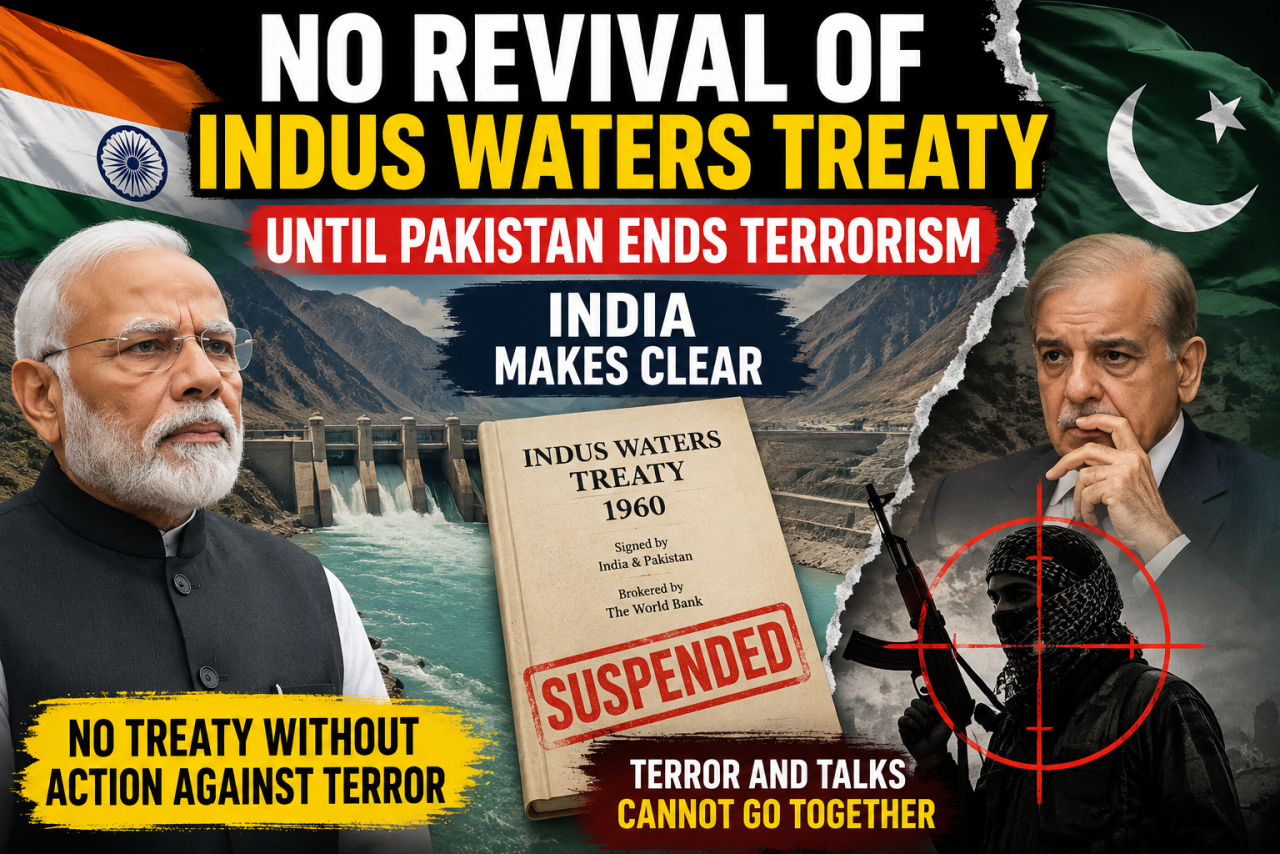
India has ruled out restoring the Indus Waters Treaty unless Pakistan ends support for cross-border terrorism, signalling a major shift in water diplomacy and bilateral relations.
India has signalled that the Indus Waters Treaty will not return to its original form unless Pakistan takes verifiable steps to end its support for cross-border terrorism. Officials familiar with the matter said the 1960 pact, which governs the sharing of six rivers between the two countries, remains in abeyance more than a year after New Delhi suspended it following the Pahalgam terror attack.
The treaty was signed in September 1960 by then prime minister Jawaharlal Nehru and Pakistan's president Mohammad Ayub Khan, brokered by the World Bank. It gave Pakistan control over the western rivers, the Indus, Jhelum and Chenab, while India received rights to the eastern rivers, the Ravi, Beas and Sutlej. India suspended the arrangement in May 2025 as part of a broader set of diplomatic and economic measures after The Resistance Front, a proxy of the Pakistan-based Lashkar-e-Taiba, killed 26 civilians in Pahalgam. India subsequently launched Operation Sindoor to strike terror infrastructure inside Pakistan.
According to officials who spoke on condition of anonymity, any review of the suspension is tied directly to Pakistan abjuring support for cross-border terrorism. They said there is no sign that Islamabad has taken meaningful action on this front. Individuals and groups sanctioned by the United Nations Security Council's 1267 Sanctions Committee continue to appear at public events in Pakistan and retain platforms to spread their messages, the officials said. They also pointed to continued activity by these groups close to the Line of Control as evidence that no credible steps have been taken to rein them in.
The officials pushed back on Pakistan's attempt to project itself as a victim of India's decision, noting that New Delhi had made repeated efforts to engage before suspending the treaty. India formally approached Pakistan four times since 2023 to renegotiate the pact. Its last such communication indicated willingness to meet at a location of Pakistan's choosing. In its final response, dated May 8, 2025, Pakistan said it was open to hearing India's position only at the level of the Indus Waters Commissioners, a forum India considers inadequate, insisting instead that discussions must take place directly between the two governments.
Officials also blamed Pakistan's conduct for undermining the cooperative spirit on which the treaty was built. They said Islamabad has worked to block nearly every water management project India has proposed on the shared rivers, eroding the goodwill that underpinned the treaty's original framework. They further argued that the terms India agreed to in 1960 were heavily skewed in Pakistan's favour, granting it roughly 81 percent of the water from the six rivers. That arrangement, they said, was meant to help resolve outstanding disputes between the two nations, an outcome that never materialised.
The officials also disputed Pakistan's claims that India's suspension amounts to cutting off its water supply, arguing that Islamabad has failed to make efficient use of its own share. Of the roughly 140 million acre-feet of water available annually across the cross-border rivers, they said Pakistan allows nearly 35 million acre-feet, more than India's entire share, to flow unused into the sea.
Since the treaty was put in abeyance, India has accelerated work on water management and hydropower projects in Jammu and Kashmir, several of which had been been delayed for decades because of objections raised by Pakistan under the treaty's provisions. Officials said 3,300 megawatts of hydropower capacity has been built in the region over the past six decades, and another 3,500 megawatts is expected to come online in the next few years. The Kiru and Pakal Dul hydroelectric projects are set to be commissioned this year, while the Kwar and Ratle projects are targeted for completion by 2028.
Beyond the immediate diplomatic standoff, officials indicated that any eventual renegotiation of the treaty would need to account for changes since the 1960s, including climate change, shifts in population and water demand, and advances in hydrological science that were unavailable when the original terms were drawn up. This suggests that even if talks eventually resume, India is unlikely to accept a simple restoration of the treaty's earlier terms.
For now, the message from New Delhi is unambiguous. The treaty's suspension is not a temporary or symbolic gesture but a structural response to what India regards as Pakistan's continued failure to act against terror groups operating from its soil. With no formal negotiations underway and India pressing ahead with infrastructure projects that the treaty had long constrained, the standoff over the Indus Waters Treaty appears set to continue well into the foreseeable future.
India has signalled that the Indus Waters Treaty will not return to its original form unless Pakistan takes verifiable steps to end its support for cross-border terrorism. Officials familiar with the matter said the 1960 pact, which governs the sharing of six rivers between the two countries, remains in abeyance more than a year after New Delhi suspended it following the Pahalgam terror attack.
The treaty was signed in September 1960 by then prime minister Jawaharlal Nehru and Pakistan's president Mohammad Ayub Khan, brokered by the World Bank. It gave Pakistan control over the western rivers, the Indus, Jhelum and Chenab, while India received rights to the eastern rivers, the Ravi, Beas and Sutlej. India suspended the arrangement in May 2025 as part of a broader set of diplomatic and economic measures after The Resistance Front, a proxy of the Pakistan-based Lashkar-e-Taiba, killed 26 civilians in Pahalgam. India subsequently launched Operation Sindoor to strike terror infrastructure inside Pakistan.
According to officials who spoke on condition of anonymity, any review of the suspension is tied directly to Pakistan abjuring support for cross-border terrorism. They said there is no sign that Islamabad has taken meaningful action on this front. Individuals and groups sanctioned by the United Nations Security Council's 1267 Sanctions Committee continue to appear at public events in Pakistan and retain platforms to spread their messages, the officials said. They also pointed to continued activity by these groups close to the Line of Control as evidence that no credible steps have been taken to rein them in.
The officials pushed back on Pakistan's attempt to project itself as a victim of India's decision, noting that New Delhi had made repeated efforts to engage before suspending the treaty. India formally approached Pakistan four times since 2023 to renegotiate the pact. Its last such communication indicated willingness to meet at a location of Pakistan's choosing. In its final response, dated May 8, 2025, Pakistan said it was open to hearing India's position only at the level of the Indus Waters Commissioners, a forum India considers inadequate, insisting instead that discussions must take place directly between the two governments.
Officials also blamed Pakistan's conduct for undermining the cooperative spirit on which the treaty was built. They said Islamabad has worked to block nearly every water management project India has proposed on the shared rivers, eroding the goodwill that underpinned the treaty's original framework. They further argued that the terms India agreed to in 1960 were heavily skewed in Pakistan's favour, granting it roughly 81 percent of the water from the six rivers. That arrangement, they said, was meant to help resolve outstanding disputes between the two nations, an outcome that never materialised.
The officials also disputed Pakistan's claims that India's suspension amounts to cutting off its water supply, arguing that Islamabad has failed to make efficient use of its own share. Of the roughly 140 million acre-feet of water available annually across the cross-border rivers, they said Pakistan allows nearly 35 million acre-feet, more than India's entire share, to flow unused into the sea.
Since the treaty was put in abeyance, India has accelerated work on water management and hydropower projects in Jammu and Kashmir, several of which had been been delayed for decades because of objections raised by Pakistan under the treaty's provisions. Officials said 3,300 megawatts of hydropower capacity has been built in the region over the past six decades, and another 3,500 megawatts is expected to come online in the next few years. The Kiru and Pakal Dul hydroelectric projects are set to be commissioned this year, while the Kwar and Ratle projects are targeted for completion by 2028.
Beyond the immediate diplomatic standoff, officials indicated that any eventual renegotiation of the treaty would need to account for changes since the 1960s, including climate change, shifts in population and water demand, and advances in hydrological science that were unavailable when the original terms were drawn up. This suggests that even if talks eventually resume, India is unlikely to accept a simple restoration of the treaty's earlier terms.
For now, the message from New Delhi is unambiguous. The treaty's suspension is not a temporary or symbolic gesture but a structural response to what India regards as Pakistan's continued failure to act against terror groups operating from its soil. With no formal negotiations underway and India pressing ahead with infrastructure projects that the treaty had long constrained, the standoff over the Indus Waters Treaty appears set to continue well into the foreseeable future.


























Leave a Comment