
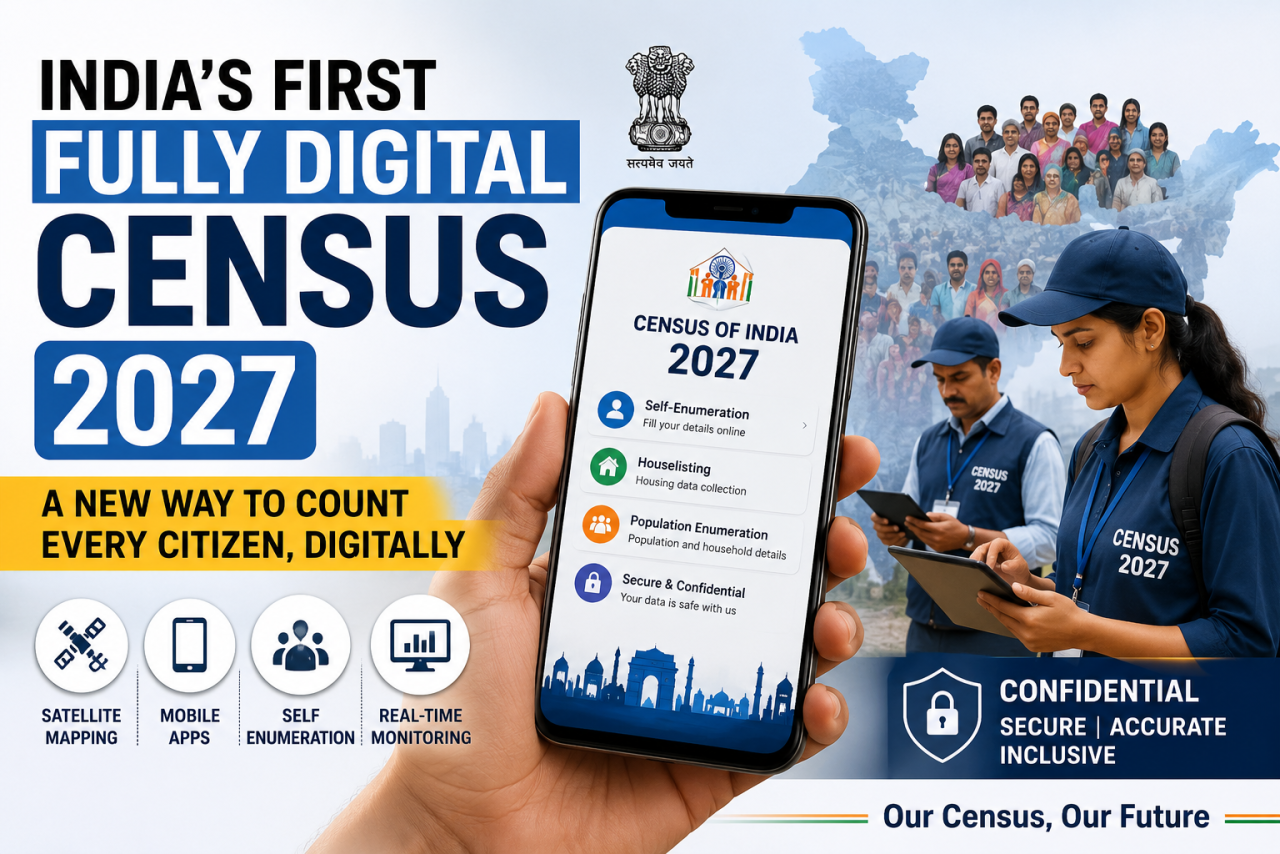
India's biggest data collection exercise is going digital. From online self-enumeration to mobile-based surveys and caste data, Census 2027 will fundamentally change how the nation counts itself.
India will conduct its next census entirely through digital means, marking a sharp departure from the paper-based enumeration methods used since independence. The Census of India 2027 will cover the country's entire population using mobile applications and, for the first time, a self-enumeration option that lets households submit their own data online before field officers arrive.
The exercise is being carried out under the Census Act, 1948 and the Census Rules, 1990. All individual-level data collected during the process will remain confidential, with only aggregated figures released at various administrative levels.
Four New Digital Platforms
Union Home Minister and Minister of Cooperation Amit Shah has soft-launched four digital tools built specifically for this census cycle.
The Houselisting Block Creator is a web-mapping application that allows Charge Officers to digitally mark out houselisting blocks using satellite imagery, ensuring uniform geographic coverage nationwide.
Paired with it is the HLO Mobile Application, a secure offline app through which enumerators collect and upload housing data directly from the field. Only enumerators registered on the Census Management and Monitoring System can access this app, and all data flows straight from field to server, cutting out paperwork entirely. The app works on both Android and iOS and supports 16 regional languages.
The most significant change for ordinary citizens is the Self-Enumeration Portal. Eligible household members can now log their household details online before an enumerator ever knocks on their door. Once submitted, the system generates a unique Self-Enumeration ID, which the enumerator later uses to verify the information during the physical visit.
Overseeing all of this is the Census Management and Monitoring System, a centralised dashboard that lets officials at the sub-district, district, and state levels track enumeration progress and field readiness in real time.
A Two-Phase Rollout
The census will unfold in two distinct phases.
Phase 1: Houselisting and Housing Census
The first phase, the Houselisting and Housing Census, was notified on 7 January 2026 and will be carried out between 1 April and 30 September 2026.
Each state and union territory will conduct its own 30-day enumeration window within this period, and households will get an optional 15-day self-enumeration period before enumerators visit in person.
This phase gathers data on housing conditions, household amenities, and assets.
Phase 2: Population Enumeration
The second phase, Population Enumeration, is scheduled for February 2027 across most of the country. It will record demographic, social, economic, education, and migration-related details of every individual.
Notably, this phase will also include a caste-related question, a detail that carries considerable political weight given the long-running national debate over a caste census.
Two regions will follow a different timeline altogether. In the Union Territory of Ladakh and the snow-bound, non-synchronous areas of Jammu and Kashmir, Himachal Pradesh, and Uttarakhand, enumeration will take place earlier, in September 2026, because of terrain and weather constraints that make winter access difficult.
The reference date for the census, the point in time to which all collected data corresponds, is set at 00:00 hours on 1 March 2027 for most of the country. For Ladakh and the snow-bound areas conducting early enumeration, the reference date is 00:00 hours on 1 October 2026.
Why States Still Matter
Despite the heavy digital push, state and union territory governments remain central to the exercise.
Field-level work, including data collection, verification, supervision, and progress review, will be carried out by census functionaries appointed and deployed by the respective state and UT administrations, operating under the same central Census Act and Rules.
A Long-Delayed Exercise
India's census, ordinarily conducted every ten years, was last completed in 2011. The 2021 Census was postponed indefinitely, first due to the COVID-19 pandemic and later because of prolonged administrative delays. As a result, the country will have gone more than 15 years without updated population data by the time Census 2027 concludes.
This prolonged gap has affected everything from constituency delimitation to welfare scheme targeting, making the shift to a faster, technology-driven census especially significant.
The government has also introduced two mascots for the exercise, Pragati and Vikas, as part of its public outreach campaign to encourage citizen participation, particularly through the new self-enumeration route.
India will conduct its next census entirely through digital means, marking a sharp departure from the paper-based enumeration methods used since independence. The Census of India 2027 will cover the country's entire population using mobile applications and, for the first time, a self-enumeration option that lets households submit their own data online before field officers arrive.
The exercise is being carried out under the Census Act, 1948 and the Census Rules, 1990. All individual-level data collected during the process will remain confidential, with only aggregated figures released at various administrative levels.
Four New Digital Platforms
Union Home Minister and Minister of Cooperation Amit Shah has soft-launched four digital tools built specifically for this census cycle.
The Houselisting Block Creator is a web-mapping application that allows Charge Officers to digitally mark out houselisting blocks using satellite imagery, ensuring uniform geographic coverage nationwide.
Paired with it is the HLO Mobile Application, a secure offline app through which enumerators collect and upload housing data directly from the field. Only enumerators registered on the Census Management and Monitoring System can access this app, and all data flows straight from field to server, cutting out paperwork entirely. The app works on both Android and iOS and supports 16 regional languages.
The most significant change for ordinary citizens is the Self-Enumeration Portal. Eligible household members can now log their household details online before an enumerator ever knocks on their door. Once submitted, the system generates a unique Self-Enumeration ID, which the enumerator later uses to verify the information during the physical visit.
Overseeing all of this is the Census Management and Monitoring System, a centralised dashboard that lets officials at the sub-district, district, and state levels track enumeration progress and field readiness in real time.
A Two-Phase Rollout
The census will unfold in two distinct phases.
Phase 1: Houselisting and Housing Census
The first phase, the Houselisting and Housing Census, was notified on 7 January 2026 and will be carried out between 1 April and 30 September 2026.
Each state and union territory will conduct its own 30-day enumeration window within this period, and households will get an optional 15-day self-enumeration period before enumerators visit in person.
This phase gathers data on housing conditions, household amenities, and assets.
Phase 2: Population Enumeration
The second phase, Population Enumeration, is scheduled for February 2027 across most of the country. It will record demographic, social, economic, education, and migration-related details of every individual.
Notably, this phase will also include a caste-related question, a detail that carries considerable political weight given the long-running national debate over a caste census.
Two regions will follow a different timeline altogether. In the Union Territory of Ladakh and the snow-bound, non-synchronous areas of Jammu and Kashmir, Himachal Pradesh, and Uttarakhand, enumeration will take place earlier, in September 2026, because of terrain and weather constraints that make winter access difficult.
The reference date for the census, the point in time to which all collected data corresponds, is set at 00:00 hours on 1 March 2027 for most of the country. For Ladakh and the snow-bound areas conducting early enumeration, the reference date is 00:00 hours on 1 October 2026.
Why States Still Matter
Despite the heavy digital push, state and union territory governments remain central to the exercise.
Field-level work, including data collection, verification, supervision, and progress review, will be carried out by census functionaries appointed and deployed by the respective state and UT administrations, operating under the same central Census Act and Rules.
A Long-Delayed Exercise
India's census, ordinarily conducted every ten years, was last completed in 2011. The 2021 Census was postponed indefinitely, first due to the COVID-19 pandemic and later because of prolonged administrative delays. As a result, the country will have gone more than 15 years without updated population data by the time Census 2027 concludes.
This prolonged gap has affected everything from constituency delimitation to welfare scheme targeting, making the shift to a faster, technology-driven census especially significant.
The government has also introduced two mascots for the exercise, Pragati and Vikas, as part of its public outreach campaign to encourage citizen participation, particularly through the new self-enumeration route.





















Leave a Comment