
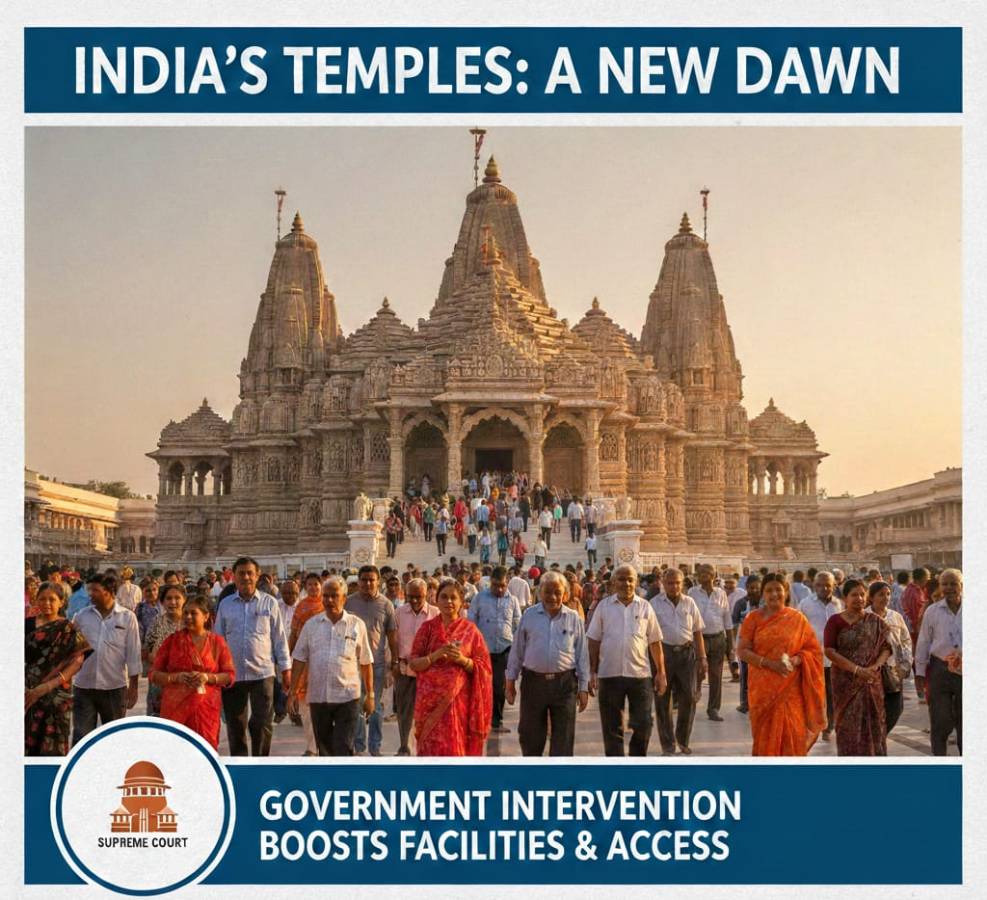
The Supreme Court has drawn a clear line in India’s temple debate, saying government oversight has strengthened facilities and protected every devotee’s right to worship
The Supreme Court of India on January 27, 2025, observed that government intervention in temple administration has led to improved facilities for devotees across the country. The court stated that temples are public religious institutions and not private properties, and therefore no individual has the authority to restrict entry to others. Every devotee has an equal right to worship.
A bench led by Chief Justice Surya Kant examined issues related to temple management and noted that government-appointed committees have played a role in improving infrastructure and amenities at temples. These committees use temple funds to enhance facilities for pilgrims, resulting in better crowd management, sanitation, and overall access. The court said such intervention has generally benefited the public and should not be viewed negatively.
The judges also addressed the question of exclusion from temples. The court clarified that personal rights cannot be used to deny access to others. Temples exist for collective worship and must serve all devotees equally. According to the court, government oversight helps ensure that this public character of temples is maintained.
These observations were made during the hearing of a case from Karnataka concerning the Anjanadri Hills temple. The petition was filed by a seer and priest, Vidyadas Babaji, who claimed that state government intervention had prevented him from performing his religious duties and violated earlier court directions.
During the hearing, the court referred to reports of a physical altercation at the temple in the previous month. It was alleged that the petitioner had assaulted another priest. The judges questioned how a priest could engage in violence and remarked that such conduct was inconsistent with religious responsibility. The petitioner denied the allegations and claimed that he was the one who had been attacked. He also stated that he had been performing rituals at the temple for many years and that the government takeover was unlawful.
The case reflects a broader legal debate on whether state governments should manage temples. Several petitions challenging state control of religious institutions are currently under consideration by the Supreme Court. In the Karnataka matter, the High Court has been examining the issue since 2019. The Supreme Court chose not to intervene at this stage and directed the petitioner to pursue remedies before the High Court until a final decision is reached.
The Supreme Court also recently addressed a separate issue concerning entry rules at the Mahakal Temple in Ujjain. A petition challenged the practice of granting special access to the garbhagriha, or inner sanctum, based on permissions given by the district administration. The court declined to interfere, stating that it cannot regulate temple entry policies.
While observing that no person is a “VIP” before God and that all devotees are equal in faith, the court held that administrative decisions regarding access must be taken by temple authorities. The judges advised the petitioner to approach the temple management instead of seeking judicial intervention.
Overall, the Supreme Court reiterated that government involvement has contributed to better management and improved facilities at temples. At the same time, it emphasized that courts should avoid involvement in day-to-day temple administration. Temples are public places of worship, and both government authorities and courts aim to ensure that they remain accessible, safe, and well-managed for all devotees.























Leave a Comment