
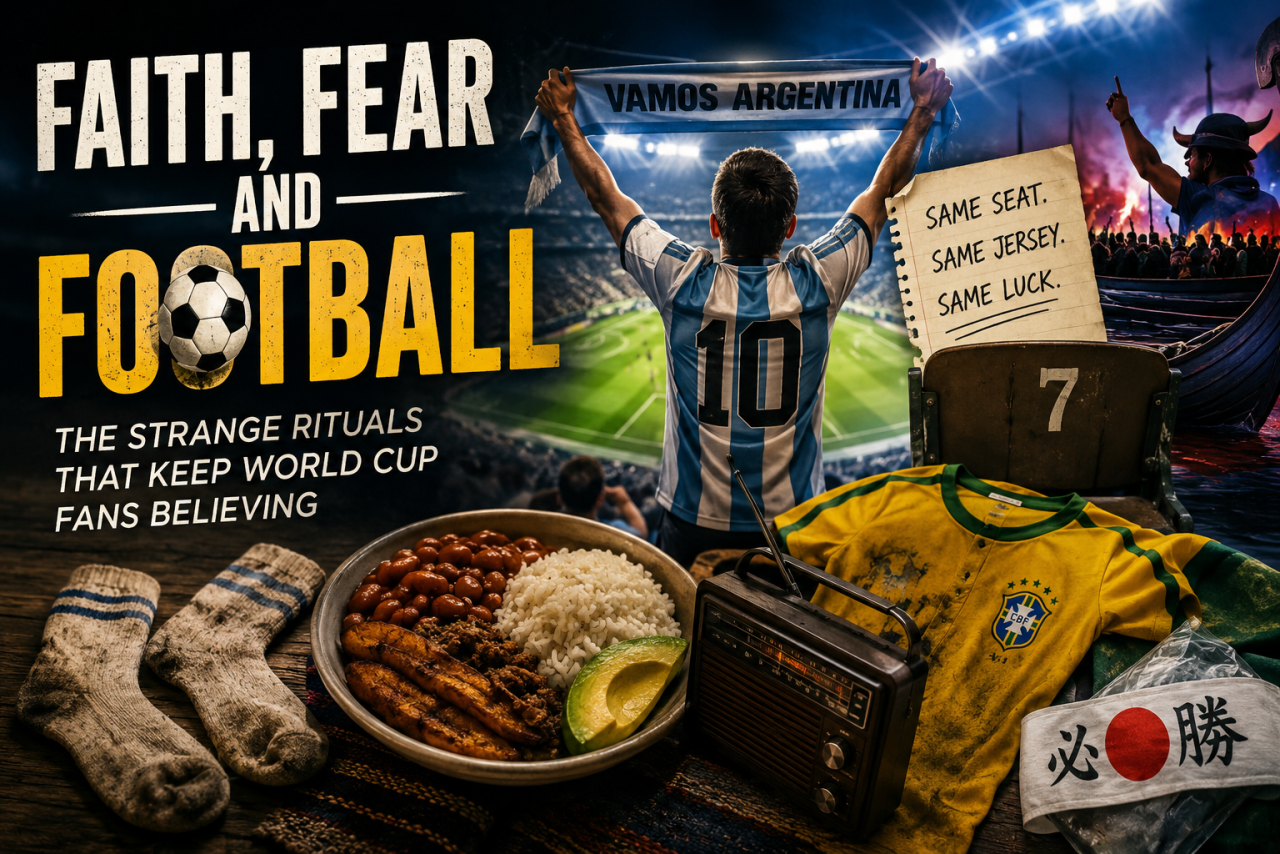
From lucky socks to sacred meals, discover the fascinating rituals that millions of World Cup fans believe can help their team win.
The FIFA World Cup 2026 is the world's biggest football spectacle, but some of its fiercest battles are being fought far from the stadium. In homes, cafés, crowded street-side dhabas, and packed fan zones, millions of supporters are following rituals they believe can influence the fate of a match. Some wear the same unwashed socks throughout the tournament. Others refuse to change their seat, switch off the television during penalties, or insist on serving the same meal after every victory. Ask them why, and few will offer a logical explanation. Most simply smile and say, "It worked last time."
It is easy to dismiss these habits as superstition. Yet behind every ritual lies a story shaped by a nation's history, culture, humour, and heartbreak. Around the world, football is not just watched. It is believed in.
Norway: An Army That Rows Together
Norway had not played in a major tournament for years, but its travelling fans were already famous. They call themselves the Viking Army. Before kick-off, they gather and perform their signature act: locking arms, bending forward, and rowing together as if pulling an invisible ship through invisible water. The chant grows louder with every stroke, until the whole stand seems to move like one body. It is a performance borrowed from Norse legend. These fans do not see themselves as spectators. They see themselves as a crew, rowing their team into battle, one imaginary wave at a time.
Colombia: The Kitchen as a Shrine
For Colombian families, luck does not live in a jersey or a scarf. It lives in the kitchen. Once a winning streak begins, the matchday meal becomes sacred. If bandeja paisa was on the table during a win, it stays on the table, cooked the same way and eaten at the same time for every match that follows. Change the rice or rearrange the food on the plate, and you risk breaking the streak. Mothers across Colombia end up preparing the same dish, match after match. Not because they truly believe in kitchen magic, but because no one wants to be the reason the luck runs out.
Argentina: A Curse Borrowed and Redirected
Argentine football has its own strange folklore, built around a man most fans never met. In the 1980s, a supporter named Kiricocho was believed to bring bad luck to any team he supported in person. His presence alone seemed to unsettle rivals. He has been gone for years, but his name has outlived him. Even today, whenever an opponent prepares to take a penalty or a dangerous free kick, Argentine crowds chant "Kiricocho." They hope the curse will cross the pitch and land on the other side.
Brazil: The Jersey That Must Not Be Washed
Nowhere is superstition more physical than in Brazil, a country where football is often treated like a religion. A jersey worn during a win is often left unwashed for the rest of the tournament. Fans fear that soap and water might wash away whatever good luck clings to the fabric. Seats work the opposite way. A fan will refuse to move from a winning seat, but the moment the team loses, that same place suddenly feels cursed. Everyone rushes to find a new spot, as if the seat itself had betrayed them.
England: The Radio Rule
In England, superstition takes a quieter, more homely shape. Many fans insist on watching matches from the exact spot on the sofa where they sat during a past win, with phones switched off and curtains drawn just as before. Some refuse to watch live matches altogether. They prefer to follow the score through radio commentary or a friend's phone call, convinced that their own eyes bring bad luck to a result they cannot control.
Japan: Cleaning Up After Heartbreak
Japanese fans have built a very different kind of reputation, one that has nothing to do with penalties or curses. After matches, whether their team wins or loses, groups of supporters stay behind to collect litter around their seats before leaving the stadium. What began as an act of discipline has gradually become a ritual of respect, reflecting the belief that how you leave a place matters just as much as how your team performed there.
None of these rituals will change a single kick of the ball. Referees do not check for unwashed jerseys, and video assistant referees have no interest in kitchen menus. Yet these small, stubborn acts of faith reveal something deeply human about football. For the people who love the game most, a match is never just ninety minutes on a screen. It is a story they feel responsible for shaping, one lucky sock, one repeated meal, and one whispered curse at a time.
The FIFA World Cup 2026 is the world's biggest football spectacle, but some of its fiercest battles are being fought far from the stadium. In homes, cafés, crowded street-side dhabas, and packed fan zones, millions of supporters are following rituals they believe can influence the fate of a match. Some wear the same unwashed socks throughout the tournament. Others refuse to change their seat, switch off the television during penalties, or insist on serving the same meal after every victory. Ask them why, and few will offer a logical explanation. Most simply smile and say, "It worked last time."
It is easy to dismiss these habits as superstition. Yet behind every ritual lies a story shaped by a nation's history, culture, humour, and heartbreak. Around the world, football is not just watched. It is believed in.
Norway: An Army That Rows Together
Norway had not played in a major tournament for years, but its travelling fans were already famous. They call themselves the Viking Army. Before kick-off, they gather and perform their signature act: locking arms, bending forward, and rowing together as if pulling an invisible ship through invisible water. The chant grows louder with every stroke, until the whole stand seems to move like one body. It is a performance borrowed from Norse legend. These fans do not see themselves as spectators. They see themselves as a crew, rowing their team into battle, one imaginary wave at a time.
Colombia: The Kitchen as a Shrine
For Colombian families, luck does not live in a jersey or a scarf. It lives in the kitchen. Once a winning streak begins, the matchday meal becomes sacred. If bandeja paisa was on the table during a win, it stays on the table, cooked the same way and eaten at the same time for every match that follows. Change the rice or rearrange the food on the plate, and you risk breaking the streak. Mothers across Colombia end up preparing the same dish, match after match. Not because they truly believe in kitchen magic, but because no one wants to be the reason the luck runs out.
Argentina: A Curse Borrowed and Redirected
Argentine football has its own strange folklore, built around a man most fans never met. In the 1980s, a supporter named Kiricocho was believed to bring bad luck to any team he supported in person. His presence alone seemed to unsettle rivals. He has been gone for years, but his name has outlived him. Even today, whenever an opponent prepares to take a penalty or a dangerous free kick, Argentine crowds chant "Kiricocho." They hope the curse will cross the pitch and land on the other side.
Brazil: The Jersey That Must Not Be Washed
Nowhere is superstition more physical than in Brazil, a country where football is often treated like a religion. A jersey worn during a win is often left unwashed for the rest of the tournament. Fans fear that soap and water might wash away whatever good luck clings to the fabric. Seats work the opposite way. A fan will refuse to move from a winning seat, but the moment the team loses, that same place suddenly feels cursed. Everyone rushes to find a new spot, as if the seat itself had betrayed them.
England: The Radio Rule
In England, superstition takes a quieter, more homely shape. Many fans insist on watching matches from the exact spot on the sofa where they sat during a past win, with phones switched off and curtains drawn just as before. Some refuse to watch live matches altogether. They prefer to follow the score through radio commentary or a friend's phone call, convinced that their own eyes bring bad luck to a result they cannot control.
Japan: Cleaning Up After Heartbreak
Japanese fans have built a very different kind of reputation, one that has nothing to do with penalties or curses. After matches, whether their team wins or loses, groups of supporters stay behind to collect litter around their seats before leaving the stadium. What began as an act of discipline has gradually become a ritual of respect, reflecting the belief that how you leave a place matters just as much as how your team performed there.
None of these rituals will change a single kick of the ball. Referees do not check for unwashed jerseys, and video assistant referees have no interest in kitchen menus. Yet these small, stubborn acts of faith reveal something deeply human about football. For the people who love the game most, a match is never just ninety minutes on a screen. It is a story they feel responsible for shaping, one lucky sock, one repeated meal, and one whispered curse at a time.



























Leave a Comment